
I went to the bank to withdraw $300 for my grandson’s birthday gift. I expected to be home before lunch, perhaps with enough time to stop at the bakery and order his favorite chocolate cake. Instead, a young teller looked at me with a confused smile and said something that would change my family forever.
“Back again, Mrs. Lane? That’s three times this week.”
I stared at her.
“Three times?”
“Yes, ma’am. Monday, Tuesday, and Wednesday. You’re certainly keeping us busy.”
I hadn’t stepped inside that bank in nearly four weeks.
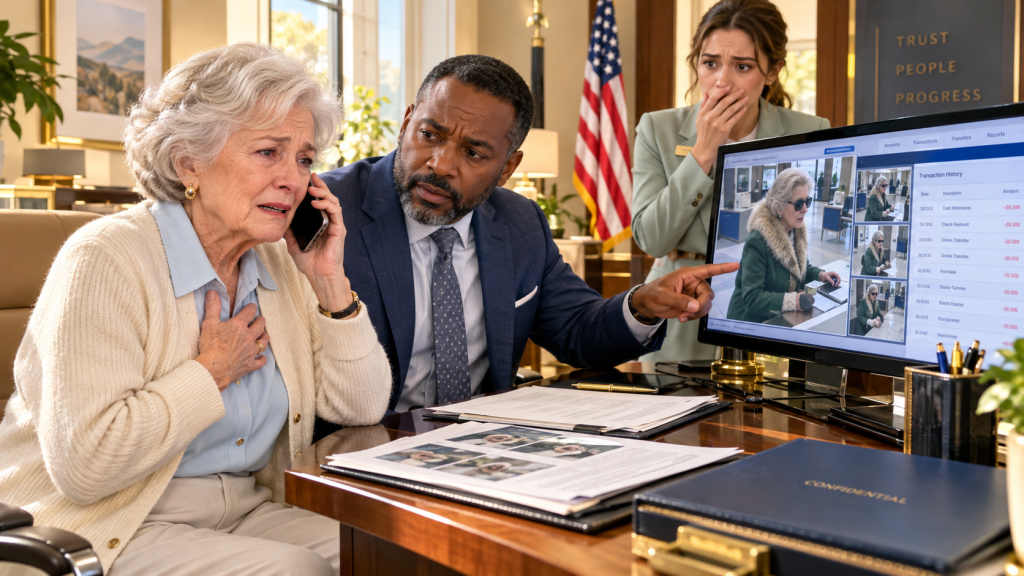
And when the branch manager pulled up the security footage, I discovered that someone had withdrawn $61,000 from my savings account.
Someone who looked remarkably like me.
Someone wearing my missing green winter coat.
Someone carrying my identification.
But the worst discovery came afterward, when the manager showed me a cashier’s check made payable to a man who had been dead for eleven years.
My husband.
And before that Thursday was over, I would learn that the people responsible weren’t strangers who had stolen my identity.
They were people who had sat at my Thanksgiving table, celebrated birthdays in my living room, and told me they loved me.
My name is Eleanor Lane. I am eighty years old, and I have lived long enough to know that betrayal rarely arrives wearing an unfamiliar face.
Sometimes it comes carrying a casserole.
Sometimes it kisses your cheek.
And sometimes it calls you Mom.
I had maintained my accounts at the same bank since 1971, back when my late husband, Samuel, and I were newlyweds and considered twenty dollars left over at the end of the month a small miracle.
Samuel worked as an electrician. I spent thirty-eight years teaching elementary school.
We never had an extravagant lifestyle.
We bought a modest three-bedroom house with a narrow driveway, planted two maple trees in the front yard, and raised our daughter, Caroline, beneath a roof we worked very hard to keep over our heads.
Samuel believed money should provide security, not status.
“Ellie,” he used to say, “a beautiful kitchen won’t keep you warm if you can’t pay the heating bill.”
I always laughed at that.
He was particularly suspicious of people who spent money before they earned it.
I used to think he worried unnecessarily.
Now I wish I had listened more carefully.
Samuel passed away eleven years ago after a long battle with heart disease.
The final months of his life were difficult, but even when he could barely climb the stairs, he insisted on reviewing our household finances with me every Sunday afternoon.
He wanted to know that I would be comfortable after he was gone.
Between his life insurance benefit, our savings, and the retirement funds we had accumulated over decades, he left me financially secure.
Not wealthy.
Secure.
There is an enormous difference.
I lived carefully, maintained my home, donated to the church, and occasionally helped Caroline when unexpected expenses arose.
I had never imagined that my financial independence would become something my own family resented.
Until that Thursday.
Brittany, the young teller, had just turned her monitor toward me.
Three transactions appeared on the screen.
Monday: $19,500.
Tuesday: $19,500.
Wednesday: $22,000.
The first two were cash withdrawals.
The third involved a cashier’s check.
Every transaction had supposedly been authorized by me.
“Mrs. Lane,” Brittany whispered, “are you certain you didn’t come in earlier this week?”
I looked directly at her.
“Honey, at my age, I occasionally forget where I put my reading glasses. But I assure you, I would remember withdrawing sixty-one thousand dollars.”
Her cheeks went pale.
Within a minute, she had summoned the branch manager, Mr. Okafor.
He was a dignified man in his early fifties who had been managing that branch for nearly a decade.
He knew Samuel before my husband died.
He had attended his funeral.
When Mr. Okafor saw the transaction records, his expression immediately changed.
“Mrs. Lane, would you please come into my office?”
He offered me a chair and a glass of water.
Then he closed the door.
“I want you to understand that we are taking this very seriously.”
“Then tell me where my money went.”
He hesitated.
“The transactions were completed in person. The individual presented identification, entered the correct PIN, and provided accurate answers to the account verification questions.”
“That individual wasn’t me.”
“I understand.”
“No,” I said, keeping my voice steady. “You don’t understand. That money represents forty years of careful decisions. Forty years of working, saving, and doing without things we couldn’t afford.”
He nodded.
“Which is why I want you to look at something.”
He opened the security recordings.
The first video showed the bank lobby on Monday morning.
A woman approached Brittany’s counter.
She was short.
Gray-haired.
Slightly stooped.
She wore large sunglasses, a scarf, and a green wool coat with a fur collar.
My coat.
The same coat I had searched for repeatedly since spring.
I had last worn it to Caroline’s house during a cold evening in March.
When I couldn’t find it afterward, I assumed I’d accidentally left it there.
Caroline had even promised to look for it.
“Mom, you probably put it somewhere strange,” she’d said cheerfully. “You know how you are.”
I had accepted that explanation.
Now I watched another woman wearing my coat while she emptied my savings.
“Freeze it,” I whispered.
Mr. Okafor stopped the recording.
The woman had turned toward the exit.
For one brief moment, her sunglasses slipped down her nose.
I recognized the face immediately.
“Diane.”
Mr. Okafor leaned forward.
“Excuse me?”
“Her name is Diane Mercer. She’s my son-in-law’s mother.”
For fifteen years, Diane and I had attended the same family gatherings.
We were approximately the same height, had similarly styled gray hair, and both wore glasses.
More than once, people had confused us from behind.
At Caroline’s wedding, a photographer even mistakenly addressed Diane as the mother of the bride.
We had laughed about that for years.
I wasn’t laughing now.
“She’s wearing my coat,” I said. “And if she has my identification, someone helped her get it.”
“Who has access to your house?”
“My daughter has a key. Her husband, Brian, has another.”
Mr. Okafor was silent.
I thought about Caroline’s new kitchen.
The marble countertops.
The expensive appliances.
The custom cabinets.
Three weeks earlier, she had proudly invited me over to see the completed renovation.
“Fully financed,” she’d announced.
Brian had smiled and added, “We finally decided to invest in our future.”
At the time, I congratulated them.
Now I wondered what that future had cost me.
I asked Mr. Okafor to contact his fraud department, restrict further withdrawals, and preserve every recording associated with the transactions.
Then I requested that he witness a telephone call.
Caroline answered almost immediately.
“Hi, Mom! What’s up?”
“I’m at the bank, sweetheart.”
“Oh! Everything okay?”
“I’m looking at a photograph of Diane wearing my green winter coat.”
Silence.
“Would you like to explain why she withdrew money from my account, or would you prefer the police to ask Brian?”
For several seconds, I heard nothing.
Then Caroline whispered four words.
“Mom, Brian made me.”
I closed my eyes.
Even now, those four words hurt more than the missing money.
“Made you do what, Caroline?”
Her breathing became uneven.
“He said we’d replace it. He promised nobody would ever know.”
Mr. Okafor quietly pushed a notepad toward me.
On it, he had written:
KEEP HER TALKING.
“Who gave Diane my identification?”
Caroline began crying.
“Mom, please understand. Things have been terrible here.”
“Who gave her my identification?”
“I did.”
The room seemed to tilt.
I gripped the telephone.
“And my PIN?”
Another pause.
“Brian already knew it.”
“How?”
“He watched you enter it when you used the cash machine last Christmas.”
I remembered that afternoon.
Brian had offered to drive me to the bank because the sidewalks were icy.
He stood beside me while I withdrew cash for Christmas cards.
I had trusted him.
“Caroline,” I said slowly, “you allowed your mother-in-law to impersonate me and steal my savings?”
“It’s not stealing if we planned to put it back!”
“That is precisely what stealing is.”
Suddenly, I heard Brian in the background.
“Who’s on the phone?”
Caroline didn’t answer.
His voice grew louder.
“Caroline, who are you talking to?”
“Mom,” she whispered urgently, “there’s something about Dad’s money you don’t understand.”
My heart thudded.
“What about your father?”
“Brian found some papers, and he said—”
“CAROLINE! HANG UP!”
The line went dead.
Mr. Okafor and I stared at the telephone.
Then he made a call to the fraud department.
Before he could finish explaining the situation, Brittany knocked on his office door.
She entered carrying a printed document.
“Sir, I found something concerning Wednesday’s transaction.”
She laid the paper on his desk.
The final $22,000 hadn’t been taken in cash.
It had been converted into a cashier’s check.
I looked down at the recipient’s name.
Samuel Thomas Lane.
My husband.
The man I had buried eleven years earlier.
For a long moment, I couldn’t speak.
Then I asked, “Why would someone make a check payable to a dead man?”
Mr. Okafor examined the document.
“I don’t know yet, Mrs. Lane.”
He picked up the telephone again.
“But I intend to find out.”
I studied Samuel’s name on the paper.
Seeing it printed on a recent bank document felt almost unnatural.
I had spent eleven years learning to live without him.
I had stopped reaching across the bed at night.
Stopped setting two coffee cups on the breakfast table.
Stopped listening for his footsteps coming up the driveway.
But I had never stopped missing him.
And now someone had used his name to take my money.
That made the betrayal feel almost personal to him, too.
Mr. Okafor explained that the bank could attempt to prevent payment of the cashier’s check while investigators examined the circumstances.
He couldn’t promise the money would be recovered.
He couldn’t even guarantee the bank would immediately reimburse the other withdrawals.
But he promised that every available record would be preserved.
“Mrs. Lane, have you retained documents relating to your husband’s estate?”
“Of course.”
“Where are they?”
“In a locked cabinet in my study.”
“Who knows where you keep them?”
I looked at him.
“My daughter.”
He lowered his eyes.
I understood what he was thinking.
The missing identification and coat were bad enough.
But someone had apparently gone through Samuel’s estate paperwork, too.
And if Brian had access to those documents, the missing $61,000 might not be the entire problem.
I left the bank accompanied by a police officer who had been sent to take my initial report.
Detective Marisol Vega from the financial crimes division contacted me later that afternoon.
She spoke carefully, without making promises.
“Mrs. Lane, I understand you recognize the individual in the recordings. We’re going to investigate the transactions, the identification used, and the movement of the funds.”
“Will you arrest her?”
“That depends on what the evidence establishes.”
“She was wearing my coat.”
“I understand. And that is important evidence.”
I appreciated that Detective Vega didn’t treat me like a confused old woman.
She listened.
She wrote things down.
And when I told her about the cashier’s check made payable to Samuel, she became particularly interested.
“Did your husband have a trust or business account?”
“No.”
“Was his estate settled?”
“Yes. Eleven years ago.”
“Has anyone recently asked you to sign estate-related documents?”
I thought carefully.
Then I remembered something.
Two months earlier, Brian had visited me on a Sunday afternoon.
He had brought a box of pastries and offered to help organize my financial paperwork.
“You’re eighty now, Eleanor,” he’d said. “You should really have someone younger keeping track of these things.”
I’d told him I managed my finances perfectly well.
He smiled.
“Of course you do. But what happens if there’s an emergency?”
He suggested that I sign a broad financial power of attorney.
He even had paperwork prepared.
I refused.
“Brian, my attorney already has the documents I need. I don’t require anyone else controlling my accounts.”
His expression had changed for a moment.
Not anger exactly.
Something colder.
Then he’d recovered and laughed.
“Just trying to help.”
I told Detective Vega about that conversation.
She asked whether I still had the papers.
I did.
They were in my desk drawer, untouched.
“Please don’t discard them,” she said. “We may want to examine them.”
That evening, I drove home with a terrible feeling in my stomach.
My house looked exactly as it always had.
The porch light glowed.
The maple trees rustled in the wind.
Samuel’s old wooden bench sat beneath the front window.
But when I unlocked my door, I felt like a stranger entering a place that had been violated.
I went directly to my study.
The cabinet was locked.
Nothing seemed disturbed.
Then I opened the bottom drawer.
Samuel’s estate folder was missing.
I stood there holding the empty hanging file.
The folder had contained his death certificate, copies of our marriage certificate, old account information, and records from the settlement of his estate.
I had kept those documents together for eleven years.
I knew exactly where they belonged.
Someone had taken them.
I called Detective Vega immediately.
She advised me not to search through or rearrange anything else until the scene could be documented.
Then she asked whether there was any possibility that I had lent the folder to Caroline.
“No.”
“Are you certain?”
“Detective, I have been eighty years old for six months. That doesn’t mean I’ve forgotten my entire life.”
She paused.
“You’re right, Mrs. Lane. I apologize for how that sounded.”
I softened.
“I know you’re doing your job.”
“And I intend to do it properly.”
That night, I sat at the kitchen table staring at Samuel’s photograph.
He was smiling in the picture.
It had been taken on our thirty-fifth wedding anniversary, when Caroline surprised us with a picnic by the lake.
She had been so thoughtful that day.
She bought flowers, baked a cake, and spent hours arranging everything.
I kept wondering when the little girl who made handmade cards for her father had become a woman willing to steal from her mother.
Was it gradual?
Had I missed the signs?
Or had she simply chosen the comfort of her marriage over the safety of the woman who raised her?
At eight-thirty, my telephone rang.
Caroline.
I let it ring.
She called again.
And again.
Finally, a message appeared.
Mom, please. I need to explain before Brian tells you his version.
I read it twice.
Then I replied.
You may explain to Detective Vega.
Her response came immediately.
Please don’t ruin our family.
I stared at those words.
Our family.
As though the family hadn’t already been damaged by what they had done.
As though filing a police report were somehow worse than emptying an elderly widow’s savings.
I turned off the telephone.
Then I cried.
Not loudly.
Not dramatically.
I simply sat at my kitchen table and allowed myself to grieve the daughter I thought I knew.
The following morning, Detective Vega arrived with another investigator.
They documented the missing folder and examined the cabinet and surrounding area.
There were no signs of forced entry.
That didn’t surprise me.
Brian had a key.
So did Caroline.
When the detective asked whether I wanted to change my locks, I answered before she finished the question.
“Yes.”
By noon, a locksmith had replaced every exterior lock.
I also contacted my attorney, Rebecca Collins, who had represented Samuel and me for more than twenty years.
Rebecca was seventy-two, sharp-minded, and completely unimpressed by people who assumed older women couldn’t protect themselves.
When I told her what had happened, she went silent.
Then she said, “Eleanor, I’m coming over.”
She arrived carrying a legal pad and a folder of documents.
Her first question surprised me.
“Has anyone mentioned your house?”
“Not recently.”
“Has Brian asked about your will?”
“Several times.”
“Has Caroline?”
I hesitated.
“She asked whether I intended to leave the property to her.”
“And what did you tell her?”
“That my estate plan was my business.”
Rebecca nodded.
“Good.”
She explained that we needed to review my estate documents, ensure no unauthorized changes had been made, and notify the appropriate financial institutions about the suspected identity theft.
She also suggested monitoring my credit records for unfamiliar accounts or applications.
“I don’t want you frightened,” she said. “I want you informed.”
That distinction mattered.
For the first time since leaving the bank, I felt slightly less helpless.
Rebecca examined the power-of-attorney paperwork Brian had brought me.
She frowned.
“Eleanor, where did he get this?”
“He said a lawyer prepared it.”
“Which lawyer?”
“He didn’t say.”
She turned several pages.
“This would have granted extremely broad financial authority. Including transactions involving real estate.”
I stared at her.
“Real estate?”
“Yes.”
“But he said it was for emergencies.”
Rebecca gave me a sad look.
“People can describe a document however they wish. What matters is what it actually says.”
I remembered how disappointed Brian had appeared when I refused to sign.
Now I understood why.
The next development came that afternoon.
Detective Vega called to say investigators had obtained additional information about the cashier’s check.
It had been presented for deposit at another financial institution.
The receiving account was supposedly associated with Samuel Lane’s estate.
But the account was newly opened.
And the contact information listed on the paperwork led directly to Brian.
I nearly dropped the telephone.
“How can my husband’s estate have a new account? He died eleven years ago.”
“That’s one of the questions we’re investigating,” Detective Vega said.
She explained that someone appeared to have used documents associated with Samuel’s identity and estate to create the appearance of a legitimate account relationship.
The paperwork was being examined for possible forgery.
The check had been flagged before the funds were released.
“We may be able to preserve that twenty-two thousand,” she said. “But I don’t want to promise anything until the institutions complete their review.”
I sat down slowly.
“And the other thirty-nine thousand?”
“We’re following that money, too.”
I thanked her.
After hanging up, I stared at the wall for several minutes.
Brian hadn’t simply wanted my savings.
He had been building something around Samuel’s identity.
And he had expected me never to notice.
That evening, an unexpected visitor appeared on my porch.
My grandson, Ethan.
He was turning sixteen the following week.
Ethan was tall, quiet, and remarkably similar to Samuel around the eyes.
He stood outside carrying his school backpack.
“Grandma?”
I opened the door.
“Sweetheart, what are you doing here?”
He looked uncomfortable.
“Can I come in?”
“Of course.”
He sat at my kitchen table while I made hot chocolate.
Ethan had always preferred my house when he wanted peace and quiet.
Caroline and Brian’s home was beautiful, but often tense.
They argued over bills.
Over travel plans.
Over things Ethan couldn’t always understand.
He told me once that his father became angriest when money was mentioned.
I hadn’t thought much about it then.
Now I remembered.
“Grandma,” Ethan said carefully, “did Dad take your money?”
I stopped stirring the hot chocolate.
“Who told you that?”
“I heard them fighting.”
“What did they say?”
He looked down.
“Dad said you were going to destroy everything. Mom said she couldn’t keep lying. Then Grandma Diane started crying.”
I sat opposite him.
“Ethan, this is an adult matter. You shouldn’t have been put in the middle of it.”
“I know. But I want to understand.”
I considered telling him nothing.
Then I remembered how much damage had already been done by secrets.
“Someone took money from my bank account without permission,” I said. “The police are investigating.”
He swallowed.
“Was it Dad?”
“I can’t tell you what the police will eventually determine.”
“But you know something.”
I nodded.
“Yes, sweetheart. I do.”
His eyes filled with tears.
“Are you going to lose your house?”
That question broke my heart.
“No, darling.”
“Mom said you have plenty of money.”
I took his hand.
“Having savings doesn’t mean someone else is entitled to take them.”
He nodded slowly.
Then he whispered, “Dad said you wouldn’t even notice.”
I felt something inside me go very still.
“What exactly did he say?”
Ethan hesitated.
“I heard him talking to Grandma Diane last Sunday. He said you had more than enough, and the money would belong to Mom someday anyway.”
The words were almost identical to something Samuel had warned me about years earlier.
Some people don’t see an inheritance as a gift.
They see it as money being unfairly withheld.
I asked Ethan whether his father had said anything else.
“He said nobody could prove anything if Grandma Diane followed the instructions.”
My throat tightened.
“Ethan, did you tell anyone what you heard?”
“No.”
“Why not?”
“Because Dad told me not to repeat private family conversations.”
I squeezed his hand gently.
“You did nothing wrong by telling me.”
He wiped his face.
“Am I still allowed to come here?”
I moved around the table and hugged him.
“Sweetheart, this house will always be a place where you are loved.”
He clung to me.
For a moment, I could almost feel Samuel standing beside us.
After Ethan left, I contacted Detective Vega and told her what he had said.
She thanked me and explained that any interview with Ethan would need to be handled carefully because he was a minor.
I agreed.
I would not allow my grandson to become another weapon in this family dispute.
The following Monday, Caroline came to my house.
She arrived alone.
I saw her through the front window, standing on my porch with swollen eyes and a small handbag clutched against her chest.
For a moment, she looked like the frightened teenager who had once come home after failing her driving test.
My instinct was to open the door and comfort her.
Then I remembered the bank footage.
I remembered Diane wearing my coat.
And I remembered Caroline admitting she had handed over my identification.
I opened the door but didn’t invite her inside.
“Mom,” she whispered.
“Caroline.”
“Please. I need to talk.”
“Is Brian with you?”
“No.”
“Does he know you’re here?”
She shook her head.
I studied her face.
“Before we begin, you need to understand that I’m not agreeing to keep anything secret.”
“I know.”
“And anything you tell me may need to be shared with the investigators.”
Her eyes filled again.
“Okay.”
I stepped aside.
She entered the living room and sat on the sofa.
For several seconds, neither of us spoke.
Then Caroline looked at Samuel’s portrait above the fireplace.
“Dad would hate what I’ve done.”
I answered quietly.
“Yes. He would.”
She flinched.
But I refused to pretend otherwise.
Caroline began explaining what had happened.
Six months earlier, Brian had invested heavily in a commercial property venture with two friends.
He believed the investment would produce substantial profits.
Instead, the project collapsed.
One partner withdrew.
Another filed for bankruptcy.
Brian found himself responsible for debts he hadn’t properly explained to Caroline.
He had also borrowed money against their home.
The new kitchen, which Caroline had presented as a carefully planned renovation, had been financed with additional borrowing before the investment failed.
They were already behind on payments.
And an important loan deadline was approaching.
“How much did he owe?” I asked.
She lowered her head.
“More than a hundred thousand.”
I stared.
“A hundred thousand dollars?”
“That’s what he finally admitted.”
“And you thought stealing sixty-one thousand from me would solve it?”
Caroline began crying.
“Brian said it was temporary.”
“Temporary theft is still theft.”
“He promised the business would recover.”
“What business?”
She didn’t answer.
That told me enough.
I asked when they had first discussed using my money.
“About two months ago.”
The same time Brian had brought me the power-of-attorney paperwork.
I felt sick.
“You were planning this while having Sunday dinner at my house?”
Caroline pressed her hands over her face.
“Mom, please.”
“Answer me.”
“Yes.”
“And Diane?”
“Brian talked to her after you refused to sign the paperwork.”
I waited.
“Diane said she’d help because she couldn’t stand watching her son lose everything.”
“By taking everything from me?”
“She didn’t think you needed all that money.”
I almost laughed.
Not because anything was funny.
Because the arrogance was astonishing.
“Did Diane know she was impersonating me?”
Caroline nodded.
“Yes.”
“Did she know it was illegal?”
“Yes.”
“Did you?”
Her silence was the answer.
I stood and walked to the window.
Outside, the two maple trees Samuel and I had planted were beginning to lose their leaves.
I remembered Caroline as a little girl, jumping into the piles Samuel raked every autumn.
She used to call those trees her giants.
I wondered how we had arrived at this moment.
“Mom,” Caroline whispered, “Brian said you’d forgive us if you knew we were desperate.”
I turned around.
“Then why didn’t you ask me for help?”
She looked miserable.
“Because we knew you’d say no.”
I sat down again.
There it was.
The truth beneath all the excuses.
They hadn’t stolen from me because there was no alternative.
They had stolen because they didn’t like the answer they expected.
“Caroline, did Brian use your father’s name to open another account?”
She went completely still.
“How do you know about that?”
“The police told me.”
She began trembling.
“Mom, I didn’t understand what he was doing.”
“Then explain what you did understand.”
She described watching Brian sort through documents he’d taken from my study.
He had photographed Samuel’s death certificate and old financial records.
He claimed there was a way to move money through an account connected to Samuel’s estate.
He told Caroline it would make the transactions appear less suspicious.
“Did you believe him?”
“I wanted to.”
“That’s not what I asked.”
She looked up.
“No. Not completely.”
I nodded.
At least that was an honest answer.
Then I asked the question I had been avoiding.
“Why my father? Why use Samuel’s name?”
Caroline stared at the floor.
“Brian said nobody checks on dead people.”
I closed my eyes.
For a moment, I couldn’t breathe.
Samuel had spent his entire life protecting our family.
He worked overtime when Caroline needed braces.
He drove a twelve-year-old truck so she could attend college without crushing debt.
He used vacation days to care for her when she had complications after Ethan’s birth.
And now his own son-in-law was using his identity as a hiding place for stolen money.
I felt something deeper than anger.
Disgust.
Caroline reached for my hand.
I pulled away.
“Mom, please forgive me.”
I looked at her.
“Do you know what forgiveness means?”
She shook her head.
“It doesn’t mean pretending something never happened. It doesn’t mean protecting you from the consequences of your choices.”
She cried harder.
“I know.”
“No, sweetheart. I don’t think you do.”
She remained another twenty minutes.
Before leaving, she told me Brian had become increasingly desperate after discovering that the cashier’s check had been flagged.
He wanted her to persuade me to withdraw my complaint.
He had even suggested telling relatives that I was becoming forgetful.
That revelation made my blood run cold.
“Forgetful?”
Caroline nodded miserably.
“He said people might believe you authorized the withdrawals and then forgot.”
I stared at her.
“And what did you say?”
“I told him I wouldn’t do that.”
“Would you have said the same thing before I caught you?”
She couldn’t answer.
I opened the front door.
“Caroline, I love you. I always will. But I don’t trust you.”
She covered her mouth.
I continued.
“If you want any possibility of rebuilding our relationship, you need to tell the investigators everything. Not just the parts that make Brian look guilty.”
She nodded.
“I will.”
I watched her walk toward her car.
For the first time in her life, I didn’t call after her to be careful.
I simply closed the door.
Two days later, Rebecca telephoned with another discovery.
She had been reviewing copies of Samuel’s estate records retained in her office.
While comparing them with information provided through the investigation, she noticed something unusual.
A document had been submitted to the receiving financial institution claiming that Brian was authorized to act on behalf of Samuel’s estate.
The document purported to carry a signature from a court-appointed representative.
But the appointment information didn’t match the official estate records.
Rebecca believed someone had fabricated or altered the paperwork.
“He’s not simply moving money, Eleanor,” she said. “He’s apparently trying to create a false paper trail.”
“Why?”
“We don’t know everything yet. But the estate account may have been intended to receive more than this one check.”
My stomach tightened.
“More money?”
“Possibly.”
She explained that a separate review had identified inquiries involving property records associated with my home.
No unauthorized transfer had been confirmed.
But someone appeared to have been collecting the documents needed to evaluate its ownership and equity.
I gripped the receiver.
“My house?”
“Yes.”
I looked around my living room.
The house Samuel and I had purchased when Caroline was three years old.
The place where we hosted Christmas dinners.
Where Ethan learned to ride his bicycle.
Where Samuel had spent his final weeks, looking out at the maple trees.
Brian hadn’t been satisfied with my savings.
He had apparently been exploring my largest remaining asset, too.
Rebecca assured me that my actual property records had not shown an unauthorized transfer.
We reviewed additional safeguards and arranged to monitor for suspicious activity.
I was grateful for her calmness.
But when the call ended, I sat motionless.
Had I signed Brian’s power-of-attorney paperwork, I might have placed much more than sixty-one thousand dollars at risk.
That evening, I opened Samuel’s old desk.
I hadn’t used it much since his death.
The drawers still smelled faintly of cedar and the peppermint candies he kept in his pockets.
Inside the top drawer were pencils, postage stamps, and a small wooden ruler.
Beneath them lay a worn notebook.
Samuel had used it to record household expenses.
I opened it without expecting anything unusual.
Most pages contained ordinary notes.
Insurance payments.
Roof repairs.
Car maintenance.
Then I reached a page dated twelve years earlier.
Brian’s name appeared.
Beside it, Samuel had written:
Personal loan: $14,000.
Repayment promised by December.
I stared at the entry.
Samuel had never told me he’d lent Brian that much money.
On the following page, another note appeared.
Payment received: $500.
Balance outstanding.
A few pages later:
Spoke with Brian again. He says business is improving. Caroline must not be caught between us.
My chest tightened.
I turned another page.
There was a final entry.
Brian requested additional assistance. Refused.
Underneath, Samuel had written:
Eleanor must be protected from this pattern.
I read those words repeatedly.
Samuel had seen something I hadn’t.
And he’d tried, in his quiet way, to protect me.
I remembered how Brian behaved during Samuel’s final illness.
He visited regularly, brought groceries, and offered to help with paperwork.
I had been touched by his thoughtfulness.
Now I wondered whether some of those visits had been motivated by financial curiosity.
The next morning, I showed the notebook to Rebecca.
She read it carefully.
“This doesn’t prove the present fraud,” she said, “but it may provide useful context.”
I nodded.
“I know.”
She touched my arm.
“Eleanor, are you all right?”
I considered lying.
Then I shook my head.
“No. I’m furious with myself.”
“Why?”
“Because Samuel warned me about this man without ever directly saying so.”
Rebecca closed the notebook.
“You trusted your daughter’s husband. That’s not foolishness.”
“Maybe not. But I should have been more careful.”
She didn’t argue.
Instead, she said something I needed to hear.
“You can become more careful now.”
And that was what I decided to do.
I would cooperate with the investigation.
I would protect my finances.
And I would stop treating my family’s convenience as more important than my own safety.
A week after the bank discovery, Diane telephoned.
I recognized her voice immediately.
“Eleanor, dear.”
I said nothing.
She cleared her throat.
“I think there’s been a terrible misunderstanding.”
I nearly hung up.
Then I remembered that people sometimes reveal more when allowed to speak.
“What misunderstanding, Diane?”
“Brian told me you had agreed to help.”
“By allowing you to wear my coat and pretend to be me?”
A pause.
“Well, he said there were reasons for handling it discreetly.”
“What reasons?”
“He said you’d become rather anxious about financial decisions.”
I felt my jaw tighten.
“So you decided to steal my identity?”
“I wouldn’t use that word.”
“What word would you use?”
She sighed.
“Eleanor, we are family.”
I looked toward Samuel’s photograph.
“Family doesn’t make you the owner of my savings.”
Diane’s tone changed.
“At our age, money is supposed to help the younger generation.”
I stared at the wall.
“At our age?”
“Well, yes. What are we saving it for if not our children?”
I couldn’t believe her audacity.
“Diane, if you believe older people should give away their savings, you’re welcome to begin with yours.”
She became defensive.
“That’s different.”
“Why?”
“Because I don’t have what you have.”
There it was again.
The idea that having more meant I deserved less protection.
I spoke slowly.
“You walked into my bank wearing my coat, carrying my identification, and pretending to be me. You took money I had not authorized you to take.”
Diane began crying.
“I was trying to save my son.”
“And I was trying to live the rest of my life without worrying about money.”
“Brian said he’d repay everything.”
“Then he should have obtained a lawful loan.”
“He couldn’t!”
“That wasn’t my responsibility.”
Her voice hardened.
“You’re willing to see your own daughter and grandson suffer over money?”
I felt the old guilt rising.
The familiar pressure to sacrifice because somebody else had made terrible decisions.
But this time, I recognized it.
“Ethan is already suffering because of what you all did.”
Diane was silent.
I continued.
“And if you ever want him to understand the difference between right and wrong, you should stop pretending this was an act of love.”
She hung up.
I immediately documented the conversation and informed Detective Vega.
Several days later, the investigation moved forward.
Detective Vega visited with news that Brian and Diane had both been interviewed.
She couldn’t share every detail.
But financial records, surveillance footage, and communications obtained through legal procedures had begun to establish how the withdrawals were arranged.
The two cash withdrawals had been timed around an urgent debt deadline.
Investigators were tracing what happened to the money after it left the bank.
Some had apparently been used to satisfy outstanding obligations connected to Brian’s business activities.
Other amounts were still being traced.
The $22,000 cashier’s check remained the most revealing transaction.
The fraudulent estate-account documentation had led investigators to additional records.
Brian had apparently planned to use Samuel’s identity and estate paperwork to disguise the destination of the funds.
And the inquiry into my property records suggested he’d considered broader schemes before settling on impersonation at the bank.
“Was Caroline involved in those plans?” I asked.
Detective Vega looked at me carefully.
“Your daughter has acknowledged providing access to your identification and assisting with preparations for the bank visits.”
I closed my eyes.
“Was she forced?”
“We’re examining all relevant circumstances. But she has described making decisions she now regrets.”
I nodded.
It was a painful distinction.
Brian might have pressured her.
He might have manipulated her fears.
But Caroline had still made choices.
She had handed over my identification.
She had allowed Diane to enter the bank pretending to be me.
And she had remained silent while the money disappeared.
I could love my daughter without denying those facts.
The detective also explained that the bank was conducting its own internal review.
The teller procedures, identification checks, and withdrawal approvals were being examined.
I was asked to provide a written statement confirming that I had not authorized any of the transactions.
I did so immediately.
My hands trembled while signing.
Not because I doubted the truth.
Because it felt unbearable that I had to formally prove my own innocence.
The bank eventually advised me that the cashier’s check funds had been secured while the disputed transaction was addressed.
The two cash withdrawals required additional investigation.
I was relieved that at least part of the money might be recovered.
But I knew the financial damage was only one part of what had happened.
My sense of safety had been stolen too.
I no longer opened my door without checking who stood outside.
I no longer left financial papers on my desk.
Whenever the telephone rang, I wondered whether another member of the family was calling to pressure me.
I had spent eighty years building a peaceful life.
And three people had disrupted it in less than a week.
One Saturday afternoon, Ethan arrived carrying a small paper bag.
He had called first, as I’d requested.
“What’s this?” I asked when he handed it to me.
“A present.”
Inside was a framed photograph.
It showed Samuel holding Ethan when he was only four years old.
They were sitting on the old wooden bench outside my house.
Samuel was laughing.
Ethan was wearing an oversized baseball cap.
“I found it in Mom’s photo box,” Ethan said.
I stared at the picture.
“I remember that day.”
“Grandpa was teaching me how to whistle.”
I smiled through sudden tears.
“He spent three hours trying.”
Ethan grinned.
“I still can’t do it very well.”
We sat together on the porch.
After a while, he asked, “Grandma, do you hate Dad?”
I considered the question carefully.
“No.”
“Even after everything?”
“Anger and hatred aren’t the same thing, sweetheart.”
He stared at the grass.
“I don’t know if I can trust him anymore.”
I put my arm around his shoulders.
“Trust is something people earn through their actions. You don’t have to pretend everything is fine.”
He nodded.
“Mom says she’s going to tell the truth.”
“I hope she does.”
“Will you forgive her?”
I looked at the maple trees.
“I don’t know what our relationship will look like yet.”
“Does that mean you don’t love her?”
“No, Ethan. I love her very much.”
“Then why can’t you just make up?”
I turned toward him.
“Because love doesn’t erase responsibility. If it did, people could hurt the ones who loved them and never have to change.”
He thought about that.
Then he rested his head against my shoulder.
We stayed there until the afternoon grew chilly.
I never gave Ethan the three hundred dollars I’d intended to withdraw on that Thursday morning.
Not because I wanted to punish him.
But because his birthday had become complicated by everything happening around us.
Instead, I bought him a simple watch with an engraved message on the back.
Your time matters. Spend it wisely. Love, Grandma.
When he opened it, he hugged me so tightly that I nearly lost my balance.
“It’s perfect,” he whispered.
And for the first time in weeks, I felt something uncomplicated.
Joy.
The following month brought a confrontation I hadn’t expected.
Caroline asked whether we could meet with Rebecca present.
She said she wanted to explain everything without Brian interrupting.
I agreed to a meeting in Rebecca’s office.
Not my home.
That distinction mattered to me.
I was no longer willing to make every difficult conversation happen in the place where I was supposed to feel safe.
Caroline arrived with a folder.
She looked exhausted.
Her hair was pulled back, and there were dark circles beneath her eyes.
She sat across from me and immediately began crying.
“Mom, I’m going to cooperate fully.”
Rebecca nodded.
“Then tell us what you believe we need to know.”
Caroline opened the folder.
Inside were printed messages and financial records.
She explained that Brian had been concealing debts for more than a year.
Whenever she questioned expenses, he accused her of not understanding business.
When she became worried about their home, he promised everything was under control.
Then the demands for money became more urgent.
At first, Brian wanted Caroline to ask me for a loan.
But he insisted she describe it as a kitchen-related expense.
“Why the kitchen?” I asked.
“Because he thought you’d help if it sounded like home improvement.”
“And when I wouldn’t?”
Caroline wiped her eyes.
“He started looking for another way.”
I stared at her.
“Did you suggest taking my identification?”
She hesitated.
Then nodded.
That admission hurt more than I expected.
“I told him where you kept it,” she whispered. “I didn’t think it would go this far.”
“How far did you think it would go?”
She began crying harder.
“I thought he’d borrow a smaller amount and repay it.”
“Without asking me?”
“Yes.”
Rebecca remained quiet.
I appreciated that.
This wasn’t a moment for anyone else to rescue Caroline from answering.
She continued describing the plan.
Diane would impersonate me because of our similar appearance.
Brian would provide the account information.
Caroline would make sure my identification and necessary documents were available.
They believed they could complete the transactions without attracting attention.
Then, according to Caroline, Brian’s plan changed.
He decided to withdraw more money than originally discussed.
He wanted to satisfy debts and move additional funds through the fraudulent account associated with Samuel’s estate.
Caroline had objected.
But she hadn’t stopped him.
“Why didn’t you call me?” I asked.
She looked at me with devastated eyes.
“Because I was afraid you’d never forgive me.”
I leaned back.
“So you chose to let me be robbed instead.”
She lowered her head.
“Yes.”
There was nothing else to say.
After a long silence, Caroline slid another document toward Rebecca.
It was a copy of a message Brian had sent Diane.
In it, he referred to my expected inheritance arrangements and described my savings as money that would eventually remain within the family.
One sentence stood out.
Eleanor won’t need it much longer anyway.
I read those words three times.
Then I looked up.
“What did he mean by that?”
Caroline began shaking her head.
“Mom, he didn’t mean—”
“What did he mean?”
“I don’t know.”
I turned the paper toward Rebecca.
She read it carefully.
Then she looked at Caroline.
“Your mother is alive, competent, and entitled to control her property. Do you understand that?”
Caroline nodded.
Rebecca continued.
“An expectation of inheritance creates no entitlement to take someone’s assets while they are living.”
I wanted to thank her.
Instead, I stared at the words.
Eleanor won’t need it much longer anyway.
I had spent my entire marriage being treated as a person whose needs mattered.
Samuel would ask whether I was comfortable before adjusting the thermostat.
He would walk on the traffic side of the sidewalk.
He knew how I liked my tea.
And now my own family had reduced me to a financial inconvenience with an expiration date.
I folded the paper.
“Caroline, I need you to leave.”
She looked stricken.
“Mom—”
“Please.”
Rebecca stood.
The meeting was over.
I remained seated after Caroline departed.
For several minutes, I couldn’t speak.
Then I asked Rebecca a question.
“Is it terrible that part of me still wants to protect her?”
Rebecca shook her head.
“No. She’s your daughter.”
“Then why do I feel ashamed?”
“Because you’ve been taught that protecting your family means absorbing whatever pain they cause.”
I stared at her.
She continued gently.
“Sometimes protecting your family means refusing to help them avoid the truth.”
Those words stayed with me.
As the investigation continued, several consequences unfolded.
Brian’s business creditors began pursuing their lawful remedies.
His marriage to Caroline deteriorated.
Diane stopped attending family gatherings.
And relatives who had previously praised the kitchen renovation suddenly developed opinions about my decision to involve law enforcement.
My cousin Margaret telephoned one evening.
“Eleanor, surely this could have been settled privately.”
“How?”
“Well, perhaps Brian could have arranged a repayment schedule.”
“He was welcome to ask me for a loan before stealing the money.”
Margaret sighed.
“But think of Caroline’s reputation.”
I looked at the telephone in disbelief.
“My daughter participated in stealing from me, and you’re concerned about her reputation?”
“I’m simply saying that family matters should remain within the family.”
“Margaret, a family matter is disagreeing about Christmas dinner. This is financial fraud.”
She fell silent.
Then she said something I had heard too often.
“At your age, do you really want to spend your remaining years fighting?”
I took a slow breath.
“At my age, Margaret, I know exactly how valuable my remaining years are. That’s why I won’t spend them pretending this was acceptable.”
She never raised the subject again.
Not everyone reacted that way.
My neighbor Ruth came over with homemade soup and offered to accompany me to appointments.
A former colleague called to remind me that I had taught hundreds of children to stand up for themselves.
My church friends quietly checked on me without demanding explanations.
And Ethan continued visiting.
Those people didn’t ask whether I could afford to lose the money.
They understood that being wronged was not less serious simply because I had savings.
Several weeks later, Detective Vega contacted me with an update.
Investigators had obtained evidence supporting charges against Brian and Diane.
Caroline’s involvement was also being addressed through the legal process.
The precise allegations and outcomes would be determined in court, but the investigation had established far more than an unfortunate misunderstanding.
It had uncovered a deliberate plan.
The bank recordings showed Diane completing the withdrawals.
Records connected Brian to the fraudulent account documentation.
Communications revealed coordination among the participants.
And Caroline’s statements helped explain how they had obtained access to my identification and personal records.
There was no mysterious outside criminal.
No computer hacker.
No stranger who guessed my PIN.
The fraud began at my own dining table, among people who knew precisely where I kept my belongings.
I asked about the money.
Detective Vega explained that the $22,000 cashier’s check had not been successfully negotiated and the disputed funds were being returned through the bank’s process.
Some of the cash withdrawn earlier had also been located or traced to recoverable payments.
Other amounts remained outstanding and could become part of restitution proceedings.
It wasn’t the immediate, complete recovery I had hoped for.
But it was progress.
More importantly, there was finally an official record of what had happened.
The truth no longer depended on whether my daughter admitted it at Thanksgiving.
Months passed.
I attended necessary meetings.
Provided records.
Answered questions.
And learned more about financial fraud than I had ever wanted to know.
There were days when I grew exhausted.
Days when I wondered whether the stress was worth it.
But whenever I considered withdrawing, I remembered Brian’s words.
Eleanor won’t need it much longer anyway.
I was still here.
And I mattered.
Eventually, Caroline moved out of the house she shared with Brian.
She rented a small apartment near Ethan’s school.
Their financial situation was difficult, and she had to make adjustments she’d never imagined.
She sold some jewelry.
Returned furniture purchased on credit.
And began working additional hours at her job.
For years, Caroline had treated financial discomfort as something that should be solved by finding someone else to pay.
Now she was learning what it meant to live within her actual means.
I didn’t celebrate her hardship.
Watching your child struggle is painful, even when that struggle follows serious wrongdoing.
But I refused to erase the consequences for her.
Caroline began attending counseling.
She also followed through on her agreement to cooperate with investigators.
For the first time, our conversations contained fewer excuses.
One afternoon, she asked whether she could visit.
I agreed.
She arrived carrying a plain envelope.
Inside was a check for five hundred dollars.
I looked at it.
“What’s this?”
“The beginning of what I owe you.”
I shook my head.
“Caroline, restitution arrangements are being addressed through the proper process.”
“I know. This is separate. I wanted you to understand that I’m not waiting for someone to force me.”
I studied her face.
She looked frightened.
Not of Brian.
Not of being caught.
Of whether I would ever believe her again.
I placed the check back inside the envelope.
“Then document it properly and make sure any payment is coordinated with the people handling your case. I don’t want confusion later.”
She nodded.
“Okay.”
I looked at her for a long time.
“Do you understand why I can’t simply forget what happened?”
“Yes.”
“Tell me.”
Her eyes filled.
“Because I knew you trusted me, and I used that trust to help take something from you.”
I waited.
She continued.
“Because I knew Diane was pretending to be you, and I did nothing to stop her.”
Her voice broke.
“And because I let Brian convince me that your money mattered more than your feelings.”
I shook my head.
“Not just my feelings, Caroline. My security. My choices. My right to decide what happens to my own life.”
She nodded.
“You’re right.”
For the first time, I believed she was beginning to understand.
That didn’t mean everything was repaired.
It meant we had finally stopped pretending the damage was smaller than it was.
The legal proceedings were difficult.
Diane appeared in court wearing a dark blue suit.
Without my green coat and oversized sunglasses, she looked nothing like me.
She looked like a frightened seventy-eight-year-old woman facing the consequences of her choices.
At one point, our eyes met.
She quickly looked away.
I wondered whether she still believed she’d done nothing worse than help her son.
Brian appeared equally uncomfortable.
He had always been confident at family gatherings.
He spoke loudly, laughed easily, and enjoyed explaining financial matters to people he believed knew less than he did.
Now he sat quietly beside his attorney.
I didn’t take pleasure in his discomfort.
I simply wished he’d shown a fraction of that humility before taking my money.
The case proceeded through negotiations and court hearings.
Brian and Diane ultimately accepted responsibility for offenses arising from the fraudulent withdrawals and related documentation.
Caroline also faced consequences for her participation, though her cooperation and individual conduct were considered separately.
The court imposed penalties and restitution obligations according to each person’s role.
I won’t pretend the process felt satisfying every moment.
There were delays.
There were legal arguments.
There were days when the language used in court seemed strangely detached from what had happened to me.
Unauthorized transactions.
Fraudulent representations.
Financial loss.
Those words were accurate.
But they couldn’t capture the sensation of watching your daughter admit she’d helped steal from you.
They couldn’t describe what it felt like to see your dead husband’s name used as a tool in someone else’s scheme.
And they couldn’t measure the sleepless nights.
Still, accountability mattered.
By the time the proceedings concluded, the bank had completed its review of the disputed transactions.
The cashier’s check funds had been restored, and the remaining financial loss was addressed through a combination of recovered funds, account adjustments, and restitution obligations.
I maintained careful records of every amount.
I didn’t assume that a court order meant money would instantly appear.
I understood that some repayments could take time.
But I had regained control of my accounts.
And that was something no one could take from me again without a fight.
The first anniversary of Samuel’s death after the fraud was especially difficult.
I visited the cemetery early in the morning.
I carried yellow roses, his favorite flowers to give me even though he insisted roses were overpriced.
I stood beside his headstone for a long time.
“Well, Sam,” I said softly, “you were right about Brian.”
The wind moved through the nearby trees.
I smiled sadly.
“I wish you’d told me more.”
Then I remembered the notebook.
Samuel’s warning.
Eleanor must be protected from this pattern.
For months, I’d interpreted those words as evidence that he knew I would be vulnerable.
But standing there, I realized something else.
Samuel hadn’t thought I was weak.
He knew I was generous.
And he knew generosity could be exploited by people who confused kindness with permission.
I placed the roses beside the stone.
“I’m taking care of myself now,” I whispered.
I stayed another few minutes.
Then I drove home.
That winter, I made several changes.
I organized my financial records with Rebecca.
Updated my estate plan.
Reviewed account safeguards.
And made sure the people authorized to assist me were individuals I trusted for reasons stronger than family relationships.
I also installed better lighting around the house.
Not because I wanted to live in fear.
Because I wanted to live with confidence.
I joined a local community group that helped older residents understand financial scams and identity theft.
At first, I attended simply to listen.
Then the organizer asked whether I would share my experience.
I hesitated.
My story was deeply personal.
I wasn’t interested in becoming a neighborhood spectacle.
But one afternoon, a woman named Helen spoke about her nephew repeatedly pressuring her to add him to her bank accounts.
She seemed embarrassed.
“He says I’m being ungrateful,” she whispered. “He does so much for me.”
I recognized the expression on her face.
It was the same uncertainty I’d felt when Brian suggested I couldn’t manage my finances.
So I told her something.
“Someone helping you doesn’t automatically earn the right to control your money.”
She looked at me.
“But he’s family.”
I nodded.
“That’s why boundaries matter.”
Afterward, she thanked me.
A few weeks later, she told the group she’d met with an independent attorney and arranged assistance on terms she understood.
I was proud of her.
Not because she’d accused anyone of wrongdoing.
Because she’d remembered that she was entitled to make her own decisions.
Gradually, I began sharing more of my story.
Not every detail.
Not every painful conversation.
But enough to help people recognize warning signs.
Someone who pressures you to sign documents quickly.
Someone who insists you don’t need to understand financial paperwork.
Someone who asks you to keep money arrangements secret.
Someone who treats your savings as a family resource instead of your property.
I told people to seek independent advice and verify anything they didn’t understand.
And I told them that age did not cancel their right to say no.
By spring, my life had begun to feel like my own again.
The maple trees outside my house were budding.
Ethan had started learning to drive.
Caroline had settled into her apartment and was slowly rebuilding her finances.
Our relationship remained cautious.
We spoke occasionally.
Sometimes she visited for coffee.
Sometimes we took short walks.
I didn’t give her access to my accounts or house keys.
I didn’t lend her money.
And I didn’t pretend those limits were temporary simply to make her feel better.
One afternoon, she asked whether I thought we’d ever be close again.
I considered the question.
“Caroline, we may be close in a different way.”
She looked sad.
“Different how?”
“With more honesty. And with boundaries that should have existed long ago.”
She nodded slowly.
“I miss how things were.”
I looked at her.
“So do I.”
Then I added, “But things weren’t what I thought they were.”
She began crying.
I reached across the table and held her hand.
For the first time in months, I was able to comfort her without feeling that I was betraying myself.
That felt like progress.
Not forgiveness forced by obligation.
Not a happy ending manufactured for appearances.
Just two women facing the truth.
Ethan turned seventeen the following autumn.
He had grown taller than Samuel ever was, though he still carried the same gentle expression.
For his birthday, I invited him to choose where we would spend the afternoon.
He selected a small diner Samuel had loved.
We ordered hamburgers and milkshakes.
Then we drove to the lake.
Ethan sat beside me on a bench overlooking the water.
“Grandma,” he said, “I’ve been thinking about what happened.”
I looked at him.
“That’s understandable.”
“I used to think adults always knew what they were doing.”
I laughed softly.
“Oh, sweetheart, no.”
He smiled.
“Now I think some adults just get better at pretending.”
I considered that.
“Sometimes.”
He grew serious.
“I don’t want to be like Dad.”
I turned toward him.
“Ethan, you don’t have to define yourself by your father’s worst choices.”
“But what if I make mistakes?”
“You will.”
He looked surprised.
I continued.
“Everyone does. What matters is whether you take responsibility, tell the truth, and try to repair the harm you’ve caused.”
He thought about that.
Then he reached into his jacket pocket.
He pulled out a small folded piece of paper.
“I wrote something for school.”
“What is it?”
“An essay about someone I admire.”
I opened it.
The title read:
My Grandmother, Who Refused to Disappear.
My eyes blurred immediately.
He had written about the way I cared for Samuel.
About my years as a teacher.
About how I helped him learn multiplication at the kitchen table.
And about the year our family made terrible choices.
He hadn’t included private financial details.
Instead, he wrote about courage.
One paragraph stopped me completely.
My grandmother taught me that being old doesn’t make someone less important. She says every person deserves to make choices about their own life. When people tried to take that away from her, she stood up for herself. I hope I can be that brave someday.
I pressed the paper against my chest.
“Ethan, this is the most beautiful gift you could have given me.”
He looked embarrassed.
“It’s just an essay.”
“No, sweetheart.”
I wiped my eyes.
“It’s much more than that.”
We sat together until the sun began sinking toward the lake.
For the first time in a long while, I realized the fraud no longer occupied every corner of my thoughts.
It was part of my history.
But it wasn’t the whole story of who I was.
The following Christmas, Caroline invited me to dinner.
She was still living in her apartment.
There was no marble kitchen.
No expensive dining room.
No elaborate decorations.
Just a small table, a modest tree, and the smell of roasted chicken.
Ethan opened the door.
“Grandma!”
He hugged me.
Caroline emerged from the kitchen.
She looked nervous.
“I’m glad you came.”
I smiled.
“Thank you for inviting me.”
We ate together.
The meal wasn’t perfect.
The potatoes were slightly overcooked.
The rolls were a little burned.
And Caroline accidentally dropped a serving spoon.
For a moment, she looked as though she might cry.
Then Ethan laughed.
“Mom, relax. Grandma doesn’t grade Christmas dinner.”
I laughed, too.
And Caroline finally smiled.
After dessert, she handed me a small package.
Inside was my green wool coat.
The one Diane had worn to impersonate me.
I stared at it.
Caroline’s face tightened.
“The police released it after everything they needed was completed. I had it cleaned.”
I ran my fingers over the familiar fabric.
The fur collar was soft.
One button was still slightly loose.
Samuel had bought me that coat twenty years earlier.
We’d been shopping after Thanksgiving, and I’d insisted it was too expensive.
He bought it anyway.
“You spend half your life being cold,” he’d said. “Consider it an investment in peace.”
I had worn it every winter since.
Until it disappeared.
Caroline swallowed.
“I thought you might want it back.”
I looked at the coat.
Then at my daughter.
“Thank you.”
She hesitated.
“Will you wear it again?”
I thought about the bank footage.
Diane’s lowered face.
The sunglasses.
The stolen identification.
The terrible moment I realized who was standing at the counter.
Then I thought about Samuel.
His laughter.
His warm hands.
The way he always insisted on buttoning the top button when the weather was especially cold.
“Yes,” I said quietly. “I will.”
Caroline began crying.
I held the coat against me.
I wasn’t going to surrender twenty years of good memories because someone had used the garment to do something terrible.
That coat belonged to my life with Samuel.
Not to Diane’s crime.
The next morning, I wore it to church.
Several friends complimented me.
One said she remembered Samuel buying it.
I smiled.
“So do I.”
When I returned home, I hung the coat beside the front door.
Then I made a cup of tea and sat beneath the window overlooking our maple trees.
The house was quiet.
Not lonely.
Quiet.
There is a difference I hadn’t understood when I was younger.
For years, I believed a full house meant a full life.
I believed being needed meant being loved.
I believed that if I gave enough of myself, my family would never question my value.
But the year of the bank fraud taught me something different.
Love should not require surrendering your dignity.
Generosity should never be mistaken for an unlimited obligation.
And the people who benefit from your kindness do not automatically deserve access to everything you’ve worked to build.
I still love Caroline.
I still love Ethan.
I even hope Diane eventually understands the harm she caused.
As for Brian, I no longer spend my days wondering whether he regrets what he did.
His feelings are his responsibility.
My peace is mine.
Sometimes people ask whether I would change anything about that Thursday at the bank.
They expect me to say I wish I’d never gone.
That I wish Brittany hadn’t recognized the unusual visits.
That I wish the manager hadn’t shown me the recordings.
But I don’t wish any of those things.
Because if I hadn’t gone to withdraw three hundred dollars for Ethan’s birthday, I might never have discovered what was happening.
The cashier’s check might have cleared.
The fraudulent paperwork might have gone unnoticed longer.
And Brian might have continued looking for ways to gain control over my remaining assets.
The truth was painful.
But ignorance would have been far more dangerous.
One afternoon, nearly two years after that Thursday, Mr. Okafor telephoned me.
He wanted to tell me that Brittany had been promoted.
She had completed additional training and had become involved in helping the branch improve procedures for recognizing suspicious transactions involving older customers.
“She still talks about you,” he said.
I laughed.
“Hopefully for good reasons.”
“Very good reasons.”
Then his voice softened.
“Mrs. Lane, she says you taught her something important.”
“What’s that?”
“That when an older customer says something is wrong, we need to listen carefully instead of assuming confusion.”
I sat quietly for a moment.
“Please tell her I’m proud of her.”
“I will.”
A few weeks later, I stopped by the bank.
Not because anything was wrong.
Not because I needed to report another suspicious transaction.
I simply wanted to withdraw some money for groceries.
Brittany greeted me with a wide smile.
“Mrs. Lane! It’s wonderful to see you.”
I smiled back.
“Congratulations on your promotion, sweetheart.”
She blushed.
“Thank you.”
Then she hesitated.
“Can I tell you something?”
“Of course.”
“I still think about that day.”
“So do I.”
“I wish I’d noticed sooner.”
I reached across the counter and touched her hand.
“Brittany, the people who betrayed me were the people who knew me best. You were the one who noticed something was wrong.”
Her eyes filled.
“I just asked a question.”
I smiled.
“Sometimes one question changes everything.”
She completed my transaction carefully.
Then she handed me the receipt.
I checked it.
Every figure was correct.
Every dollar was accounted for.
I thanked her and walked toward the door.
Outside, the afternoon sun was shining.
The air was cool, and the sky was a beautiful shade of blue.
I paused beside my car and looked down at my green coat.
Samuel would have liked that day.
He would have suggested we drive to the lake, buy coffee, and sit in the car watching the water.
For a moment, I could almost hear him.
“Ellie, life’s too short to spend it worrying about people who don’t appreciate you.”
I smiled.
He would have been proud of the way I handled everything.
Not because I won some spectacular victory.
Not because anyone was humiliated.
But because I finally understood what he’d spent our marriage trying to teach me.
Security isn’t only about the money in your bank account.
It’s about knowing your worth.
Knowing your boundaries.
And having the courage to protect both.
I got into my car and drove home.
My house was waiting.
The maple trees stood tall.
Samuel’s photograph was still above the fireplace.
And on the kitchen table sat a birthday card from Ethan, who had written a message inside.
Grandma, thank you for teaching me that doing the right thing matters, even when it’s hard. I love you.
I placed the card beside Samuel’s picture.
Then I made myself a cup of tea.
I was eighty-two years old.
I had been a wife, a mother, a grandmother, and a teacher.
I had known tremendous love and devastating disappointment.
I had buried the man I loved most.
And I had survived betrayal from people I once trusted without question.
But I was still standing.
Still making decisions.
Still finding reasons to smile.
I thought about the woman I had been when I entered the bank that Thursday.
She wanted three hundred dollars for a birthday present.
She believed the people closest to her would never deliberately hurt her.
She assumed that being a loving mother meant she would always be treated with love in return.
That woman had been innocent in ways I could never be again.
But the woman who emerged from everything that followed was stronger.
Not harder.
Not crueler.
Simply wiser.
I had learned that trust should be supported by actions, that boundaries are not punishments, and that no one becomes entitled to another person’s life savings merely because they expect to inherit them someday.
Most importantly, I had learned that protecting myself did not make me a bad mother.
It made me a person who understood her own value.
And if there is one thing I hope people remember from my experience, it is this:
You are never too old to defend your dignity.
You are never too old to demand honesty.
You are never too old to begin again.
And no matter how much you love your family, you should never have to prove that love by allowing them to take what belongs to you.
My grandson’s birthday gift was supposed to cost three hundred dollars.
Instead, that trip to the bank uncovered sixty-one thousand dollars in fraud and a betrayal that changed my family forever.
Yet it also gave me something I hadn’t realized I was missing.
The courage to say no.
The confidence to stand alone when necessary.
And the freedom to spend the rest of my life on my own terms.
Samuel once told me that the greatest gift we could leave Caroline wasn’t money.
It was an example of how to live with integrity.
For many years, I thought that lesson had been lost.
But whenever Ethan visits, hugs me, and tells me about the honest life he wants to build, I know Samuel’s legacy survives.
Not in a bank account.
Not in a beautiful kitchen.
Not in an inheritance someone believes they’re owed.
It survives in the choices we make when nobody is watching.
And that, after everything, is the inheritance I am proudest to leave behind.
💬THE END! THANK YOU FOR READING!