
THE SILVER CROSS THAT BROUGHT A MOTHER AND SON BACK TOGETHER
I was only eighteen when my parents pressured me into giving up my newborn son. For thirty-one years, I searched for him, never knowing where he’d been taken.
Then, at forty-nine, I woke up in a hospital after emergency surgery.
The surgeon who had saved my life entered my room, and as he leaned over to examine my chart, a small silver cross slipped from beneath his shirt.
My heart nearly stopped.
I recognized that necklace immediately.
It was the same cross I’d hidden inside my baby’s blanket on the day he was born.
“Where did you get that?” I whispered. “That belonged to my son.”
The doctor froze, his fingers closing around the necklace.
For several seconds, he simply stared at me. His expression changed from professional concern to something I couldn’t identify. He looked frightened, almost as though a memory he’d spent years trying to understand had suddenly come alive in front of him.
Then he pulled a chair beside my bed.
“Before I answer,” he said quietly, “I need to ask you something. Did your family ever tell you what really happened to your baby after you signed those papers?”
My fingers tightened around the hospital blanket.
“No,” I answered. “They told me he was adopted. They said they didn’t know where he went. I’ve spent thirty-one years looking for him.”
The doctor closed his eyes briefly.
When he opened them again, they were shining with tears.
“My name is Fabian Bennett,” he said. “I was adopted as a newborn.”
My entire body went still.
He reached beneath his collar and carefully removed the silver cross, allowing it to rest in his palm.
“My adoptive parents told me my birth mother had chosen adoption because she wanted a different life. They said she had signed the papers willingly and never wanted to meet me.”
He swallowed.
“But two months ago, after my adoptive father died, I discovered something in his private files. Something that made me question everything I’d been told about my birth.”
He opened the drawer beside my bed and took out a folded envelope.
On the front, written in handwriting I recognized immediately, were the words:
“If Laura ever searches for her son, make sure she never finds him.”
My mother’s handwriting.
The same handwriting that had appeared on birthday cards, grocery lists, and notes she used to leave on the kitchen counter when I was a child.
I stared at the envelope until the letters blurred.
“Where did you get that?”
“From my father’s study,” Fabian answered. “He kept it inside a locked filing cabinet with my adoption records. There were other documents, too. Letters. Receipts. Names. And something that suggests your parents knew exactly where I was taken.”
A sob escaped my throat.
For thirty-one years, I’d imagined hundreds of different ways I might discover the truth about my son.
Never once had I imagined that the truth would arrive wearing a white coat, standing beside my hospital bed.
“Please,” I whispered. “Tell me everything.”
Fabian looked at the envelope, then back at me.
“I will,” he promised. “But I think we need to start at the beginning.”
And just like that, the past I had spent three decades trying to escape came rushing back.
Thirty-one years earlier, I was eighteen years old, fresh out of high school, and convinced that my life was only beginning.
I lived with my parents in a modest two-story house on the outskirts of a small town. My father, Richard, managed a hardware supply business, and my mother, Margaret, devoted most of her time to keeping the house immaculate and making sure the neighbors believed our family was respectable.
We weren’t wealthy, but we were comfortable.
My father believed in discipline, appearances, and obedience. He liked things done his way, at the time he chose, without arguments.
My mother was gentler in public, but inside our house, she rarely contradicted him.
As their only daughter, I had learned early that keeping the peace was easier than challenging my father’s authority.
I worked part-time at a local grocery store and dreamed of attending college. I wanted to study nursing, rent a small apartment, and eventually build a life where every decision didn’t require my father’s approval.
Then I fell in love.
His name was Daniel Mercer.
Daniel was nineteen, worked at a small auto repair shop, and had the kindest smile I’d ever seen. He wasn’t wealthy or particularly ambitious in the way my father defined ambition, but he was thoughtful, patient, and honest.
When my bicycle chain broke one afternoon outside the grocery store, Daniel stopped to help me fix it.
He walked me home afterward.
The next day, he came back with a small paper bag containing two pastries from the bakery where his aunt worked.
We began spending time together.
We talked about everything: our favorite songs, the places we’d travel if we ever had enough money, the children we might have someday, and the kind of parents we hoped to become.
Daniel made me feel as though my opinions mattered.
When I spoke, he listened.
When I laughed, he laughed with me.
When I told him I was afraid of disappointing my parents, he held my hand and said, “One day, Laura, you’ll have a home where nobody makes you afraid to be yourself.”
I believed him.
Then I discovered I was pregnant.
I remember the morning I took the test.
I stood in the tiny bathroom beside my bedroom, staring at the result while the house remained silent around me.
At first, I couldn’t breathe.
I was frightened, of course. I didn’t know how I would finish school, pay for a baby, or explain the situation to my parents.
But underneath the fear was something else.
A strange, overwhelming tenderness.
There was a little life growing inside me.
And somehow, even before I’d heard a heartbeat, I already loved that child.
I told Daniel that evening.
He stared at me for several seconds, then sat down on the edge of the bed and covered his face with his hands.
I thought he was going to leave.
Instead, he looked up with tears in his eyes.
“Are you sure?”
I nodded.
He took both my hands.
“Then we’ll figure it out. I don’t have much money, and I can’t promise everything will be easy, but I won’t pretend this baby doesn’t exist. I won’t leave you to face it alone.”
He promised to find a better-paying job.
He said we could get married if I wanted to, although he didn’t want me to feel trapped by a wedding simply because we were having a child.
For the first time since seeing the test, I felt hopeful.
We were young, and our future was uncertain, but I believed we could make a life together.
I wanted to tell my parents.
Daniel begged me to wait until he could speak to his own family and make a practical plan.
I agreed.
Unfortunately, my father discovered the pregnancy before I was ready to tell him.
He found a clinic appointment card in the pocket of my coat.
That evening, he placed it on the kitchen table and asked me what it meant.
I tried to explain, but the moment I said the word pregnant, his face turned red.
“Who is responsible for this?”
I lowered my eyes.
“Dad, please let me explain.”
“I asked you a question.”
I said nothing.
He struck the table with his palm.
“Who is the father?”
I couldn’t bring myself to tell him Daniel’s name.
I knew what my father thought of boys who worked with their hands, lived in rented rooms, and didn’t have influential parents. He had once called Daniel a directionless young man who would never amount to anything.
I was afraid my father would find him, threaten him, or make him disappear from my life.
So I refused to answer.
That only made him angrier.
My mother began crying.
She kept asking how I could have done this to our family, how I could have allowed such a thing to happen, and what people would say when they found out.
I tried to tell her that I was still her daughter.
I told her I was frightened, too.
I told her I needed her.
She looked at me as though she couldn’t understand how I could be thinking about my own feelings when our family’s reputation was at stake.
That night, I went to my room and cried until my head hurt.
The following days were filled with arguments.
My father reminded me that I had no savings, no permanent job, and nowhere else to live.
He told me I couldn’t raise a child on grocery store wages.
He said I would ruin my future.
He warned that no decent man would want to marry a girl who already had a baby.
Every time I said I intended to keep my child, he responded with another reason I would fail.
My mother began mentioning adoption.
She spoke about loving families who couldn’t have children of their own, about babies who grew up in comfortable homes, and about how giving a child a better life could be an act of love.
I understood what she was suggesting.
But I refused.
“I’m keeping my baby,” I said.
I repeated those words so often that eventually my father stopped arguing whenever I mentioned the pregnancy.
For a while, I thought perhaps he had finally accepted my decision.
My mother began accompanying me to prenatal appointments.
She asked about vitamins, helped me select maternity clothes, and sometimes sat beside me while I looked through catalogs of baby furniture.
My father even brought home a secondhand crib.
When I asked why he had changed his mind, he shrugged.
“Whatever happens, we need to be practical.”
I desperately wanted to believe him.
One evening, my parents invited me to sit with them at the kitchen table.
My mother reached across and held my hand.
“We’ve talked about everything,” she said. “You’re our daughter, and we’re not going to let you face this alone.”
My father nodded.
“We’ll help you raise the baby.”
I remember how those words felt.
It was as though someone had opened a window in a room where I’d been suffocating.
I cried with relief.
My mother hugged me, and for the first time in months, I believed that perhaps I could bring my baby home without losing my family.
I began preparing for his arrival.
I bought tiny white socks, soft blankets, and little shirts whenever I could spare a few dollars. I saved money from every paycheck and made a list of things the baby would need during his first year.
I found a small dresser at a yard sale and painted it pale blue.
My father assembled the crib in the spare bedroom.
My mother helped me wash the baby clothes.
Everything seemed ordinary enough that I began imagining the life waiting for us.
I even chose a name.
Fabian.
I’d heard it in a book I’d read during high school, and the name had stayed with me. I liked how it sounded: gentle but strong.
Every night, I placed my hands over my growing belly and whispered to the baby.
“Goodnight, Fabian. Mommy can’t wait to meet you.”
Sometimes I imagined his face.
Sometimes I imagined his laugh.
I wondered whether he’d have Daniel’s dark eyes or my mother’s dimpled smile.
I wondered what his first word would be.
I wondered whether he’d like music, books, or running through the grass on summer afternoons.
Most of all, I promised myself that he would never have to wonder whether he was wanted.
He would always know.
As the pregnancy progressed, I noticed that my parents had become strangely secretive.
They whispered to each other when they thought I wasn’t listening.
My father took several telephone calls outside.
My mother began insisting that I attend appointments at a different clinic, claiming it had better maternity facilities.
When I asked questions, she told me not to worry.
“Everything is being taken care of,” she said.
I should have been suspicious.
But I was eighteen, exhausted, and desperate to believe that the people who had raised me were finally standing beside me.
Then, a few weeks before my due date, Daniel told me he had to travel to another town for temporary work.
The repair shop had reduced its hours, and his uncle had arranged a position for him at a larger garage several hours away.
He wanted me to come with him.
He said we could rent a small apartment and start preparing for the baby together.
I wanted to go.
But my father refused to allow it.
“You’re not running away with a boy who can’t even provide a proper home,” he declared.
I argued that Daniel had a job and was trying to make things work.
My father told me I was being foolish.
When I asked my mother to support me, she looked away.
Daniel left the following week.
Before he went, he promised he would return as soon as he had saved enough money.
He kissed my forehead and told me to keep writing to him.
I did.
I wrote letters describing the baby’s movements, the names I was considering, and how much I missed him.
But after a while, his letters stopped arriving.
I assumed he was busy working.
I didn’t know that my father had begun interfering with our lives in ways I wouldn’t discover for decades.
On the night my son was born, rain hammered against the hospital windows.
My labor began shortly after midnight.
My mother drove me to the hospital while my father followed in his car.
The contractions became stronger, and I remember gripping the side of the bed while a nurse encouraged me to breathe.
I was frightened, exhausted, and in pain.
But I kept thinking about the moment I would finally see my baby.
After hours of labor, a small cry filled the room.
My son had arrived.
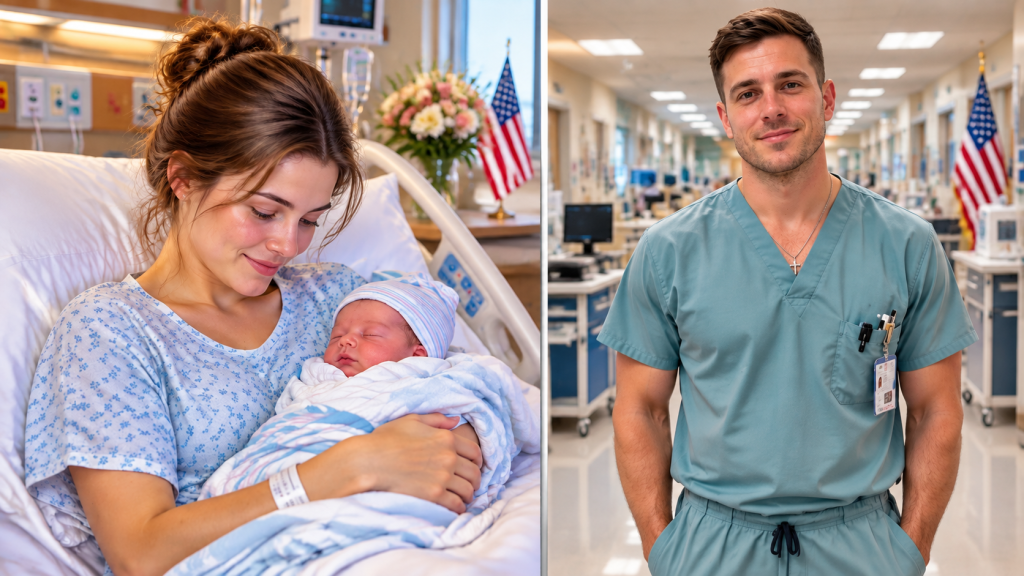
A nurse placed him against my chest.
He was warm and impossibly tiny, with a wrinkled forehead, a little nose, and dark hair flattened against his head.
His fingers curled around one of mine.
I stared at him and began to cry.
There was no doubt in my heart.
No question.
No uncertainty.
He was my son.
I kissed his forehead.
“Hello, Fabian,” I whispered. “I’ve been waiting for you.”
For a few precious hours, the world seemed to disappear.
I forgot my father’s anger.
I forgot the money I didn’t have.
I forgot the uncertain future waiting outside the hospital room.
There was only my baby, his warm little body against mine, and the promise I’d made before he was born.
I would protect him.
I would love him.
I would never willingly abandon him.
Before a nurse took him for a routine examination, I remembered the silver cross my grandmother had given me.
It was small and delicate, with a narrow chain and a tiny scratch on one arm.
My grandmother had worn it for years.
Before she died, she placed it in my palm and told me that love was something we carried with us, even when the people we loved couldn’t be physically beside us.
I’d kept it ever since.
I carefully wrapped the cross in a small piece of soft cloth and tucked it into a little pocket I’d sewn inside the baby’s blanket.
I didn’t want it to scratch his skin, so I made sure the chain was secured and the fabric covered it completely.
Then I kissed his forehead.
“This way, you’ll always carry a little piece of me,” I whispered.
I had no idea that the tiny necklace would become the one thing capable of bringing us back together.
A few hours later, my parents entered my hospital room.
My father carried a thick folder.
My mother wouldn’t meet my eyes.
I assumed they had brought paperwork for my discharge.
Instead, my father placed the folder on my bed.
“There’s been a change of plans,” he announced.
I looked from him to my mother.
“What plans?”
He opened the folder.
“Adoption documents.”
For a moment, I genuinely believed I had misunderstood him.
“What are you talking about?”
My mother sat beside me.
“Laura, sweetheart, we’ve thought about this carefully.”
“No.”
She flinched.
“You haven’t even heard us out.”
“I don’t need to hear anything. I’m taking Fabian home.”
My father removed several pages from the folder.
“The family has already been arranged. They’re prepared to provide him with everything you cannot.”
I stared at him.
“You promised me.”
He didn’t answer.
“You promised I could keep him! You said you’d help me!”
My mother began crying.
“We’re trying to do what’s best for everyone.”
“What’s best for everyone?” I repeated. “He’s my son!”
I tried to sit up, but the pain from childbirth forced me back against the pillows.
My father placed a pen beside the documents.
“Sign them.”
I pushed the folder away.
“No.”
His expression hardened.
“Then you’ll need to find somewhere else to live.”
I stared at him, unable to believe what I was hearing.
He continued speaking in the same cold voice he used when telling employees they had made a mistake.
“You have no money, no home, and no way to support yourself or a newborn. If you refuse, you can leave this house the moment you’re discharged. Don’t expect us to pay your bills or provide a place for you to stay.”
I looked at my mother.
She had once promised that I would never have to face this alone.
Now she sat beside my hospital bed, crying silently while my father threatened to throw me out.
“Mom, please,” I whispered. “You said you would help me.”
She reached for my hand.
“Maybe someday you’ll understand.”
“I understand perfectly. You’re taking my baby away.”
She began sobbing harder.
But she didn’t stop him.
I begged them to give me a few weeks.
I asked for time to find an apartment, save enough money, and arrange childcare.
I promised I would work day and night.
I told them I would accept any job, live in the smallest room, and give up everything I wanted for myself.
I only needed them to let me keep my son.
My father refused.
He told me the decision had already been made.
My mother said the adoption family was waiting.
Waiting.
As though my baby were a parcel that had already been promised to someone else.
I was eighteen years old, recovering from childbirth, and terrified of being thrown out onto the street with a newborn.
I signed the papers.
I did not sign because I stopped loving my son.
I signed because the people who should have protected me had made me believe I had no other choice.
My hand shook so badly that my signature looked unfamiliar.
When I finished, my father collected the documents.
A nurse came to take Fabian away.
I reached for him one last time.
“Please,” I begged. “Let me hold him.”
The nurse hesitated, then carefully placed him in my arms.
I pressed my cheek against his soft hair.
I memorized his face.
His little fingers.
The tiny crease beside his nose.
The way he made a quiet sound when he was comfortable.
“I love you,” I whispered into his blanket. “I love you more than anything. Please believe that someday.”
Then he was gone.
My parents left the hospital without looking back.
For days, I moved through the world as though I were underwater.
My body was healing, but something inside me felt permanently broken.
I returned to the same bedroom where I’d prepared his crib.
The pale-blue dresser stood against the wall.
Tiny clothes were folded in drawers.
A stuffed rabbit sat on the shelf.
I couldn’t bear to touch any of it.
My mother eventually packed the belongings into boxes and placed them in the attic.
My father told me I needed to move on.
He said the adoption had been completed, and there was no point dwelling on something that couldn’t be changed.
I asked where Fabian had gone.
My parents said they didn’t know.
I asked which adoption agency had handled the placement.
My father claimed the paperwork had been managed privately.
I asked for the family’s name.
He refused.
Whenever I brought up my son, he repeated the same sentence.
“You signed the papers, Laura. It’s over.”
But it was never over for me.
Not for one day.
Not for one hour.
I became obsessed with the possibility of finding him.
I began by writing to every adoption agency I could identify.
Most told me their records were sealed.
Some asked for identifying information I didn’t possess.
Others explained that they couldn’t release information about an adopted adult without his consent.
I understood their position.
I wasn’t asking them to violate anyone’s privacy.
I simply wanted the opportunity to tell my son that I had loved him from the moment he was born.
When I was twenty-one, I moved into a small apartment and found a full-time job at a medical billing office.
I saved money, attended night classes, and slowly built a life of my own.
For the first time, my father could no longer threaten to throw me out of the house.
I began searching more aggressively.
I hired a private investigator who specialized in locating biological relatives.
He spent months examining public records and contacting agencies.
Eventually, he told me that the trail had gone cold.
There were no useful records available to him, and the private arrangement appeared to have been handled through an attorney who had since retired.
I refused to give up.
At twenty-five, I paid another investigator.
At twenty-eight, I contacted a lawyer who explained the legal process for requesting access to sealed adoption records.
At thirty, I sent letters to state authorities.
At thirty-three, I attended a support group for birth parents who had been separated from their children through closed adoptions.
I listened to other mothers describe their searches.
Some had reunited with their children.
Others had received letters explaining that their children were not ready for contact.
I was happy for those who found their families, even when their stories made me cry on the drive home.
I began keeping a journal.
Every year on Fabian’s birthday, I wrote him a letter.
I told him what had happened in my life.
I described the weather, the flowers blooming outside my apartment, and the little things I thought he might have enjoyed.
I told him I hoped he was healthy.
I hoped he had friends.
I hoped someone had held him when he was frightened and celebrated when he accomplished something difficult.
Most of all, I hoped he never believed that his birth mother had willingly abandoned him.
I wrote that sentence so often that eventually it became the first line of every letter.
If you ever find these words, please know that I never stopped looking for you.
I never sent those letters because I had no address.
I placed them in a box beneath my bed.
My parents continued insisting they knew nothing about Fabian’s adoptive family.
My father grew increasingly irritated whenever I asked questions.
My mother sometimes cried when I mentioned my son, but she always claimed that she had no information.
Over the years, I learned to recognize the look she gave me when she wanted a conversation to end.
It was the same look she’d worn in the hospital room.
I came to believe that my parents had deliberately arranged an adoption so thoroughly closed that neither Fabian nor I would ever be able to find the other.
I hated them for it.
But I also missed them.
That was the most confusing part.
Even after what they’d done, they were still my parents.
I still remembered my mother’s hands smoothing my hair when I was little.
I remembered my father teaching me to ride a bicycle.
I remembered family picnics, birthday cakes, and evenings spent playing board games around the kitchen table.
It took years to accept that people could love you in some ways and still hurt you in ways you might never recover from.
My father died when I was forty-one.
His heart gave out one morning while he was getting dressed for work.
I attended his funeral.
I stood beside my mother and accepted condolences from relatives who spoke about what a good man he had been.
I wanted to scream.
I wanted to ask whether a good man would have taken his daughter’s newborn child and then spent decades helping conceal where that child had gone.
But I said nothing.
After the funeral, I asked my mother one last time.
“Dad knew where Fabian went, didn’t he?”
She stared at the floor.
“No, Laura.”
“Look me in the eyes and tell me.”
She raised her face.
For one brief second, I thought she might confess.
Instead, she said, “Please don’t do this to me.”
I left without another word.
My mother and I remained in contact, but our relationship never recovered.
We spoke on holidays and occasionally met for lunch.
We discussed the weather, our relatives, and ordinary family matters.
We never discussed Fabian again.
I was forty-nine when my life took another unexpected turn.
I had been working at a medical records office for nearly twenty years.
One afternoon, while reviewing documents at my desk, I developed a sudden, severe pain in my abdomen.
At first, I assumed it was something I had eaten.
But the pain intensified so quickly that I could barely stand.
A coworker called an ambulance.
The next thing I remembered was waking briefly beneath bright hospital lights while a doctor explained that I needed emergency surgery.
I was frightened, but I could barely keep my eyes open.
Someone told me they were taking me to the operating room.
Then everything went dark.
When I woke again, my abdomen ached, my throat felt dry, and a monitor beeped steadily beside my bed.
A nurse explained that the surgery had gone well.
I had suffered an acute abdominal emergency that required immediate intervention, but the surgeons had managed to stabilize me.
I was exhausted.
I drifted in and out of sleep for hours.
The following afternoon, a doctor entered my room to check on my recovery.
He was tall, with dark hair, kind eyes, and a calm manner that immediately reassured me.
He introduced himself as Dr. Bennett, the surgeon who had performed my operation.
I thanked him for saving my life.
He smiled politely, asked how I was feeling, and leaned over to examine my chart.
That was when the silver cross slipped from beneath his collar.
I recognized it instantly.
The small shape.
The delicate chain.
The tiny scratch on one arm.
My grandmother’s necklace.
The necklace I’d placed inside my son’s blanket thirty-one years earlier.
“Doctor,” I whispered.
He looked up.
“Are you all right?”
I pointed toward his chest.
“Where did you get that necklace?”
He touched the cross.
“This?”
“Yes.”
“My adoptive mother gave it to me when I turned eighteen. It was in the blanket I came home in.”
My heart began pounding.
I could barely speak.
“Thirty-one years ago, I placed that exact cross inside my newborn son’s blanket.”
The doctor’s face changed.
He looked at me carefully, as though trying to determine whether I was confused from the medication.
Then he asked my name.
“Laura Whitmore,” I answered.
He went completely still.
For several seconds, he didn’t move.
Then he pulled the chair beside my bed and sat down.
“Did your parents ever tell you what actually happened to your son after you signed those papers?”
I told him no.
And then he showed me the envelope.
The one with my mother’s handwriting on the front.
“If Laura ever searches for her son, make sure she never finds him.”
My fingers trembled as I opened it.
Inside was a letter dated three days after Fabian’s birth.
I recognized my mother’s handwriting immediately.
The letter read:
“Mr. Bennett,
My husband insists that everything must remain as it is. Laura has signed the papers, and we cannot allow her to reopen the matter. She is young, emotional, and will eventually build a life of her own.
“Please understand that she did not make this decision willingly. I watched her cry. I heard her beg us to let her keep her child. I know what we have done to her.
“But Richard says we must protect our family from further embarrassment. He has made it clear that if Laura discovers where her son has been placed, she will try to contact you.
“If she ever searches for him, please do not tell her where he is.
“I pray that you will give the child the loving home we have failed to give him through our own actions.
“Margaret Whitmore.”
I read the letter twice.
Then I covered my mouth and began to sob.
My mother had known.
She had known exactly where my baby had gone.
She had known that I was searching.
And for thirty-one years, she had allowed me to believe the information had been lost.
Fabian waited quietly while I cried.
When I could finally speak, I asked him how he had obtained the letter.
“My adoptive father, Thomas Bennett, was a lawyer,” he explained. “He handled private family matters for many years. He and my mother struggled with infertility, and they eventually pursued adoption.”
He paused.
“They were told my birth mother had voluntarily relinquished me and had specifically requested a closed adoption. My father believed the arrangement was legitimate. He believed he was honoring the wishes of a young woman who wanted a different life.”
I wiped my eyes.
“But the letter says otherwise.”
“Yes.”
“What else did you find?”
Fabian took a slow breath.
“After my father died, I began sorting through his papers. I found the letter along with a copy of the adoption agreement, correspondence with your father, and a record of the payment made to the attorney who handled the arrangement.”
He shook his head.
“I don’t believe my adoptive parents bought me. They genuinely wanted a child, and they loved me as their own. But my father knew the adoption had been arranged through your family, and he knew your mother had doubts about whether you had truly consented.”
“Why didn’t he tell you?”
“I don’t know. Perhaps he thought he was protecting everyone. Perhaps he was afraid that telling me the truth would destroy the family we had built.”
He looked down at the cross.
“I found the letter two months ago. Since then, I’ve been trying to locate you.”
I stared at him.
“You’ve been looking for me?”
“Yes.”
He reached into the envelope and removed another document.
It was a photocopy of an old letter written by my father.
The date was several days before my son’s birth.
My father’s words were unmistakable.
“Thomas,
As discussed, we need this matter handled discreetly. My daughter is young and has become attached to the idea of keeping the child. I believe she will eventually understand that this is the best arrangement.
“I am willing to cover the legal expenses. In return, I expect the adoption to remain confidential. No identifying information should be shared with Laura, and no future contact should be encouraged.
“I appreciate your willingness to help us resolve this family difficulty.”
I felt physically sick.
My father had arranged everything before Fabian was even born.
The promises he’d made about helping me raise my child had never been sincere.
He had allowed me to believe I had a future with my baby while quietly arranging to send him away.
“Was your father my father’s friend?” I asked.
“Not exactly. They knew each other through business. My father had handled legal matters for your father’s company. They had met several times before the adoption.”
That explained how the arrangement had been made so quickly.
My father hadn’t needed to search for a family.
He already knew someone who wanted a child.
Someone he trusted to keep the secret.
“Did your parents know I was being forced?”
Fabian hesitated.
“My mother says she was told you were frightened and uncertain, but that you ultimately agreed. She never saw these letters until after my father died.”
He paused.
“She has been devastated since I showed them to her.”
“Your mother is alive?”
“Yes. Her name is Evelyn. She lives about an hour from here.”
I looked at the cross resting in his palm.
“Did she know about the necklace?”
“She kept the blanket for years. When I was eighteen, she gave me the cross and told me it had come with me from the hospital. She said she wanted me to have something that had belonged to my birth family.”
He smiled sadly.
“I’ve worn it almost every day since.”
I began to cry again.
For thirty-one years, I had wondered whether my son was alive.
I had wondered whether he was loved.
I had wondered whether he had been warm, safe, and happy.
Now I was sitting in a hospital room with a man who had grown into a doctor.
A man who had spent his life helping others.
A man who carried the one thing I’d given my baby on the day we were separated.
“Fabian,” I whispered, “I need you to know something.”
He leaned closer.
“I never stopped looking for you. Not once. I wrote you letters every year on your birthday. I kept every little thing I bought for you. I never wanted to give you away.”
He pressed his lips together.
“I believe you.”
Those three words broke something open inside me.
For thirty-one years, I had imagined saying them to my son.
I had imagined having to prove myself.
I had imagined him being angry, confused, or unwilling to listen.
I had never imagined that he would look at me with compassion.
But I was still afraid.
“What if the documents are wrong?” I asked. “What if there has been some mistake?”
Fabian nodded.
“That’s why I brought copies of the records. And if you’re comfortable with it, we can arrange a DNA test. I want to be certain before we make any assumptions.”
I agreed immediately.
We arranged for a test through the appropriate medical and laboratory channels, with the hospital’s patient privacy procedures followed.
Fabian also explained that, now that we had discovered a possible family relationship, he would arrange for another surgeon to oversee the remainder of my postoperative care.
He wanted to make sure that our personal connection did not interfere with my treatment.
I appreciated that.
Even in the middle of an emotional crisis, he remained thoughtful and careful.
Before leaving my room, he hesitated at the door.
“May I come back tomorrow?”
I reached for his hand.
“Please.”
He squeezed my fingers gently.
“I’ll bring my mother, if you want to meet her.”
I nodded.
“I want to meet everyone who loved you.”
When he left, I lay back against the pillows and stared at the ceiling.
For the first time in thirty-one years, I knew where my son was.
I knew his name.
I knew his face.
And I knew that the search I had once feared would never end had finally brought me to him.
But one question remained.
Why had my mother been so determined to keep us apart?
The following morning, Fabian returned with a woman in her early seventies.
She had silver hair, gentle eyes, and a nervous expression.
She carried a small handbag in both hands.
“Laura,” Fabian said, “this is my mother, Evelyn.”
Evelyn stepped toward the bed.
“I don’t know what to say,” she whispered.
I looked at the woman who had raised my son.
The woman who had held him when he cried, taught him to walk, celebrated his birthdays, and watched him grow into the man standing beside her.
For one brief moment, jealousy rose inside me.
I imagined all the firsts I’d missed.
His first word.
His first day of school.
His first bicycle.
His first heartbreak.
His graduation.
His wedding, if he’d married.
I had missed thirty-one years of his life.
Then I looked at Evelyn’s face and saw the tears gathering in her eyes.
She wasn’t my enemy.
She had loved my son.
She had given him a home.
And she had been lied to, too.
“I owe you an apology,” she said.
I shook my head.
“You loved him. That’s what matters.”
She began to cry.
“Your parents told us you wanted a closed adoption. They said you were young and wanted to move on. My husband believed the attorney had handled everything properly. I believed him.”
She sat beside me.
“When Fabian was little, he used to ask whether his birth mother ever thought about him. I told him I hoped she did. I never imagined that you had spent your life searching for him.”
I reached for her hand.
“I did.”
“I know.”
She opened her handbag and took out a small photograph.
It showed Fabian as a baby, wrapped in a pale blanket.
My breath caught.
It was the blanket.
The same blanket I had held in the hospital.
The same one into which I’d tucked the silver cross.
Evelyn placed the photograph in my hands.
“We kept everything,” she said. “His first shoes, his baby clothes, his school drawings. We wanted him to know that every part of his life mattered.”
I looked at the photograph until tears fell onto the paper.
“Thank you,” I whispered.
Evelyn covered my hand with hers.
“I hope you’ll let us help you recover the years you were denied.”
I didn’t know how to answer.
No one could return the years I’d lost.
But perhaps we could build something new.
Over the next several days, Fabian visited whenever his schedule allowed.
Sometimes he sat beside my bed and told me about his work.
Sometimes he asked about my childhood.
He wanted to know whether I had always wanted to work in medicine, what music I liked, and whether my grandmother had been the person who taught me to sew.
I told him stories about the woman who had given me the cross.
I told him about the summers I spent at her house, the pies she baked, and the way she used to sit on the porch with a book in her lap.
He listened to everything.
He also told me about his childhood.
His adoptive parents had lived in a quiet neighborhood with a garden and a big oak tree in the backyard.
Evelyn had taught him to read before he started school.
Thomas had taken him fishing on weekends.
They had celebrated his birthdays with homemade cakes and family photographs.
He’d been an excellent student, enjoyed science, and eventually decided to become a doctor after watching his grandfather receive compassionate medical care during a difficult illness.
“I wanted to do something that mattered,” he explained.
I smiled through my tears.
“You certainly did.”
He laughed softly.
“I suppose you could say I had good reasons to choose this profession.”
He told me about his medical training, the long nights, the difficult cases, and the patients he still thought about after leaving the hospital.
I listened with a mixture of pride and grief.
I was proud of the man he’d become.
I grieved the fact that I’d never been able to encourage him, comfort him, or tell him how extraordinary I thought he was.
One afternoon, while we were talking, he asked me a question that caught me off guard.
“Do you ever wonder whether I would have become a doctor if I’d grown up with you?”
I considered it carefully.
“Of course I wonder what your life might have been like,” I answered. “But I don’t think your profession is what makes you my son.”
He watched me quietly.
“You would have been my son if you’d become a mechanic, a teacher, an artist, or someone who simply wanted to live a quiet life.”
I squeezed his hand.
“I didn’t spend thirty-one years looking for a doctor. I spent thirty-one years looking for my baby.”
His eyes filled with tears.
For a moment, neither of us spoke.
Then he leaned forward and rested his forehead against my hand.
And I finally understood that love had survived the separation.
It had changed shape.
It had endured years of silence, confusion, and unanswered questions.
But it had survived.
The DNA results arrived several days later.
The laboratory confirmed that Fabian was my biological son with a probability of maternity exceeding 99.99 percent.
I read the report three times.
Then I pressed it against my chest and cried.
Fabian sat beside me, holding my hand.
“So,” he said softly, “I guess we have our answer.”
I looked at him.
“Yes,” I whispered. “We do.”
He smiled through his tears.
“Hello, Mom.”
I had imagined hearing that word for thirty-one years.
I had imagined it spoken by a toddler learning to talk, a teenager calling from another room, or a grown man returning home after a long day.
I had never imagined hearing it from a thirty-one-year-old doctor sitting beside my hospital bed.
But it was beautiful.
I reached up and touched his cheek.
“Hello, my darling boy.”
We both cried.
Then Fabian told me that he wanted to help uncover everything that had happened.
He didn’t want our reunion to be built on unanswered questions.
He wanted to know why my father had arranged the adoption, why my mother had helped conceal it, and whether anyone else had been involved.
I agreed.
I had spent thirty-one years searching for my son.
I wasn’t going to let the truth remain hidden now that we had finally found each other.
Two weeks after my surgery, I was discharged from the hospital.
Fabian drove me home.
He insisted on carrying my bags, checking my medication instructions, and making sure I had everything I needed for the first few days of recovery.
His concern touched me, although I reminded him repeatedly that I could manage a few stairs without assistance.
He laughed.
“I’m a doctor, Mom. Let me worry a little.”
I smiled at the word.
Mom.
It still sounded unfamiliar, but I never wanted to stop hearing it.
Before leaving, he placed a small box on my kitchen table.
Inside were several photographs from his childhood.
There he was at six months old, sitting in a high chair with cake smeared across his face.
At five, he stood beside a Christmas tree holding a toy train.
At twelve, he wore a school uniform and smiled proudly at the camera.
At eighteen, he stood beside his adoptive parents on graduation day.
And at thirty-one, he wore a white coat, a stethoscope around his neck, and the silver cross resting against his chest.
I studied every photograph.
I wanted to memorize them all.
“I wish I could have seen these years as they happened,” I whispered.
Fabian sat beside me.
“I wish you could have, too.”
He paused.
“But I don’t want us to spend the rest of our lives only grieving what we missed. I want us to make memories now.”
I looked at him.
He was right.
We couldn’t change the past.
But we could decide what happened next.
A week later, Fabian called me with news.
He had spoken with his mother and reviewed more of the documents left by Thomas.
They had discovered a second letter, one that had been tucked into a separate folder.
It was written by my mother approximately six months after the adoption.
Unlike the first letter, it was addressed to my father.
The letter read:
“Richard,
I cannot continue pretending that what we did was right.
Laura still asks about her son. She believes we have no information, and every time she searches, I feel as though I am lying to her all over again.
“We know where he is. We know he is being raised by a family who loves him. We could at least tell her that he is safe.
“But you refuse.
“You say that if she finds him, she will ruin the life we arranged for her. You say she will abandon everything she has worked for and try to reclaim the child.
“I don’t know what she will do.
“I only know that she deserves the truth.
“Please let me tell her.
“Margaret.”
My hands shook as I finished reading.
My mother had wanted to tell me.
At least once, she had tried.
But she had remained silent for the next thirty years.
I couldn’t decide whether that made her less guilty or more.
Fabian listened while I tried to explain what I was feeling.
“I think I need to speak to her,” I finally said.
“Then I’ll take you,” he answered.
I looked at him.
“Are you sure?”
“Yes. Whatever happens, I don’t want you to face this alone.”
For the first time in my life, someone was offering to stand beside me without demanding that I obey them in return.
It was my son.
The following Sunday, Fabian drove me to my mother’s house.
She was seventy-two years old and living alone in the same home where I had grown up.
The house looked smaller than I remembered.
The paint around the front door had begun to peel, and the flower beds my mother once maintained with military precision were overgrown.
I sat in the passenger seat for several minutes before getting out.
Fabian waited patiently.
“Are you ready?” he asked.
“No,” I admitted. “But I don’t think I’ll ever be ready.”
He offered me his arm.
We walked to the front door together.
My mother opened it after the second knock.
She looked at me first.
Then her eyes moved to Fabian.
She stared at the silver cross resting against his shirt.
The color drained from her face.
“Oh, my God,” she whispered.
I felt something inside me harden.
“You know exactly who he is.”
My mother gripped the doorframe.
“I…”
“You knew where he was, Mom. You knew all these years.”
She began to cry.
“Laura, please.”
“No. I have spent thirty-one years asking you to tell me the truth. I have searched through records, hired investigators, written letters, and prayed that someday I would find my son.”
My voice trembled.
“And every time I asked you, you looked me in the eyes and told me you knew nothing.”
She covered her mouth.
“I was afraid.”
“Of what?”
“Your father.”
I stared at her.
“Dad has been dead for eight years.”
“I know.”
“Then why didn’t you tell me after he died?”
She had no answer.
I stepped into the house.
Fabian followed.
We sat in the living room where I had spent countless childhood afternoons.
The same curtains hung beside the windows.
The same family photographs stood on the mantel.
One of them showed my parents and me at a summer picnic when I was sixteen.
I remembered that day.
My father had laughed when I accidentally dropped a piece of watermelon onto my dress.
My mother had taken the photograph.
Looking at it now, I wondered how many of our happiest memories had existed alongside secrets I knew nothing about.
My mother sat opposite us, twisting a tissue between her fingers.
“I know I cannot undo what happened,” she began.
“No,” I answered. “You can’t.”
She nodded.
“But I want to explain.”
I folded my hands in my lap.
“Then tell me everything.”
She took a shaky breath.
“Your father was terrified of what people would think when they learned you were pregnant. He believed that if you married Daniel, you would throw away your future. He also believed that having a child outside marriage would damage our family’s reputation.”
I interrupted her.
“Did you know Daniel was the father?”
She looked down.
“Yes.”
My heart began pounding.
“How?”
“Your father found one of your letters. It had Daniel’s name on it. He also found a photograph of the two of you.”
I closed my eyes.
I’d spent so much time protecting Daniel’s identity that I hadn’t realized my father had already discovered it.
“What did Dad do?”
“He contacted Daniel’s family.”
My mother paused.
“He told them that you were going to give the baby up for adoption. He said you wanted to end the relationship and didn’t want Daniel involved.”
“That isn’t true.”
“I know.”
I stared at her.
“Did Daniel know I was in labor?”
She shook her head.
“Your father told him the baby had died shortly after birth.”
I felt as though the room had tilted beneath me.
For thirty-one years, I had believed my father had taken my child from me.
Now I was learning that he had also stolen the truth from Daniel.
“Did Daniel believe him?”
My mother began crying harder.
“I don’t know. Your father said Daniel eventually left town and never contacted us again.”
I pressed my fingers against my forehead.
Daniel had promised he would return.
He had promised we would find a way to raise our child.
I had spent years believing he had abandoned us.
But my father had lied to both of us.
“Why didn’t you tell me?” I asked.
My mother wiped her face.
“Because your father said the arrangement was permanent. He said the Bennetts would give the baby a better life. He told me that if we allowed you to contact them, you would become obsessed with trying to reclaim him.”
I looked at Fabian.
He sat quietly beside me, his expression unreadable.
My mother continued.
“At first, I told myself you would eventually be happy. I told myself that the baby was safe and loved, and that you would have opportunities you might not otherwise have had.”
She shook her head.
“But as the years passed, I realized that I had helped take something from you that could never be replaced.”
I could barely speak.
“You watched me search.”
“Yes.”
“You watched me pay investigators who found nothing.”
“Yes.”
“You watched me cry on his birthdays.”
She covered her face.
“Yes.”
I stood up.
For a moment, I thought I might shout.
I wanted to demand that she explain how she had lived with herself.
Instead, I walked to the window and stared into the garden.
I remembered sitting in that same room as a little girl, believing my mother would always protect me.
I remembered the day I told her I was pregnant and begged her to stand beside me.
I remembered her promise.
We won’t let you face this alone.
And I remembered the hospital room where she’d sat silently while my father threatened to throw me out.
I turned back toward her.
“Did you ever regret it?”
My mother looked up.
“Every day.”
“Then why did you never fix it?”
She cried silently for several seconds.
“Because every time I thought about telling you, I imagined your anger. I imagined you never speaking to me again. I told myself that if I waited a little longer, I might find the courage.”
Her voice broke.
“Then a year passed. Then five. Then ten. Eventually, I was so ashamed that I couldn’t imagine how to begin.”
I stared at her.
“You protected yourself from my anger for thirty-one years.”
She lowered her head.
“Yes.”
“And you called it protecting the family.”
She didn’t answer.
For the first time, I saw the truth without the excuses my mother had spent decades building around it.
She had been frightened.
She had been controlled by my father.
She had been ashamed.
But she had also made choices.
She could have told me after he died.
She could have given me the letters.
She could have admitted that she knew where my son was.
Instead, she had continued the lie.
I sat down again.
“There’s something else I need to know.”
My mother nodded weakly.
“Did you ever see Fabian after the adoption?”
She looked at him.
“No. Not in person.”
“Did you receive photographs?”
She hesitated.
Then she stood, walked to a small cabinet, and removed a narrow wooden box.
“I kept these.”
Inside were several photographs.
A baby wrapped in a pale blanket.
A little boy standing beside a Christmas tree.
A child holding a birthday cake.
A teenager wearing a graduation gown.
I stared at them.
My mother had been receiving updates.
Perhaps not every year, but enough to know how Fabian was growing.
“You had pictures of him?”
She nodded.
“Your father arranged for them to be sent through the attorney. We were never supposed to contact the family directly.”
I lifted one photograph.
Fabian was about eight years old.
He was smiling at the camera, missing one front tooth.
My throat tightened.
“You watched him grow up while I didn’t even know what city he lived in.”
My mother wept.
“Yes.”
I placed the photograph back into the box.
“I don’t know how to forgive you.”
“I don’t expect you to.”
For once, she didn’t ask me to make her feel better.
She didn’t tell me to move on.
She didn’t say she had done what was best for me.
She simply sat there and accepted the truth.
Fabian finally spoke.
“Mrs. Whitmore, I want to ask you something.”
My mother looked at him.
“Did you ever consider telling me the truth yourself?”
She swallowed.
“Yes. Many times.”
“Then why didn’t you?”
She stared at her hands.
“Because I was afraid you would hate us. I was afraid you would want to meet Laura and that we would lose you.”
Fabian shook his head slowly.
“You didn’t have the right to decide that for us.”
“I know.”
He touched the cross.
“My parents raised me with love. They gave me a wonderful childhood. I will always be grateful to them.”
My mother nodded.
“But they also deserved the truth. And Laura deserved the chance to know her own son.”
He paused.
“You cannot give us back the years we lost. But you can stop lying about them.”
My mother looked at him for a long time.
Then she nodded.
“I will.”
I didn’t embrace her that afternoon.
I wasn’t ready.
I left the house with Fabian beside me, carrying the box of photographs and the letters my mother had finally agreed to release.
In the car, I sat quietly for several minutes.
Fabian didn’t rush me.
Eventually, I turned toward him.
“I’m sorry you had to hear all of that.”
He shook his head.
“You don’t have to apologize for what they did.”
I looked out the window.
“Do you think I’m a terrible person for wanting to see her suffer a little? For wanting her to feel some of what I felt?”
“No.”
His answer came without hesitation.
“You’re allowed to be angry. You’re allowed to grieve. You’re allowed to need time.”
He reached over and squeezed my hand.
“You don’t owe anyone instant forgiveness, Mom.”
I looked at him, and tears filled my eyes.
For thirty-one years, I’d been the frightened young woman who needed someone to stand beside her.
Now my son was doing exactly that.
And I realized that the reunion I’d dreamed about wasn’t simply about finding him.
It was also about discovering the person he had become.
A person who understood that love didn’t mean pretending everything was fine.
It meant telling the truth, even when the truth hurt.
Over the following months, Fabian and I began building a relationship.
We met for lunch whenever his schedule allowed.
Sometimes he brought Evelyn, who had become a dear friend.
Other times, we spent hours together talking about our lives.
He showed me photographs of his medical school graduation, his first apartment, and the hospital where he had completed his residency.
I told him about my work, my childhood, and the years I’d spent searching.
We talked about the letters I’d written every birthday.
He asked whether I still had them.
I told him they were in a box beneath my bed.
One afternoon, he came to my apartment and sat beside me while I opened it.
There were thirty-one letters.
Some were only a few paragraphs long.
Others filled several pages.
The first had been written when I was nineteen.
The most recent had been written the previous year.
I handed him the oldest one.
He read it slowly.
Then he reached for the next.
He read every letter.
Sometimes he smiled.
Sometimes he wiped his eyes.
When he finished, he sat quietly for a long time.
“I always wondered whether you ever thought about me,” he said.
I shook my head.
“Every day.”
He looked at the stack of letters.
“You remembered all my birthdays.”
“Every single one.”
He placed the letters carefully back into the box.
“Thank you for not giving up.”
I reached for his hand.
“I never could.”
He leaned forward and hugged me.
It was the first time he had embraced me without hesitation.
I held him tightly, afraid that if I let go, the moment would disappear.
But he didn’t pull away.
He stayed beside me until we were both laughing through our tears.
A few months later, Fabian suggested that we visit the cemetery where my grandmother was buried.
I immediately understood why.
The silver cross had belonged to her.
She had given it to me with the promise that love would remain even when people were separated.
I brought a small bouquet of white flowers.
Fabian wore the necklace around his neck.
We stood beside my grandmother’s grave while I told him stories about the woman who had given us the one object that had survived the separation.
I explained how she used to bake bread on Sunday mornings, how she sang while working in the garden, and how she always made me feel safe.
Fabian listened.
Then he knelt and placed his hand on the headstone.
“Thank you,” he whispered. “For giving my mother something that helped me find her.”
I covered my mouth.
For a moment, I imagined my grandmother watching us from somewhere beyond the reach of time.
I imagined her smiling.
The cross had traveled through decades of separation, from my grandmother to me, from me to my newborn son, and eventually to the man who had become a doctor.
It had survived the lies.
It had survived the closed adoption.
It had survived the years when I feared I would never see my child again.
And now it rested against Fabian’s chest while he stood beside me.
That evening, we went to dinner at Evelyn’s house.
She had prepared a simple meal and set the table with fresh flowers.
There were photographs everywhere.
Fabian as a baby.
Fabian on his first day of school.
Fabian holding a science fair ribbon.
Fabian in his graduation gown.
For the first time, I didn’t feel as though I was looking at another woman’s memories of my son.
I felt grateful that someone had loved him.
Evelyn showed me the blanket he’d come home in.
She had preserved it carefully in a box.
The little pocket where I’d hidden the cross was still there.
I ran my fingers over the stitching.
I remembered sitting in the hospital, sewing it with trembling hands while imagining the future I hoped to give my child.
Evelyn stood beside me.
“I wish I’d known,” she said softly. “If I’d known you were being forced, I would have wanted to help you.”
I believed her.
I couldn’t change the past, but I could recognize the difference between someone who had deliberately hurt me and someone who had been deceived.
Evelyn had loved Fabian.
She had also been misled.
I hugged her.
“Thank you for taking care of my son.”
She hugged me back.
“He has always been our greatest blessing.”
That night, when Fabian drove me home, he asked whether I wanted to see him again the following weekend.
I smiled.
“Of course.”
He laughed.
“Good. Because I was going to ask whether you’d like to come to the hospital sometime and see where I work.”
I looked at him.
“Your hospital?”
“Yes. I know you won’t be able to see everything, but I thought you might enjoy meeting some of the people who have become part of my life.”
I felt a warmth spread through my chest.
“I would love that.”
A few weeks later, I visited the hospital where Fabian worked.
He introduced me to nurses, doctors, and administrative staff.
Everyone seemed to know him well.
They spoke about his patience, his attention to detail, and his willingness to stay late when a patient needed extra care.
One nurse told me that he had once spent an entire evening explaining a complicated procedure to an elderly woman who was frightened and confused.
Another said he always remembered the names of patients’ family members.
I listened with tears in my eyes.
I had spent thirty-one years wondering who my son would become.
Now I knew.
He had become someone who understood that people were more than the problems they brought into a hospital.
He understood that fear could make a person feel small.
He understood that kindness sometimes meant sitting beside someone and listening when there was nothing else to say.
I was proud of him.
Not because he was a doctor.
Not because he had a successful career.
But because he had grown into a compassionate man despite beginning his life with a story filled with secrets.
One afternoon, several months after our reunion, Fabian invited me to a small family gathering.
Evelyn was there, along with a few relatives who had known him since childhood.
I felt nervous when I arrived.
I wondered whether they would see me as an intruder.
Instead, Evelyn greeted me warmly and led me into the living room.
She had prepared a table with photographs, flowers, and a cake.
Fabian stood beside it, smiling.
“There’s something I want to say,” he announced.
Everyone grew quiet.
He looked at Evelyn first.
“You and Dad gave me a wonderful life. You taught me how to love, how to work hard, and how to care about other people. Nothing that happened before my adoption changes the fact that you are my parents.”
Evelyn wiped her eyes.
Then Fabian turned toward me.
“And my birth mother spent thirty-one years searching for me, even when she had no idea whether she would ever find me.”
He took the silver cross from beneath his shirt.
“This necklace began as a gift from a grandmother to her granddaughter. Then it became a mother’s promise to her newborn son. And eventually, it became the reason we found each other again.”
He paused.
“I don’t want to spend my life thinking about the family I might have had. I want to be grateful for the family I have now.”
He reached for my hand.
“And I want everyone here to know that I have two mothers who love me.”
I couldn’t stop crying.
Evelyn came to stand beside us.
She took my other hand.
For the first time, I understood that love did not have to be divided into competing pieces.
Fabian could love the woman who had raised him and the woman who had given birth to him.
He could honor his adoptive father while acknowledging the truth about the adoption.
He could be grateful for his childhood while grieving the years we had lost.
And I could be his mother without needing to erase the people who had helped him become the man he was.
That was the family we began building.
It wasn’t the family I had imagined when I was eighteen.
It was more complicated.
It carried grief, regret, and unanswered questions.
But it was real.
As for my mother, our relationship changed slowly.
I did not immediately forgive her.
For a long time, I couldn’t bear to visit her house.
When we spoke on the telephone, I kept our conversations short.
She apologized repeatedly, but I told her that apologies were only the beginning.
If she wanted to repair our relationship, she needed to accept that I might never trust her in the same way again.
She agreed.
Over time, she began telling the truth without making excuses.
She admitted that she had chosen her fear over my happiness.
She admitted that she had allowed my father to make decisions that belonged to me.
She admitted that she had watched me suffer and had done nothing to stop it.
I listened.
Sometimes I cried.
Sometimes I became angry.
Sometimes I ended the conversation because I couldn’t bear to hear any more.
But eventually, I began to understand that I could acknowledge her remorse without pretending the damage had never happened.
Forgiveness, I learned, was not a door that swung open simply because someone knocked.
It was a process.
And it was mine to decide.
One afternoon, nearly a year after Fabian and I reunited, my mother asked whether she could meet him again.
I spoke with Fabian first.
He agreed, but he made one condition.
“We don’t pretend everything is fine,” he said. “We can be civil. We can hear what she has to say. But nobody gets to rewrite what happened.”
I agreed.
We met at a quiet café.
My mother arrived early and sat near the window.
When she saw Fabian, she stood.
She looked smaller than I remembered.
Older.
More fragile.
For a moment, I felt sorry for her.
Then I remembered the letters, the photographs, and the years of searching.
I reminded myself that compassion did not require me to forget.
My mother approached Fabian.
“I don’t expect you to forgive me,” she said. “But I want you to know that I am sorry for the part I played in keeping you away from your mother.”
Fabian nodded.
“Thank you for saying that.”
She began to cry.
“I watched you grow up through photographs. I saw you graduate. I knew you had become a doctor. I was proud of you, but I had no right to feel proud when I had helped keep your mother from you.”
Fabian listened quietly.
Then he said, “I appreciate your honesty. But I need you to understand that what happened was wrong.”
She nodded.
“I do.”
He looked at me.
I reached for his hand.
We didn’t leave the café as a perfectly healed family.
There were no dramatic declarations that everything had been forgiven.
There was simply a conversation in which the truth was finally allowed to exist.
For me, that was enough for one afternoon.
Today, when I think about the thirty-one years I spent searching for Fabian, I still feel the ache of everything we lost.
I think about the birthdays I missed.
I think about the nights he might have been sick while I sat alone in my apartment, wondering whether he was safe.
I think about his first day of school, his first broken heart, and the moments when he might have needed someone to tell him he was loved.
I will always grieve those years.
But I no longer spend every birthday wondering whether I will ever see my son again.
Now, on his birthday, I call him.
Sometimes we have lunch.
Sometimes Evelyn joins us.
Sometimes Fabian is working and can only talk for a few minutes, but even then, I hear his voice and know that he is alive, safe, and living the life he worked so hard to build.
Last year, he invited me to his home for his birthday dinner.
He had prepared a simple meal and bought a small cake.
After dinner, he brought out a gift.
It was a new silver chain.
My grandmother’s cross had been cleaned and carefully repaired, but the tiny scratch on one arm remained.
“I thought you might like to keep this for a while,” he said.
I stared at him.
“Are you sure?”
He nodded.
“I’ve carried it for most of my life. But now I know where it came from, and I know what it means. I thought you might like to hold it again.”
I took the necklace in my hands.
The silver felt cool against my palm.
For thirty-one years, I had imagined that my son might have lost the cross, that it might have been discarded with the blanket, or that it might have disappeared somewhere along the way.
Instead, it had traveled with him.
It had rested against his chest through childhood, adolescence, medical school, and the years he spent becoming a doctor.
It had been there when he celebrated his greatest achievements and when he struggled through difficult days.
And somehow, through a coincidence neither of us could have planned, it had brought him back to me.
I looked at my son.
“Thank you,” I whispered.
He smiled.
“Thank you for giving it to me.”
I reached up and touched his cheek.
“I wish I could have given you so much more.”
He covered my hand with his.
“You gave me something important.”
“What?”
He looked at the cross.
“You gave me a reason to believe that love can survive things that should have destroyed it.”
I began to cry.
He hugged me, and I held him as tightly as I could.
For the first time since I was eighteen, I no longer felt as though my story had ended in that hospital room where my newborn son was taken away.
That had been the beginning of a terrible chapter.
But it had not been the end.
I had lost thirty-one years with my child.
I could never recover them.
I could never become the mother who attended his first school play, helped him with homework, or waited up for him when he came home late.
I could never give him the childhood we might have shared.
But I could love the man he had become.
I could listen to his stories.
I could learn about the life he had lived.
I could be there for the birthdays still ahead of us.
And I could tell him, as often as he needed to hear it, that he had never been unwanted.
That was the truth my parents had tried to bury.
That was the truth the silver cross had carried through three decades of silence.
And that was the truth my son finally brought home.
Sometimes, when I wake in the middle of the night, I still remember the young woman I was at eighteen.
I remember her sitting on the edge of her bed, folding tiny baby clothes and imagining the future.
I remember her whispering goodnight to the child growing inside her.
I remember the hospital room, the adoption papers, and the terrible moment when she realized that the people she trusted most had betrayed her.
I wish I could go back and hold that young woman’s hand.
I wish I could tell her that she was stronger than she knew.
I wish I could tell her that the promises she made to her baby would matter, even when she had no power to keep him beside her.
I would tell her that the world would not always be cruel.
I would tell her that one day, after years of searching and countless unanswered questions, a silver cross would appear beneath the collar of a doctor who had saved her life.
And I would tell her that the little boy she loved so desperately would grow into a compassionate man who would sit beside her and call her Mom.
I would tell her that she would cry again, but those tears would not all be tears of grief.
Some would be tears of relief.
Some would be tears of gratitude.
And some would be tears of a happiness she had once been afraid to imagine.
Most of all, I would tell her this:
Never let someone else’s decision convince you that your love was not real.
Never let someone else’s shame make you ashamed of the child you wanted.
And never believe that the years you spend searching for someone you love are proof that you have failed.
Sometimes, the search is the only way to keep hope alive.
I spent thirty-one years looking for my son.
I thought I was searching for a name, an address, a photograph, or a record that would tell me where he had gone.
I didn’t understand that I was also searching for the truth about myself.
I needed to know that the frightened eighteen-year-old who signed those papers had not abandoned her baby in her heart.
She had not.
She had loved him every day.
She had remembered him every birthday.
She had searched for him through every disappointment.
And when he finally returned to her life, she discovered that love had been waiting on the other side of all those years.
Today, the silver cross rests in a small wooden box on my bedside table whenever Fabian isn’t wearing it.
Sometimes he asks me to keep it for him while he travels.
Sometimes he wears it beneath his shirt when he goes to work.
We have agreed that the cross belongs to both of us in a way neither of us needs to explain.
It is a reminder of my grandmother, who first gave it to me.
It is a reminder of a mother who refused to forget her child.
It is a reminder of a son who grew up without knowing the full truth of his beginnings.
And it is a reminder that even the deepest family secrets cannot always keep people apart forever.
My parents believed they could decide the shape of my future by taking my baby away.
They believed silence would make the past disappear.
They believed that if enough years passed, I would eventually stop asking questions.
They were wrong.
Because love does not always arrive on time.
Sometimes it arrives after decades of heartbreak.
Sometimes it comes with questions that hurt to answer.
Sometimes it asks us to face truths we would rather avoid.
But when love finally finds its way home, it can give us something we thought we had lost forever.
A chance to begin again.
My name is Laura Whitmore.
I was eighteen when I lost my son.
I was forty-nine when I found him.
And now, whenever Fabian takes my hand and calls me Mom, I remember the promise I whispered into his blanket all those years ago.
I promised him that I would always love him.
I promised him that I would never forget him.
And I promised him that, if I ever had the chance, I would tell him the truth.
Thirty-one years later, I finally had that chance.
I kept every promise.
And I will keep them for the rest of my life.
💬THE END! THANK YOU FOR READING!