
The day my wife abandoned me with seven children, she told me I would never amount to anything. Ten years later, she walked into our youngest daughter’s birthday party carrying expensive presents, expecting to be welcomed like a queen. Instead, our twelve-year-old daughter handed her a phone and showed her something that made her turn deathly pale. But the photograph was only the beginning. When my oldest son brought out a document Vanessa had signed ten years earlier, her wealthy boyfriend suddenly looked terrified. And what we discovered about the money that had disappeared from our children’s lives would change everything.
My name is Thomas Bennett. I’m fifty-two years old, a father of seven, and someone who learned the hard way that the people you trust most can sometimes hurt you the deepest.
Ten years ago, I thought I had a good marriage.
We weren’t wealthy, but we had a comfortable little house, two cars that usually worked, and seven children who filled every room with noise, laughter, and the occasional argument over whose turn it was to wash the dishes.
My wife, Vanessa, was beautiful, ambitious, and always dreaming of something bigger.
When we first married, I admired that about her.
She wanted a nice house, expensive vacations, fashionable clothes, and the kind of lifestyle she saw in magazines.
I wanted those things for her, too.
But I also wanted to make sure our children had food, warm beds, and parents who loved them.
Apparently, those priorities were not enough.
Our oldest son, Michael, was fifteen. Grace was thirteen, Daniel was eleven, Olivia was nine, Henry was seven, Lily was five, and our youngest, Sophie, had just celebrated her second birthday.
Seven children.
Seven different personalities.
Seven little hearts that trusted us to protect them.
I worked as a construction supervisor for a small residential contractor. Vanessa stayed home with the younger children and occasionally helped a friend with decorating projects.
We had our disagreements, but I never imagined our marriage was falling apart.
Then there was Rob Mercer.
Rob lived three houses down from us.
He drove a luxury SUV, wore expensive watches, and owned a property development company. He always seemed to have money for whatever he wanted.
He was also my best friend.
At least, that was what I believed.
We had known each other for almost eight years. We watched football together, helped each other with home repairs, and regularly invited each other’s families over for dinner.
When I needed someone to help replace our garage door, Rob volunteered.
When he needed someone to inspect a leaking roof at one of his rental properties, I spent an entire Saturday helping him.
I trusted him enough to give him a spare key to my house.
That was a mistake I would remember for the rest of my life.
One Thursday afternoon, I came home two hours earlier than expected.
A delivery truck had damaged some equipment at our construction site, and my supervisor sent everyone home while the insurance company investigated.
I stopped at the grocery store and bought strawberries because Sophie loved them.
I also bought Vanessa her favorite flowers.
I remember walking through the front door and noticing how unusually quiet the house seemed.
The children were at school or daycare.
I called Vanessa’s name.
No answer.
Then I heard laughter upstairs.
I recognized her voice immediately.
The second voice belonged to Rob.
My stomach tightened.
I walked toward our bedroom, pushed open the door, and discovered my wife and my best friend together.
For several seconds, none of us spoke.
Rob scrambled to his feet.
Vanessa didn’t even bother pretending.
She pulled on her robe, folded her arms, and looked at me with an expression I had never seen before.
Not shame.
Not regret.
Annoyance.
“Well,” she said coldly, “I suppose there’s no point hiding it anymore.”
I stared at her.
“Vanessa, what are you doing?”
She rolled her eyes.
“What does it look like, Thomas?”
I looked at Rob.
“You were my friend.”
He couldn’t meet my eyes.
“Tom, listen. It’s complicated.”
“Complicated?” I repeated.
“You’ve been sitting at my dinner table. You’ve held my children. You’ve called me your brother.”
Rob remained silent.
Then Vanessa stepped between us.
“Stop making everything so dramatic. This marriage has been miserable for years.”
I felt as though the floor had disappeared beneath me.
“Miserable? We have a family.”
“We have seven children,” she snapped. “Seven children who need something every five minutes. Seven children who make it impossible for me to have a life.”
I could barely recognize her.
“Those are our children, Vanessa.”
“I know who they are!”
She took a deep breath.
“Rob makes me feel alive. He takes me places. We went to the Maldives last month while you thought I was visiting my cousin.”
I remembered that trip.
She had kissed me goodbye and thanked me for watching the children.
I had taken two days off work because Sophie had developed a fever.
Meanwhile, my wife had been relaxing on a tropical beach with my best friend.
Vanessa continued speaking.
“Rob gives me the kind of life I deserve. I’m tired of worrying about bills. I’m tired of living in this little house. I’m tired of being someone’s mother every minute of the day.”
My voice shook.
“And what about the children?”
She looked toward the window.
“You’ll manage.”
Those two words changed my life.
You’ll manage.
As though seven children were a collection of houseplants someone could simply leave behind.
I begged her to reconsider.
Not because I wanted to pretend her betrayal hadn’t happened, but because I couldn’t imagine explaining her disappearance to our children.
“Vanessa, Sophie is two. Lily still sleeps with that stuffed rabbit you gave her. Michael has exams coming up. How can you just walk away?”
She opened the closet and pulled out two suitcases.
“I can’t keep sacrificing my happiness for everyone else.”
Rob carried her luggage downstairs.
I stood in the hallway, unable to believe what was happening.
Before leaving, Vanessa turned around.
“One day, Thomas, you’ll understand. I deserve better than this.”
Then she walked out.
I watched Rob’s SUV disappear around the corner.
The strawberries were still sitting on the kitchen counter.
The flowers were crushed beneath a grocery bag.
And in a few hours, seven children would come home expecting their mother to be there.
I have survived some difficult days in my life.
Nothing compares to that evening.
Michael noticed immediately that something was wrong.
“Where’s Mom?”
I tried to answer.
The words wouldn’t come.
Grace looked toward the stairs.
“Is she sick?”
I gathered everyone in the living room.
Sophie climbed onto my lap, holding her stuffed elephant.
I told them their mother had gone away.
I explained that she wouldn’t be living with us anymore.
I tried to choose words that wouldn’t make them believe they had done something wrong.
But children understand more than adults sometimes realize.
Michael stared at the floor.
“Did she leave because of us?”
“No,” I said immediately.
“Then why didn’t she say goodbye?”
That question nearly broke me.
I had no answer that would make sense to a fifteen-year-old boy.
Lily started crying.
Henry asked whether Mom would come back before bedtime.
Olivia wanted to know if she could call her.
Daniel got angry and shouted that he didn’t care.
Grace took Sophie into her arms and whispered that everything would be all right.
And Sophie, who barely understood what was happening, kept pointing toward the front door.
“Mama?”
I told her Mama wasn’t coming home that night.
She waited anyway.
For almost three weeks, Sophie carried her little shoes to the front door every afternoon.
She would sit on the rug, place the shoes beside her, and watch through the glass.
Whenever a car slowed outside our house, she stood up.
“Mama home?”
Every time, I had to tell her no.
One evening, I found Michael sitting beside her.
He was holding a picture book upside down because he was too exhausted to concentrate.
When he noticed me watching, he smiled sadly.
“Dad, I think she’s starting to forget what Mom looks like.”
I went into the bathroom, locked the door, and cried harder than I ever had in my life.
But grief didn’t pay the electric bill.
And heartbreak didn’t put food on the table.
Within a month, I learned that Vanessa had already removed her name from our joint checking account.
She had taken most of the money she considered hers.
There was barely enough left to cover the mortgage.
I contacted a lawyer and began divorce proceedings.
Vanessa communicated through email.
She didn’t ask to visit the children.
She didn’t request weekend arrangements.
She simply wanted the marriage ended quickly.
The court eventually established my primary custody of the children and ordered her to contribute toward their support.
She rarely paid.
At first, I tried calling her.
Sometimes she answered.
Usually, she didn’t.
When she did, she complained that Rob was traveling or that she was too busy to discuss parenting.
Eventually, the calls stopped.
I didn’t have the luxury of collapsing.
Seven children were depending on me.
I began working evenings at a warehouse after my construction job.
On weekends, I repaired decks, painted houses, and installed kitchen cabinets.
For a while, I was juggling three jobs.
Some nights, I slept less than four hours.
There were mornings when I stood in the kitchen staring at the coffee machine, trying to remember whether I’d already made breakfast.
Once, I packed Henry’s lunch in Sophie’s diaper bag.
Another time, I accidentally sent Daniel to school wearing two different shoes.
He came home furious.
“Dad, everyone laughed at me!”
I apologized.
He crossed his arms.
“Mom would have noticed.”
I could have defended myself.
I could have reminded him how hard I was working.
Instead, I sat beside him.
“You’re right,” I said. “I should have noticed.”
He looked surprised.
Then his eyes filled with tears.
“I just miss her.”
“I know, buddy.”
“I miss her even though she left us.”
I pulled him close.
“You’re allowed to miss her.”
That became one of the most important rules in our house.
The children were allowed to love their mother.
They were allowed to be angry with her.
They were allowed to ask questions I couldn’t answer.
I never wanted them to feel they had to choose between being loyal to me and being honest about their feelings.
But there were moments when my own sadness almost swallowed me.
One winter, our furnace stopped working during a snowstorm.
The repair would cost nearly nine hundred dollars.
I had forty-three dollars in my checking account.
The children slept together in the living room beneath every blanket we owned.
I sat beside a portable heater, calculating which bills I could delay.
At two in the morning, I heard someone walking downstairs.
It was Grace.
She was fourteen then.
She brought me a cup of warm water with a tea bag floating in it.
“We ran out of sugar,” she whispered.
I smiled.
“That’s okay, sweetheart.”
She sat beside me.
“Dad, are we poor?”
I looked around the freezing room.
I could have lied.
Instead, I said, “We’re having a hard time financially.”
She thought about that.
“Are we going to lose our house?”
“I’m doing everything I can to make sure we don’t.”
She leaned against my shoulder.
“I don’t need a bigger house. I just want us to stay together.”
I never forgot those words.
The next morning, I called an old coworker who knew how to repair furnaces.
He came over after work, installed a replacement part, and refused to charge me for labor.
When I insisted on paying, he said, “Thomas, you’ve helped half this town for free. Let somebody help you.”
His name was Walter Jenkins.
He became one of the people who helped save our family.
Our neighbor Mrs. Alvarez began bringing dinner over on Tuesdays.
A retired schoolteacher named Margaret offered to watch Sophie while I worked Saturdays.
The school counselor quietly arranged winter coats for the younger children after noticing that Henry’s jacket had become too small.
At first, accepting help embarrassed me.
I thought being a good father meant handling everything alone.
Eventually, I learned that love sometimes arrives disguised as a casserole dish, a repaired furnace, or a neighbor volunteering to drive your children to soccer practice.
We survived because people cared.
But I also knew I couldn’t keep working three jobs forever.
My body was wearing down.
I missed school concerts.
I missed birthday breakfasts.
Once, Sophie drew a family picture in preschool.
Every child appeared in bright colors.
I was a tiny figure in the corner carrying a toolbox.
When I asked why she had drawn me so small, she smiled.
“Because Daddy is always working.”
That drawing changed something inside me.
I realized I was keeping my children financially alive while missing pieces of their childhood.
I needed a different plan.
I had always been good with my hands.
My father taught me carpentry when I was young. I could repair almost anything in a house, and I especially enjoyed restoring old furniture.
So I began accepting small renovation projects under my own business name.
Bennett Home Restoration.
At first, it was nothing more than an old pickup truck, a borrowed trailer, and a handwritten sign.
My first customer was Mrs. Alvarez.
She wanted her kitchen cabinets refinished.
I told her I could do the work for half the price a larger company had quoted.
She insisted on paying the full amount.
“Thomas, don’t start a business by teaching people your work isn’t valuable.”
She gave me something else.
A recommendation.
Within three weeks, two of her friends hired me.
Then a local realtor asked whether I could restore the woodwork in a house she was preparing to sell.
I completed the project ahead of schedule.
She referred me to another client.
Slowly, the business grew.
I worked hard, but this time I was building something that belonged to our family.
Michael helped me create a website.
Grace organized receipts.
Daniel helped carry tools during school holidays.
Olivia designed our first logo.
Henry learned how to measure boards and sand wood.
Lily loved choosing paint colors.
And Sophie insisted on putting a tiny yellow handprint on the inside of our workshop door.
“For good luck, Daddy.”
I told her that handprint would stay there forever.
It still does.
Three years after Vanessa left, I hired my first employee.
His name was Marcus Hill, a carpenter who had lost his previous job when a construction company closed.
He was talented, dependable, and raising a daughter alone.
We understood each other immediately.
One afternoon, Marcus told me about his mother.
She was recovering from surgery and couldn’t climb the stairs to her bedroom.
He wanted to build her a downstairs bathroom, but he couldn’t afford the materials.
I helped him.
We completed the project over two weekends.
His mother cried when she saw it.
“You boys have given me my independence back,” she said.
That experience gave me an idea.
We began specializing in renovations that helped elderly people and people with disabilities remain safely in their homes.
Ramps.
Accessible bathrooms.
Wider doorways.
Safer kitchens.
Every project required careful work, but it also had a human purpose.
Our reputation grew.
Four years later, Bennett Home Restoration had twelve employees.
Six years later, we had twenty-three.
By the eighth year, we were handling major residential renovations across three counties.
We moved into a proper workshop.
We purchased reliable vehicles.
We established employee benefits.
I even created a small apprenticeship program for young people who wanted to learn a trade but couldn’t afford technical school.
Eventually, a local newspaper published an article about us.
The headline read:
“Single Father of Seven Builds Million-Dollar Business After Wife Abandons Family.”
I hadn’t chosen the headline.
In fact, I found it embarrassing.
The business was worth more than a million dollars on paper, but that didn’t mean I had a million dollars sitting in a bank account.
We had payroll, equipment loans, taxes, insurance, and employees whose families depended on us.
Still, the article made the children proud.
Michael framed it.
Grace put a copy in her apartment.
And Sophie asked me to sign one for her bedroom.
“You’re famous, Daddy!”
I laughed.
“Only around here.”
She looked at the photograph of me standing with our employees.
“You’re famous to me.”
That meant more than any number on a business report.
By then, our lives had changed dramatically.
We had moved into a larger house with enough bedrooms for everyone.
It wasn’t a mansion.
It was a comfortable home on a quiet street, with a large backyard, a beautiful kitchen, and a workshop behind the garage.
I bought it because the children deserved space to grow.
Michael had graduated from college and was working in business management.
Grace had become an accountant.
Daniel was studying engineering.
Olivia was enrolled in a university nursing program.
Henry was finishing high school and dreaming of becoming an architect.
Lily was fifteen and loved photography.
And Sophie, our youngest, had grown into an intelligent, stubborn, endlessly curious twelve-year-old.
She loved science, animals, astronomy, and anything involving complicated questions.
She was also the only child who barely remembered Vanessa.
Sometimes that made things easier.
Other times, it made them harder.
Her brothers and sisters had memories of their mother making pancakes, reading bedtime stories, and singing in the car.
Sophie had only photographs.
She knew Vanessa as the beautiful woman with long brown hair who appeared in old family albums.
When she was eight, she asked me whether her mother had ever loved her.
I sat on the edge of her bed.
“Yes, sweetheart. I believe she did.”
“Then why did she leave?”
I considered my answer carefully.
“Sometimes adults make selfish decisions that hurt people they love.”
“Did I cry when she left?”
“Yes.”
“Did she come back when I cried?”
My throat tightened.
“No.”
Sophie looked down at her blanket.
“Then I don’t think she loved me enough.”
I couldn’t argue with the pain behind those words.
I simply held her until she fell asleep.
Over the years, Vanessa contacted us less and less.
In the beginning, she’d occasionally send a message asking how everyone was doing.
Sometimes she promised to call on birthdays.
Most of those calls never happened.
The last birthday card Sophie received from her mother arrived when she was four.
It contained a photograph of Vanessa and Rob standing beside a luxury swimming pool.
On the back, Vanessa had written, “Hope you’re having a wonderful birthday. Love, Mom.”
Sophie carried that card around for weeks.
Then one day, she placed it in a drawer and never mentioned it again.
I kept it.
Not because I wanted to preserve Vanessa’s image, but because I believed Sophie should have the freedom to decide what those memories meant when she was older.
For ten years, I focused on raising our children and building a stable life.
I didn’t remarry.
I dated a little, but relationships were complicated.
Some women were uncomfortable with seven children.
Others wanted more time than I could give.
Eventually, I stopped treating marriage as something I needed to prove my life was complete.
My family was enough.
And for the first time in years, I genuinely felt happy.
Then, six weeks before Sophie’s twelfth birthday, something happened that brought the past crashing back.
It began with a letter.
The envelope arrived at my office on a Tuesday afternoon.
The return address belonged to a law firm in another county.
Inside was a note from a woman named Rebecca Morris.
Rebecca was the younger sister of Vanessa’s late mother, Nora.
I hadn’t spoken to her in years.
She explained that she was moving into a retirement community and had recently discovered several old folders among Nora’s belongings.
Some of those documents concerned money Nora had set aside for her grandchildren.
I read that sentence three times.
Money for her grandchildren?
I called Rebecca immediately.
She sounded surprised to hear my voice.
“Thomas, I’m glad you received the letter.”
“Rebecca, what money are you talking about?”
She hesitated.
“I assumed Vanessa had told you.”
“Told me what?”
There was a long silence.
Then Rebecca said something that made me sit down.
“Before Nora died, she established seven custodial investment accounts. One for each grandchild.”
I gripped the telephone.
“How much money?”
“Originally, twenty-one thousand dollars per child.”
I did the calculation.
One hundred forty-seven thousand dollars.
Nora had always been a careful woman.
She had worked as a school librarian for thirty-eight years, saved money, and lived modestly.
She loved our children.
I remembered her bringing homemade cookies, buying school supplies, and telling Michael that education was the greatest gift anyone could receive.
But I had never known about the accounts.
Rebecca continued.
“Vanessa was named as the custodian. Nora wanted the money used for the children’s education and legitimate needs.”
My heart began pounding.
“Rebecca, where is that money now?”
“I was hoping you could tell me.”
I closed my office door.
For the next hour, Rebecca explained everything she knew.
Nora had established the accounts shortly before her death.
Vanessa had been responsible for managing them until the children reached the applicable age.
Rebecca had recently discovered copies of the original account paperwork, along with letters Nora had written to each child.
But when Rebecca contacted the financial institution, she learned that the accounts had been closed years earlier.
Not gradually.
Not as the children attended college.
All seven had been emptied within a short period after Vanessa left our family.
I felt sick.
I had worked three jobs to keep our children fed.
I had repaired broken appliances instead of replacing them.
I had watched Michael decline a school trip because we couldn’t afford the fee.
All while money intended for our children might have been taken from them.
I didn’t call Vanessa.
I didn’t call Rob.
Instead, I contacted a lawyer.
Her name was Nina Patel, and she specialized in family financial disputes and estate matters.
Nina was careful from the beginning.
“We need documentation before we accuse anyone of wrongdoing,” she told me.
Over the next several weeks, she reviewed Rebecca’s records and began tracing the money.
Because Nora had kept copies of account statements and transfer instructions with her attorney, we had a starting point.
Some older banking records were difficult to obtain.
Others had survived in archived files.
The more Nina investigated, the worse the situation appeared.
The original accounts had contained one hundred forty-seven thousand dollars.
A portion had been spent on expenses that appeared to benefit the children before Vanessa left.
But approximately one hundred thirty-one thousand dollars had been transferred after she moved out.
The transfer instructions described the payments as educational housing and future tuition expenses.
The money hadn’t gone to a school.
It hadn’t gone to a college savings plan.
It had gone to a property company connected to Rob Mercer.
Mercer Development Holdings.
I recognized the name immediately.
It was one of Rob’s businesses.
Nina placed a photocopy of a signed authorization on the table.
There, near the bottom, was Vanessa’s signature.
Vanessa Elaine Bennett.
Beside it was a handwritten explanation claiming the money would be invested in property for the children’s future benefit.
Attached was a receipt acknowledging the funds.
The receipt bore Rob’s signature.
I sat back in my chair.
For a moment, I couldn’t speak.
Then I remembered Vanessa standing in our bedroom, telling me about the Maldives.
I remembered Rob’s expensive watches.
The vacations.
The luxury car.
And I wondered how much of that beautiful lifestyle had been supported by money intended for my children.
Nina cautioned me against jumping to conclusions.
“The records raise serious questions,” she said. “But we need to determine precisely how the money was used and who knew its source.”
“What do we do?”
“We preserve everything. We request a full accounting. And we give the people involved an opportunity to explain.”
Then she showed me another document.
It was a copy of the financial disclosure Vanessa had submitted during our divorce.
The custodial accounts were not listed.
Vanessa had represented that she controlled no significant assets held for the children.
Nina studied the paper.
“This doesn’t necessarily tell us every legal consequence,” she said. “But it’s something I want her to explain.”
I looked at the signatures.
My wife’s name appeared again.
Ten years earlier, I had been so exhausted and desperate to protect my children that I barely understood the financial world around me.
Now, I understood enough to know something was terribly wrong.
That evening, I gathered my adult children.
I didn’t want to hide the discovery from them.
Michael sat beside me at the kitchen table.
Grace brought her laptop.
Daniel paced near the window.
Olivia listened quietly.
I showed them the letters and explained what Nina had discovered.
For a long time, nobody spoke.
Then Grace asked, “Are you saying Grandma Nora left us money for college?”
“Yes.”
“And Mom took it?”
“We know the money was transferred under her authority. We’re still investigating what happened afterward.”
Daniel slammed his hand against the table.
“I can’t believe this!”
Michael stared at the documents.
He had paid his way through part of college by working evenings and taking out student loans.
“That money could have changed everything,” he whispered.
I looked at my oldest son.
“I know.”
He shook his head.
“Dad, you worked yourself half to death.”
“I did what I had to do.”
“And she had access to all that money?”
I couldn’t answer.
Because the same question had been haunting me.
We agreed not to discuss the details with the younger children until we understood more.
But Sophie had always been observant.
A few days later, she found me sitting at the kitchen counter staring at one of Nora’s letters.
“What’s wrong, Daddy?”
“Just some old family paperwork.”
She climbed onto the stool beside me.
“Is it about Mom?”
I looked at her.
“Why do you ask?”
“Because you get that face when something reminds you of her.”
I smiled sadly.
“What face?”
“The one where you’re trying not to look sad.”
I put the letter down.
“Sophie, there’s something we’re looking into. It concerns money your grandmother wanted you and your brothers and sisters to have.”
She listened carefully.
I explained only what we knew.
I told her we weren’t certain what had happened or why.
She asked whether her mother had done something bad.
“I don’t know all the answers yet,” I said. “And I don’t want you worrying about grown-up problems.”
She considered that.
Then she asked a question that stunned me.
“If she took something from us, does that mean she has to give it back?”
“That’s what we’re trying to find out.”
Sophie nodded.
“Okay.”
She slid off the stool.
But before leaving, she turned around.
“Daddy?”
“Yes?”
“If Mom ever comes back, I want to ask her something.”
“What?”
She looked directly at me.
“Why wasn’t being our mom enough?”
I had no answer.
Two weeks later, we began preparing for Sophie’s birthday.
She wanted a backyard barbecue.
Nothing fancy.
Just family, friends, hamburgers, grilled corn, chocolate cake, and a telescope she’d been saving toward for months.
I offered to rent a party venue.
She refused.
“I want everybody at home.”
That was Sophie.
She cared more about people than appearances.
The morning of her birthday, I woke early and started preparing the yard.
Michael arrived carrying folding chairs.
Grace brought decorations.
Daniel handled the grill.
Olivia made a fruit platter.
Henry set up music.
Lily took photographs.
By noon, the backyard was full of laughter.
Sophie wore a light blue dress and white sneakers.
She ran from one group of friends to another, occasionally stopping to hug me.
“Dad, this is the best birthday ever!”
I kissed the top of her head.
“Good. That’s exactly what I wanted.”
For a few hours, everything felt peaceful.
Then, shortly after three o’clock, the doorbell rang.
I was carrying a tray of lemonade toward the backyard when I heard it.
I opened the front door.
And there stood Vanessa.
Ten years had passed.
She was older, of course.
There were faint lines around her eyes, and her hair was shorter.
But I recognized her immediately.
Beside her stood Rob.
He wore an expensive-looking jacket and held the handle of a brand-new bicycle.
Vanessa smiled brightly.
“Thomas!”
I couldn’t move.
She looked past me into the house.
“Well, aren’t you going to invite us in?”
My stomach twisted.
“What are you doing here?”
She laughed as though I’d asked something ridiculous.
“It’s Sophie’s birthday. I’m her mother.”
Those words made my blood run cold.
“You’re her mother?” I repeated.
Vanessa’s smile tightened.
“Please don’t start, Thomas. We’re here to celebrate.”
Rob stepped forward.
“Hey, Tom. Long time.”
I stared at him.
For ten years, I had imagined what I might say if I ever saw that man again.
Now, standing in front of him, I felt only a strange exhaustion.
“You shouldn’t have come without calling.”
Vanessa sighed.
“Can we please avoid making a scene?”
Before I could respond, she stepped past me.
Rob followed, rolling the bicycle across our hallway.
I closed the door and went after them.
Vanessa looked around the house.
Her expression changed.
The spacious kitchen, polished wooden floors, and large windows clearly surprised her.
“Well, Thomas,” she said, “you’ve certainly done well for yourself.”
I said nothing.
Rob looked toward the backyard.
“Nice property. Very nice.”
There was something about the way he studied the house that bothered me.
It wasn’t admiration.
It felt like calculation.
Then Vanessa saw Sophie standing near the kitchen island.
Our daughter was cutting herself another slice of chocolate cake.
She looked up.
For several seconds, she remained completely still.
Vanessa spread her arms.
“Sophie! My beautiful girl!”
Sophie looked at me.
Then back at Vanessa.
“Mom?”
Vanessa hurried toward her.
“Oh, sweetheart! Look how big you’ve gotten!”
She leaned forward to hug her.
Sophie took a small step backward.
Vanessa stopped.
Her smile faltered.
“Don’t be shy. It’s me.”
Sophie swallowed.
“I know who you are.”
I moved closer.
“Sophie, you don’t have to do anything you’re uncomfortable with.”
Vanessa shot me an irritated look.
“Thomas, please.”
Then she turned back to Sophie.
“Sweetheart, I know it’s been a while, but your mother has come home. We can finally be together.”
Sophie frowned.
“Together?”
“Of course! Look at all the presents I brought you.”
Rob wheeled the bicycle forward.
It was beautiful.
A brand-new mountain bike in Sophie’s favorite color.
Then Vanessa opened an expensive shopping bag and pulled out a tablet.
I recognized it.
It was the exact model Sophie had mentioned several times.
I hadn’t bought it because it was expensive, and because she’d already received a secondhand laptop for school.
Vanessa placed the tablet on the counter.
“See? I remembered what you wanted.”
Sophie stared at it.
Vanessa smiled triumphantly.
“I left because I needed to build a better life. And now I can finally share that life with you.”
The words struck me like a slap.
She was trying to turn ten years of abandonment into a sacrifice made for our children.
Sophie looked at the bicycle.
Then the tablet.
Then her mother.
“Thank you,” she said politely.
Vanessa reached toward her.
“Come here, sweetheart.”
But Sophie didn’t move.
Instead, she pulled her phone from her pocket.
“Mom, can I show you something?”
Vanessa smiled.
“Of course, darling.”
Sophie tapped the screen.
Then she handed the phone to her mother.
At first, Vanessa looked confused.
It was a photograph of our entire family standing outside the new house.
All seven children surrounded me.
Everybody was smiling.
Below the photograph was the newspaper article about Bennett Home Restoration.
Vanessa read the headline.
Her smile disappeared.
“Single Father of Seven Builds Million-Dollar Business After Wife Abandons Family.”
She looked up slowly.
“You own that company?”
I nodded.
“Yes.”
Rob moved closer.
“What company?”
Vanessa showed him the screen.
He read the headline.
Then he looked around the kitchen again.
His expression changed.
“You built this after we left?”
I noticed the way he said we.
As though their decision to abandon our family had been some ordinary change of address.
“Yes,” I replied.
Vanessa stared at me.
“But you were struggling. You couldn’t even afford to fix the old car.”
“I remember.”
She seemed unable to process the difference between the man she had left and the man standing before her.
Then Sophie spoke.
“Dad built the company because he wanted to be home with us more.”
Vanessa glanced at her.
“That’s wonderful, sweetheart.”
“And Michael helped make the website. Grace helped with the finances. We all helped.”
“Well, isn’t that nice?”
Sophie looked down at the phone.
“Mom, there’s something else.”
She opened another photograph.
It showed Michael standing outside a courthouse beside Nina Patel.
The picture had been taken after a meeting concerning Nora’s accounts.
Vanessa frowned.
“Why is Michael at a courthouse?”
Sophie hesitated.
I knew immediately what she wanted to show.
I moved beside her.
“Sophie, sweetheart, you don’t have to handle this.”
She looked up at me.
“Dad, I want her to see Grandma Nora’s letter.”

I could see the determination in her face.
I also knew this was becoming too much for a twelve-year-old’s birthday party.
Before I could say anything else, Sophie opened a picture of one of the financial documents.
She handed the phone back to Vanessa.
“Mom, did Grandma leave us money?”
Vanessa froze.
The color drained from her cheeks.
“What?”
Sophie pointed toward the screen.
“That’s your name.”
Rob leaned over her shoulder.
For several seconds, neither spoke.
Then Vanessa’s face twisted.
“How dare you, you little brat?!”
Her scream was so loud that conversations outside stopped.
Michael came running through the patio door.
Grace followed.
Daniel stepped into the kitchen with a grilling spatula still in his hand.
Several guests appeared behind them.
Sophie flinched.
I immediately stepped between her and Vanessa.
“Don’t you ever speak to my daughter like that.”
Vanessa was trembling.
“She’s accusing me of stealing!”
“No,” I said quietly. “She asked you a question.”
Vanessa pointed at the phone.
“Who put this in her head?”
I took the phone from Sophie’s hand and gave it back to her.
“Go sit with Olivia for a moment, sweetheart.”
Sophie looked upset.
“But Dad—”
“I’ll handle this.”
Olivia gently guided her toward the living room.
I turned toward our guests.
“I’m sorry for the interruption. Please give us a few minutes.”
Michael closed the patio door, leaving the adults involved in the conversation inside.
Vanessa folded her arms.
“This is unbelievable.”
Rob was still staring at the document.
“Vanessa, what exactly did you sign ten years ago?”
She looked at him.
“Don’t start.”
He pointed at the screen.
“That money went to Mercer Development.”
The room became silent.
Michael walked toward the dining table and picked up a folder he’d brought earlier.
He had been keeping copies of the records for our next meeting with Nina.
“Mom,” he said, “we’ve been waiting for an explanation.”
Vanessa stared at him.
“Michael?”
He placed the folder on the table.
“Grandma Nora left money for all seven of us.”
Vanessa said nothing.
“Seven accounts. One hundred forty-seven thousand dollars originally.”
Rob turned toward her.
“What accounts?”
Vanessa’s hands began shaking.
Michael continued.
“Most of that money disappeared shortly after you left.”
“That’s ridiculous,” Vanessa whispered.
Grace opened her laptop.
“We have the transfer records.”
Vanessa looked at me.
“Thomas, what is this? Some kind of ambush?”
“No,” I answered. “You came here without warning. We were celebrating our daughter’s birthday.”
Rob picked up one of the copies.
His eyes moved across the page.
I watched his expression slowly change from confusion to disbelief.
“Vanessa,” he said, “you told me this was money from your mother’s inheritance.”
She stared at him.
“Rob, not now.”
He looked at the second page.
“You told me it belonged to you.”
Vanessa reached for the document.
“Give me that!”
Rob pulled it away.
“These accounts were in the children’s names?”
Nobody answered.
The documents answered for us.
Rob sat down heavily.
For the first time since I’d known him, he looked genuinely frightened.
Ten years earlier, Vanessa had told him she’d inherited a substantial sum from her mother.
According to Rob, she’d offered to invest that money in one of his real estate projects.
He’d accepted.
He’d signed receipts acknowledging the transfers.
He’d never asked to see the original account agreements.
Or so he claimed.
Nina had warned me that we couldn’t determine what Rob knew simply from his reaction.
But one thing was clear.
The money had entered his company.
And both their signatures appeared in the paperwork.
Vanessa backed toward the counter.
“That money was mine to manage!”
Michael shook his head.
“Manage for us, Mom. Not spend however you wanted.”
“I gave birth to you!”
His face tightened.
“And then you left us.”
Those words silenced her.
Michael’s voice remained steady.
“I was fifteen. I remember everything. I remember Sophie waiting by the door. I remember Dad falling asleep at the dinner table because he was working three jobs.”
Vanessa looked away.
“I had my reasons.”
“Maybe you did,” Michael said. “But what reason did you have for taking money Grandma wanted us to have?”
Vanessa’s eyes filled with tears.
For one brief moment, I thought she might tell the truth.
Instead, she looked at me.
“Thomas, you turned them all against me.”
I shook my head.
“No, Vanessa. Your choices have consequences. I spent ten years making sure our children knew they were allowed to love you.”
Daniel stepped forward.
“He’s telling the truth.”
Vanessa looked at him.
He was twenty-one now, tall and broad-shouldered.
She hadn’t seen him since he was a little boy.
“Danny?”
“Don’t call me that.”
He swallowed.
“Dad never made us hate you. He told us we were allowed to miss you. And I did. For years.”
Vanessa opened her mouth.
Daniel continued.
“I waited for you on my thirteenth birthday. Then my fourteenth. Then my fifteenth. Eventually, I stopped waiting.”
The anger drained from his face.
“Do you know what hurts the most? You didn’t even try.”
Rob stood abruptly.
“We should go.”
Vanessa turned toward him.
“Don’t you dare leave me here!”
He looked at her.
“Did you lie to me about the money?”
Vanessa began crying.
“I thought I could replace it.”
I felt something cold settle in my chest.
Replace it.
So she knew.
She knew the money wasn’t hers to spend freely.
And she’d taken it anyway.
Grace leaned forward.
“What happened to it?”
Vanessa wiped her eyes.
“Rob’s company was doing well. I thought we could invest the money, let it grow, and eventually give the children even more.”
Rob stared at her.
“You told me it was your personal inheritance.”
“I thought the investment would work!”
“Vanessa, those were your children’s accounts!”
She looked around desperately.
“It wasn’t supposed to happen this way.”
Michael remained calm.
“Then tell us what happened.”
For several minutes, Vanessa refused.
She complained that the documents were private.
She accused Rebecca of interfering.
She insisted that Nora would have understood.
Finally, when nobody accepted those explanations, she sat down.
The truth came slowly.
After leaving us, Vanessa had wanted to prove she’d made the right decision.
Rob owned beautiful properties and appeared wealthy, but his business depended heavily on borrowed money.
He had access to expensive things, yet he also carried substantial financial obligations.
Their lifestyle was not as secure as Vanessa had imagined.
Within months, one of Rob’s developments began running into trouble.
There were contractor disputes, delayed sales, and mounting expenses.
Vanessa became frightened.
She’d already told everyone that Rob could give her a better life.
Returning home would mean admitting how much she’d sacrificed.
So she looked for money.
She remembered the accounts Nora had established for the children.
As custodian, she had authority to manage them for their benefit.
She convinced herself that investing their money in Rob’s company was a temporary solution.
She signed documents describing the transfers as arrangements for future educational needs.
Then she transferred the funds.
The money helped support one of Rob’s property projects.
But that project never produced the returns they’d expected.
Some funds were absorbed into business expenses.
Others became difficult to trace.
And Vanessa never restored the accounts.
“Why didn’t you tell me?” Rob demanded.
She looked at him with desperate eyes.
“Because you would have thought less of me.”
Rob gave a bitter laugh.
“You should have told me before I accepted the money.”
I watched them argue.
Ten years earlier, these two people had stood in my bedroom and treated my marriage like an obstacle to their happiness.
Now they were blaming each other over financial documents.
I didn’t feel triumphant.
I felt tired.
Finally, I raised my hand.
“Enough.”
Both of them turned toward me.
“I don’t want another argument in this house.”
Vanessa wiped her cheeks.
“Thomas, please. Let me explain.”
“You’ve explained enough for today.”
She looked frightened.
“What are you going to do?”
“Our lawyer will continue reviewing the records. You’ll have an opportunity to provide an accounting, and we’ll decide what legal action is appropriate.”
Rob looked toward the folder.
“Does that mean you’re suing us?”
“It means we want the truth and the money that belongs to the children.”
Vanessa’s voice trembled.
“Thomas, you don’t understand. Things haven’t been easy for us.”
I looked at her.
That sentence might have been the most astonishing thing she’d said all afternoon.
“Not easy?”
She lowered her eyes.
I continued.
“Let me tell you about difficult.”
I reminded her of the broken furnace.
The nights Sophie cried for her mother.
The Christmas when I couldn’t afford presents and made wooden toys in the garage.
The time Michael gave up a summer program because we needed money for groceries.
The mornings Grace helped dress her siblings before catching the school bus.
The years I worked until my hands cracked and my back ached.
I didn’t shout.
I didn’t need to.
“Do you know what I would have given for one afternoon of help?” I asked.
Vanessa began crying harder.
“I didn’t know.”
“You didn’t ask.”
Those three words hung between us.
Then she whispered something that revealed why she’d really come.
“I heard about your company.”
I waited.
“Rob said we should congratulate you. I thought maybe we could put everything behind us.”
Rob looked uncomfortable.
I asked, “What did you want from me?”
Vanessa hesitated.
“Nothing.”
Rob stared at the floor.
I looked between them.
“Then why did you spend the first five minutes studying my house?”
Nobody answered.
Finally, Rob spoke.
“We’ve had some problems with our properties.”
Vanessa shot him a furious look.
He ignored her.
“We thought perhaps there might be an opportunity for our companies to work together.”
I almost laughed.
They hadn’t come because Sophie turned twelve.
They hadn’t come because ten years of separation had finally become unbearable.
They had seen the article.
They had discovered that the man they abandoned now owned a successful business.
And they’d arrived with expensive gifts, hoping to reopen a door they had slammed shut.
I looked at Vanessa.
“Did you even know Sophie’s birthday before you saw it mentioned online?”
Her face gave me the answer.
“Of course I knew.”
“What day is Lily’s birthday?”
She froze.
“What?”
“Lily. Your daughter. When was she born?”
Vanessa opened her mouth.
Then closed it.
I felt my heart sink.
I hadn’t asked to humiliate her.
I had asked because I needed to know whether she understood anything about the family she’d left.
She didn’t answer.
At that moment, Sophie appeared in the doorway.
Olivia stood behind her.
Our youngest daughter had tears on her cheeks.
“Mom?”
Vanessa turned immediately.
“Oh, sweetheart.”
Sophie stepped into the kitchen.
She looked at her mother for a long moment.
Then she asked the question she’d carried for years.
“Why wasn’t being our mom enough?”
Vanessa’s lips parted.
No words came.
Sophie continued.
“Dad says sometimes grown-ups make mistakes. He says people can change.”
Vanessa nodded eagerly.
“Yes, sweetheart. That’s right.”
“But you didn’t just make one mistake.”
The kitchen went silent.
“You left us every day for ten years.”
Vanessa began sobbing.
Sophie looked toward the bicycle.
“I really like the bike.”
Vanessa managed a weak smile.
“You can have it.”
“But I don’t want you to think that means everything is okay.”
Vanessa’s face crumpled.
Sophie took a breath.
“I would have liked a birthday card.”
Those words hurt more than any accusation.
“I would have liked you to call when I was sick. Or come to my school plays. Or ask what my favorite color was.”
She wiped her nose with her sleeve.
“You brought me a tablet because you thought you knew me.”
Vanessa whispered, “I wanted to make you happy.”
Sophie shook her head.
“I wanted you to know me.”
I moved beside my daughter and placed a hand on her shoulder.
She leaned against me.
Then she said something I will never forget.
“Daddy was there even when he was tired. Even when he was sad. Even when we didn’t have money.”
She looked at Vanessa.
“That’s what a better life looks like to me.”
Nobody spoke.
Even Rob lowered his eyes.
I guided Sophie toward the living room.
“Sweetheart, your friends are waiting.”
She nodded.
Before leaving, she turned back.
“Mom?”
Vanessa looked up hopefully.
“Yes?”
“I’m glad you’re okay. But please don’t come to my birthday again unless you really want to see me.”
Then Sophie walked away.
I stood there for several seconds, trying to steady myself.
It should never have fallen to a twelve-year-old to explain the meaning of parenthood to her mother.
And I regretted allowing the confrontation to unfold in front of Sophie.
I had tried to protect my children from our marriage problems.
But the truth had arrived at our door carrying a bicycle and a shopping bag.
Sometimes the past doesn’t wait for a convenient moment.
I turned toward Vanessa and Rob.
“It’s time for you to leave.”
Vanessa stared at me.
“Thomas, please. I haven’t even had a chance to talk to everyone.”
“You can contact our lawyer about the financial matter. If you sincerely want to rebuild a relationship with the children, we’ll discuss appropriate boundaries and what each child is comfortable with.”
She glanced toward the backyard.
“Can I at least stay for cake?”
I shook my head.
“Not today.”
Rob quietly picked up the shopping bag.
He reached for the bicycle.
But Sophie appeared again.
“Can you leave the bike?”
I looked at her.
“Sophie, you don’t have to accept anything.”
“I know.”
She looked at Vanessa.
“I want to learn to ride trails with Henry. But I don’t want it to be payment for loving you.”
Vanessa nodded slowly.
“It’s yours. No conditions.”
Sophie thanked her.
Then she returned to her friends.
Rob left the bicycle against the hallway wall.
Vanessa paused at the front door.
For one brief second, she looked like the woman I had married.
The young woman who used to sing while cooking breakfast.
The woman who had once held baby Michael in her arms and cried because she couldn’t believe something so beautiful belonged to us.
“Thomas,” she whispered, “I never thought you’d build all this.”
I looked past her toward the backyard.
I could hear our children laughing again.
“Neither did I.”
She lowered her head.
“I made terrible mistakes.”
“Yes, you did.”
“Do you think you’ll ever forgive me?”
I considered the question.
Then I answered carefully.
“I don’t know what forgiveness will look like. But it won’t mean pretending nothing happened.”
She nodded.
And for the first time in ten years, she left my house without slamming a door.
After they drove away, I found Sophie sitting alone on the back steps.
The party was still going.
Her friends were playing a game near the fence.
But she looked exhausted.
I sat beside her.
“I’m sorry your birthday became so upsetting.”
She shrugged.
“It’s okay.”
“No, sweetheart. You deserved a peaceful day.”
She stared at the grass.
“Dad, was I mean to Mom?”
I shook my head.
“You asked honest questions.”
“She cried.”
“Sometimes the truth makes people cry.”
Sophie looked at me.
“Do you think she loves us?”
I took my time answering.
“I think she may have feelings for you that she hasn’t known how to turn into responsible actions.”
Sophie frowned.
“What does that mean?”
“It means love has to be more than something people say.”
She thought about that.
Then she leaned against me.
“I love you, Dad.”
“I love you too.”
After a while, she whispered, “Do you think Grandma Nora would be mad?”
“About the money?”
She nodded.
“I think Grandma would be disappointed that her gift wasn’t protected.”
Sophie picked a blade of grass.
“Maybe she wanted us to have nice things.”
“She wanted you to have opportunities.”
Sophie smiled faintly.
“I have opportunities.”
I looked at her.
“You do.”
“I have a house. I have a school. I have my brothers and sisters.”
She paused.
“And I have you.”
I wrapped my arms around her.
We sat there until Henry came outside carrying a plate of birthday cake.
“Are you two coming back? Daniel’s burning the hamburgers.”
From the yard, Daniel shouted, “I heard that!”
Sophie laughed.
And just like that, a little bit of normal life returned.
That evening, after the guests had gone home, we gathered around the kitchen table.
Sophie opened her presents.
There were books, art supplies, a new backpack, and a beautiful telescope from her brothers and sisters.
The telescope was the gift she’d wanted most.
She nearly screamed when she saw it.
“Dad! Look!”
Michael grinned.
“We all chipped in.”
Grace added, “And Daniel actually contributed without complaining.”
“That is completely false,” Daniel replied. “I complained the entire time.”
Everyone laughed.
Later, we carried the telescope onto the back deck.
The sky was clear.
Sophie pointed it toward the moon.
One by one, the children took turns looking through the eyepiece.
When my turn came, Sophie stood beside me.
“Can you see it?”
I looked through the telescope.
The moon’s surface appeared bright and beautiful.
“Yes.”
“Isn’t it amazing?”
“It really is.”
She slipped her hand into mine.
“Dad?”
“Yes?”
“Today was still a good birthday.”
I squeezed her hand.
“I’m glad.”
Then she said, “Because everybody who matters was here.”
I wanted to agree.
But I also wanted her to know that missing someone didn’t make her ungrateful.
So I told her something important.
“Sweetheart, you can be happy with the people who stayed and still wish someone else had been here.”
She looked thoughtful.
“Even Mom?”
“Even Mom.”
She nodded.
Then she went back to studying the stars.
I thought the worst of the confrontation was behind us.
I was wrong.
The following Monday, Nina called.
“Thomas, we received a message from Rob Mercer’s attorney.”
I sat down.
“What does he want?”
“He’s willing to provide some company records.”
That surprised me.
“Why?”
“Apparently, he and Vanessa are no longer agreeing about the source of the funds.”
Nina explained that Rob’s lawyer had reviewed the documents we’d sent.
The records suggested serious financial problems.
But determining whether the transfers violated Vanessa’s obligations as custodian, whether Rob’s company had received funds improperly, and what remedies were available would require further investigation.
Rob wanted to cooperate before the situation became worse.
Vanessa, meanwhile, had hired her own lawyer.
Over the following months, the financial picture gradually became clearer.
Mercer Development Holdings had received money from the custodial accounts.
The transfers had been recorded internally as an investment from Vanessa.
Rob claimed he’d believed the money belonged to her personally.
His company had used it for development expenses.
The project eventually lost money.
Some of the funds could not simply be recovered from a bank account because they’d already been spent.
But the accounting confirmed that the children’s money had been used without proper documentation showing a legitimate benefit to them.
Nina explained that our next steps would involve seeking a formal accounting and pursuing recovery where legally possible.
The process wasn’t quick.
It required statements, meetings, and difficult decisions.
I wasn’t interested in humiliating Vanessa publicly.
I wasn’t trying to destroy her.
I wanted accountability.
I wanted the children to receive whatever could be recovered.
And I wanted them to know that their grandmother’s wishes mattered.
Meanwhile, Vanessa began sending messages.
At first, they were long, emotional emails.
She wrote about how unhappy she’d been in our marriage.
She said she had felt trapped.
She accused me of never understanding her dreams.
But every message contained the same problem.
She talked about her pain.
She rarely mentioned the children.
I finally wrote back.
“Vanessa, I understand that you were unhappy. But our children were not responsible for that unhappiness. They deserve an honest explanation and an apology that doesn’t blame them or me.”
Three days later, she responded.
This time, her message was different.
She wrote:
“You’re right. I abandoned them. I convinced myself they would be better without me because that was easier than admitting I was choosing myself. I missed birthdays, graduations, illnesses, and ordinary days I can never get back. I am sorry.”
I read it twice.
Then I forwarded it to Nina.
Not because an apology required legal approval, but because I wanted advice about how to handle contact appropriately while the financial matter remained unresolved.
We also spoke with a family counselor.
She reminded me that the children would need different things.
Michael was twenty-five.
He had no interest in rebuilding a relationship with Vanessa.
Grace wanted answers about the accounts.
Daniel remained angry.
Olivia was willing to listen, but only if Vanessa stopped making excuses.
Henry said he didn’t know what he wanted.
Lily was curious, frightened, and hopeful all at once.
And Sophie wanted to understand why she’d been left.
There was no single solution that would work for everyone.
So we didn’t force one.
I told the older children they could decide whether to respond to Vanessa.
For the younger ones, we arranged for any initial contact to happen carefully, with support and clear boundaries.
Vanessa agreed to meet with a counselor.
At first, I suspected she was doing it because of the legal dispute.
Perhaps she was.
But over time, something began changing.
Her messages became shorter.
Less defensive.
More specific.
She stopped telling the children how much she missed them and began asking questions about their lives.
She remembered Olivia’s nursing exams.
She congratulated Henry on an architecture competition.
She asked Lily about her photographs.
And for Sophie’s thirteenth birthday, she mailed something unexpected.
Not a tablet.
Not jewelry.
Not a bicycle.
A handwritten letter.
Inside, Vanessa described the day Sophie was born.
She remembered how tiny her fingers were.
She remembered the yellow blanket the hospital had given her.
She remembered that Sophie used to calm down whenever someone sang softly.
Then she wrote:
“I have no right to ask you to trust me because I gave birth to you. If we ever build a relationship, I know it must happen through time, honesty, and the choices I make from now on. I am sorry I wasn’t there. You deserved better.”
Sophie read the letter quietly.
Then she placed it in the same drawer that held the old birthday card.
She didn’t cry.
She didn’t smile.
She simply said, “That’s the first time she apologized without making an excuse.”
I nodded.
“Yes.”
“Do I have to answer?”
“No.”
She looked relieved.
A few weeks later, Sophie decided she wanted one meeting.
Just one.
We arranged it at the counselor’s office.
I drove her there.
Before going inside, she held my hand.
“Dad, what if I don’t like her?”
“Then you don’t have to pretend.”
“What if I do like her?”
“Then you don’t have to feel guilty.”
She looked up at me.
“Really?”
“Really.”
She hugged me.
Then she walked inside.
The meeting lasted forty-five minutes.
When Sophie came out, she looked thoughtful.
I didn’t ask her to tell me everything.
On the drive home, she finally spoke.
“She’s different from what I imagined.”
“How?”
“She’s not as fancy.”
I smiled slightly.
“No?”
“She looks tired.”
We drove another mile.
Then Sophie said, “She told me she was scared when she left.”
I kept my eyes on the road.
“What did you think about that?”
“I told her I was scared too.”
My heart tightened.
“And what did she say?”
“She said she was sorry.”
Sophie looked out the window.
“I don’t know if I believe her yet.”
“That’s okay.”
She nodded.
“Dad?”
“Yes?”
“Can we get ice cream?”
I laughed.
“Absolutely.”
So we did.
We sat outside a little shop eating chocolate ice cream while Sophie told me about a science project involving solar-powered water filtration.
That was the thing about raising children.
The biggest emotional conversations could be followed immediately by a request for ice cream.
Life kept moving.
The financial dispute moved forward, too.
After months of negotiations and record reviews, Vanessa and Rob agreed to a settlement framework involving repayment and the transfer of certain assets.
Not every dollar could be recovered immediately.
Some obligations would take years to satisfy.
The agreement also required detailed accounting and safeguards so that any recovered funds would be handled for the children’s benefit.
Nina made sure we understood the risks before signing.
I wanted justice.
But I also knew that dragging the children through endless conflict could become another kind of injury.
We chose an agreement that provided a practical path toward recovery while preserving our ability to take further action if its terms weren’t honored.
One afternoon, after a meeting with Nina, Michael and I sat in my office.
He looked at the framed newspaper article on the wall.
“Dad, can I ask you something?”
“Anything.”
“Do you ever wish you’d gotten revenge on Mom?”
I leaned back.
“What kind of revenge?”
He shrugged.
“Something big. Something that would make her feel what we felt.”
I considered the question.
“There were nights when I was angry enough to imagine all kinds of things.”
He nodded.
“But?”
“But then somebody needed help with homework. Or Sophie needed a diaper. Or Henry had a fever.”
I smiled sadly.
“I didn’t have time to build my life around revenge.”
Michael looked down.
“I hated her for years.”
“I know.”
“Sometimes I still do.”
I reached across the desk.
“You don’t have to rush yourself into forgiveness.”
He nodded.
Then he said something that made me proud.
“I just don’t want her choices controlling the rest of my life.”
“Neither do I.”
He smiled.
“Guess you taught me that.”
I looked at my oldest son.
The boy who had once tried to read bedtime stories to Sophie while I worked late was now a grown man.
He’d carried responsibilities he never should have had to carry.
And somehow, he’d become kind without becoming weak.
That was one of the greatest achievements of my life.
Not the business.
Not the house.
Him.
All seven of them.
As the next year passed, our family continued changing.
Grace received a promotion.
Daniel completed a demanding engineering internship.
Olivia began working in a hospital.
Henry won a scholarship for an architecture program.
Lily had photographs selected for a local exhibition.
Michael moved into a management role at Bennett Home Restoration.
And Sophie won second place in a regional science competition with a project designed to make clean water more accessible in emergencies.
The night before the competition, she had been nervous.
She spread her notes across the kitchen table.
“What if I forget everything?”
I sat beside her.
“Then you’ll take a breath and remember the work you’ve done.”
“What if everybody else’s project is better?”
“Then you’ll learn something.”
She frowned.
“That’s not very encouraging.”
I laughed.
“All right. You’re brilliant, and you’re going to conquer the world.”
She grinned.
“Better.”
Then she grew serious.
“Dad, do you think Mom would come if I invited her?”
I looked at her carefully.
“Would you like her to?”
Sophie nodded.
“Maybe.”
We discussed it with the counselor, and Sophie decided to send an invitation.
Vanessa came.
She sat quietly near the back of the auditorium.
She didn’t bring flowers or expensive gifts.
She didn’t try to draw attention to herself.
She watched her daughter present the project.
When Sophie received her award, Vanessa stood with the other parents and applauded.
Afterward, Sophie approached her.
Vanessa smiled nervously.
“You were wonderful.”
“Thanks.”
“I was really impressed by your project.”
Sophie brightened.
“Did you understand the filtration part?”
Vanessa laughed softly.
“Not all of it.”
Sophie immediately began explaining.
For almost ten minutes, mother and daughter talked about filters, water pressure, and the problem of getting safe drinking water to people after storms.
I watched from a few feet away.
There was no dramatic embrace.
No sudden reunion that erased ten years.
Just a conversation.
But sometimes a conversation is where healing begins.
On the drive home, Sophie said, “Mom actually listened.”
“That’s good.”
“She asked questions.”
“Even better.”
Sophie smiled.
“She still doesn’t understand how the membrane works.”
I laughed.
“Neither do I.”
“Yes, but you admit it.”
She reached over and squeezed my hand.
I squeezed hers back.
A few months later, Rob contacted me directly.
I hadn’t spoken to him since the birthday party.
He asked whether we could meet somewhere public.
I discussed it with Nina first, then agreed.
We met at a coffee shop near my office.
Rob looked older.
The expensive watch was gone.
His hair had turned noticeably gray.
He sat across from me and stared at his coffee.
“Tom, I owe you an apology.”
I waited.
“What I did to you was unforgivable,” he continued.
I didn’t interrupt.
“I knew Vanessa was married. I knew you were my friend. I knew there were seven children.”
His voice shook.
“And I chose what I wanted anyway.”
I looked at him.
“Yes, you did.”
He nodded.
“I told myself your marriage was already broken. That she was unhappy. That somehow it made things different.”
He looked down.
“It didn’t.”
For several seconds, neither spoke.
Then he continued.
“I didn’t know those funds belonged to the children when they entered my company. But I should have asked more questions. I should have looked at the records. And I should never have accepted that money without understanding where it came from.”
I studied his face.
There was no way to know whether every word was sincere.
But I appreciated that he was finally acknowledging responsibility.
“Rob, do you know what hurt the most?”
He looked up.
“It wasn’t losing Vanessa.”
He swallowed.
“It was realizing that the man I trusted as a brother could watch my family fall apart and walk away without looking back.”
His eyes filled with tears.
“I’m sorry.”
I nodded slowly.
“I hear you.”
He looked almost hopeful.
“Can you forgive me?”
I thought about the old days.
The football games.
The barbecues.
The laughter.
The trust.
Then I thought about Sophie waiting beside the front door.
“I can work toward letting go of the anger,” I said. “But we won’t be friends again.”
He lowered his head.
“I understand.”
We finished our coffee.
Then we walked outside and went in different directions.
And I felt something surprising.
Peace.
Not because Rob had suffered.
Not because his business was struggling.
But because I no longer needed him to understand what he’d done in order to live my life.
A year after Vanessa’s unexpected appearance, we celebrated another birthday in our backyard.
Sophie was thirteen.
The same folding chairs stood on the lawn.
Daniel handled the grill.
Grace made decorations.
Michael brought a giant cake.
Olivia organized the food.
Henry set up an outdoor movie screen.
Lily took photographs.
And Sophie invited her closest friends.
Vanessa was not at the party.
Sophie had decided that family celebrations still felt more comfortable without her.
But Vanessa had sent a birthday card.
Inside was a small photograph from the science competition and a handwritten message saying how proud she was.
Sophie placed the card on her bedroom shelf.
She was beginning to understand that she could allow her mother a place in her life without pretending that the past hadn’t happened.
That afternoon, I watched my children laughing around the picnic table.
Michael was teasing Daniel about burning the hamburgers again.
Grace was arguing with Henry about music.
Olivia was helping Lily adjust her camera.
Sophie was trying to convince everyone to look through her telescope after sunset.
I stood near the patio door with a plate in my hand.
For a moment, I saw them as they had been ten years earlier.
Seven frightened children.
One exhausted father.
A house filled with unanswered questions.
I remembered wondering whether we’d survive.
I remembered counting coins on the kitchen counter.
I remembered sleeping on the couch because Sophie couldn’t bear to be alone.
I remembered the night Grace asked whether we were going to lose our home.
And now, standing in our backyard, I realized something.
We hadn’t simply survived.
We had grown.
Not perfectly.
Not without pain.
But together.
“Dad!”
Sophie ran toward me.
“What are you doing standing here by yourself?”
I smiled.
“Just thinking.”
“About what?”
I looked toward our family.
“How lucky I am.”
She laughed.
“You always say that.”
“Because it’s true.”
She took my plate and placed it on the table.
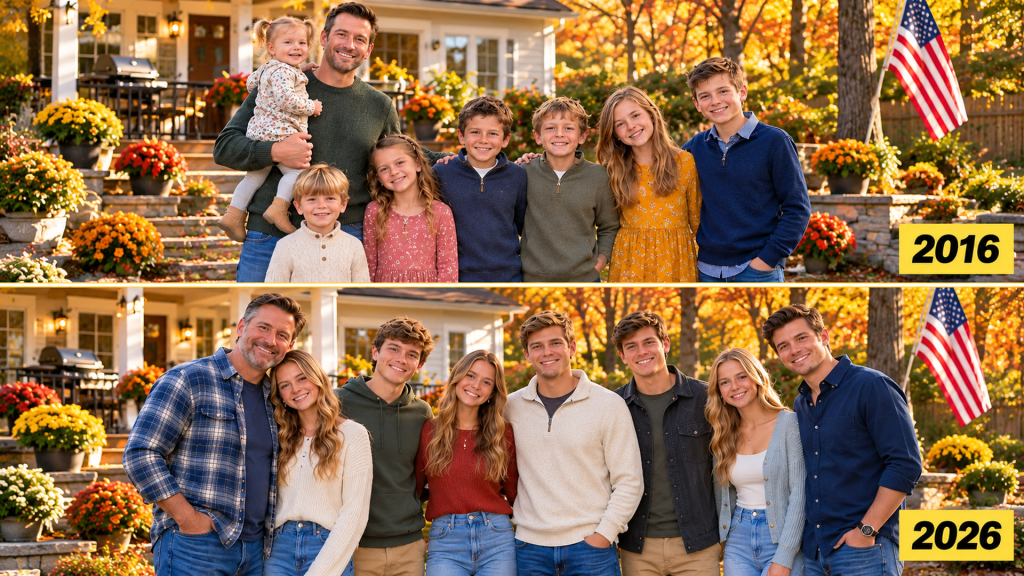
“Come on. We’re taking a family picture.”
I followed her across the lawn.
Michael set the camera on a tripod.
Grace arranged everyone.
Daniel complained about having to stand in the back.
Henry made a ridiculous face.
Lily threatened to take his phone away if he ruined the photograph.
Olivia laughed.
Sophie stood directly in front of me.
“Everybody ready?”
Michael started the timer and hurried into position.
I wrapped my arms around the children standing nearest me.
The camera flashed.
And when I saw the photograph later that evening, I noticed something that made my eyes fill with tears.
Every single one of my children was smiling.
Not the forced kind of smile people wear for photographs.
Real smiles.
The kind that come from feeling safe.
Loved.
Home.
That night, after everyone had gone to bed, I walked into the workshop behind the garage.
The yellow handprint Sophie had made years earlier was still there.
Small.
A little crooked.
Faded around the edges.
I ran my fingers over it.
I remembered the little girl who had pressed her paint-covered palm against the wood and declared it would bring us good luck.
Beside that handprint were six others.
As the business grew, the children had each added their own.
Michael’s was the largest.
Sophie’s was the smallest.
Seven handprints.
Seven reminders of why I’d kept going.
I sat on an old wooden stool and looked around.
Tools hung neatly along the walls.
Finished cabinets waited for delivery.
A photograph of our first company truck stood beside one of our newest vehicles.
And above the workbench was a small wooden sign Henry had made for me.
It read:
“Built with hard work. Held together by love.”
I stared at those words for a long time.
For years, I’d believed Vanessa had destroyed the future I was supposed to have.
But maybe there had never been only one possible future.
Maybe life had given me a different one.
A harder one.
A more exhausting one.
But also one filled with unexpected kindness, extraordinary children, and love I could count on.
I thought about Nora’s letters.
We had finally read all seven aloud together.
Each one was different.
She had written about Michael’s curiosity, Grace’s compassion, Daniel’s determination, Olivia’s kindness, Henry’s imagination, Lily’s creativity, and Sophie’s joyful spirit.
In the final letter, Nora had written something that stayed with me.
“Money can help open doors, but it cannot teach a child what matters. Give them opportunities, certainly. But above all, give them the kind of love that makes them brave enough to walk through those doors.”
I wished she’d lived long enough to see her grandchildren grow.
She would have been proud.
And I hoped that, wherever she was, she knew we were doing our best to honor her wishes.
The recovered funds and repayment arrangements would never erase the years of struggle.
They wouldn’t restore the birthdays Vanessa missed.
They wouldn’t give Michael back his teenage years.
They wouldn’t undo the nights when Sophie waited for a mother who never came.
But they could still help the children move forward.
And that mattered.
A soft knock interrupted my thoughts.
I turned.
Sophie stood in the workshop doorway wearing her pajamas.
“Dad?”
“Hey, sweetheart. Why are you still awake?”
She stepped inside.
“Couldn’t sleep.”
I held out my arms.
She came over and hugged me.
For a moment, she seemed like the little girl who used to climb onto my lap during thunderstorms.
Then she looked up.
“Can I ask you something?”
“Always.”
“Do you think Mom would have come back if we were still poor?”
I felt the question settle heavily between us.
There was no honest way to know.
“Maybe not,” I answered.
She nodded slowly.
“That’s what I thought.”
I brushed a strand of hair away from her face.
“But here’s something I want you to understand.”
“What?”
“People sometimes come back for the wrong reasons. Sometimes they learn to do better. Sometimes they don’t. You can watch what they choose to do without letting their choices decide your worth.”
She thought about that.
“Even if it’s your mom?”
“Especially then.”
She leaned against my shoulder.
“Do you think she’s changing?”
“I think she’s trying to make different choices. Time will tell whether those choices last.”
Sophie nodded.
Then she smiled.
“At least she knows when my birthday is now.”
I laughed softly.
“Yes, sweetheart.”
She looked at the seven handprints on the workshop wall.
“Remember when I made that?”
“Of course.”
“I thought it was magic.”
I glanced toward the faded yellow paint.
“Maybe it was.”
She giggled.
“Dad, you’re being silly.”
“Probably.”
Then she grew quiet.
“Can I tell you something?”
“Anything.”
She wrapped her arms around me.
“When I was little, I thought families were supposed to have a mom and a dad living together.”
I listened.
“But now I think a family is the people who keep showing up.”
My throat tightened.
“That’s a pretty good definition.”
She smiled.
“Then we have a really big family.”
I kissed her forehead.
“Yes, we do.”
We turned off the workshop lights and walked back toward the house.
Through the windows, I could see the warm glow of the kitchen.
Somebody had left a plate on the counter.
A pair of shoes sat near the stairs.
There were family photographs along the hallway and school awards hanging on the walls.
Ordinary things.
Beautiful things.
The kind of things I had once been terrified we would lose.
Before Sophie went upstairs, she turned and looked at me.
“Dad?”
“Yes?”
“Thank you for not leaving.”
I felt tears rise immediately.
I knelt so we were eye to eye.
“Sophie, I was never going to leave you.”
She hugged me tightly.
“I know.”
And in those two words, I heard something I had spent ten years trying to give my children.
Trust.
Not the kind built through promises.
The kind built through thousands of ordinary days.
Breakfasts.
School pickups.
Late-night conversations.
Doctor appointments.
Birthday cakes.
Homework.
Forgiveness.
Laughter.
And simply being there.
After Sophie went to bed, I stepped onto the front porch.
The night was cool.
The neighborhood was quiet.
I thought back to the afternoon Vanessa had packed her bags.
I remembered standing in the doorway, holding a bag of strawberries, watching her drive away.
I had believed my life was over.
I had believed nobody would ever want a man with seven children and a mountain of responsibilities.
I had believed I was a failure because I couldn’t give my wife the luxurious life she wanted.
But ten years had taught me something different.
A person’s worth isn’t determined by the car in the driveway, the size of the house, or the destination printed on an airline ticket.
It’s determined by what they do when life becomes difficult.
By whether they keep their promises.
By whether they protect the people who depend on them.
By whether they remain kind when bitterness would be easier.
Vanessa had told me she deserved a better life.
Maybe she did deserve happiness.
Everyone deserves a chance to build a meaningful life.
But happiness built by abandoning your responsibilities comes with a cost.
And sometimes the bill arrives years later, carried by a twelve-year-old girl who only wanted her mother to remember her birthday.
I didn’t know exactly what the future held for Vanessa.
I hoped she would continue taking responsibility.
I hoped she would honor the financial agreement.
I hoped she would learn to love her children through consistent actions rather than expensive presents.
But I had finally accepted something important.
Her future was not mine to build.
My responsibility was the family inside my house.
The seven children who had stood beside me when we had almost nothing.
The seven people who had helped turn a borrowed trailer and a toolbox into a business.
The seven extraordinary human beings who had made every sacrifice worthwhile.
I looked toward the upstairs windows.
One by one, the lights were going out.
My children were home.
They were safe.
They were loved.
And for the first time in a very long time, I understood that I no longer needed to prove anything to the woman who had left us.
She had once looked at our little house and seen everything she was missing.
I looked at the family we’d built and saw everything I had.
I went inside, locked the door, and turned off the porch light.
Tomorrow, there would be bills to pay, employees to manage, meals to prepare, and another hundred ordinary problems to solve.
And I would face them the same way I always had.
One day at a time.
With my children.
Because the greatest success of my life was never becoming the owner of a million-dollar business.
It was becoming the father my seven children knew they could count on.
And if I could go back to that heartbreaking afternoon ten years earlier, when I stood holding crushed flowers and wondering how I would raise seven children alone, I would tell that younger version of myself one simple thing:
“You’re going to be all right. It won’t be easy. There will be nights when you think you can’t continue. But someday, you’ll stand in a backyard surrounded by seven happy children, and you’ll realize that the life you were afraid of losing has become more beautiful than anything you ever imagined.”
Because money can be lost.
Marriages can end.
Friendships can break.
And people can walk away.
But a home built on patience, sacrifice, forgiveness, and unconditional love can survive storms that once seemed impossible to endure.
Vanessa left because she wanted a better life.
Ten years later, she returned hoping to find one.
But the best life she’d ever had was the one she’d walked away from.
And the greatest gift my daughter received on her birthday wasn’t the expensive bicycle or the brand-new tablet.
It was the certainty that, no matter what happened next, she would never have to stand beside the front door wondering whether her father was coming home.
Because I always would.
💬THE END! THANK YOU FOR READING!