
A 101-year-old man faced a possible prison sentence after being accused of stealing more than $2,000 worth of merchandise. He admitted everything without offering a single excuse. But just as the judge prepared to continue, his longtime neighbor suddenly rose from her seat.
“Your Honor, please! There’s something you need to know. Walter made me promise never to reveal it.”
The old man’s face went pale.
“Margaret, please,” he whispered. “You gave me your word.”
But she couldn’t remain silent.
Because the reason behind those mysterious thefts was far more heartbreaking than anyone in the courtroom could have imagined.
And the folded letter she was holding might change everything.
For months, employees at a local store had shown compassion toward Walter Miller.
At 101, he struggled to walk without his cane. His back was permanently bent, his hands trembled whenever he tried to hold something too small, and his eyesight had deteriorated considerably over the previous few years.
He had become familiar to almost everyone working at the neighborhood grocery and department store.
The cashiers knew him by name.
The security guards recognized his slow footsteps.
Even the young employees who had only worked there for a few weeks knew that Walter usually arrived shortly after nine in the morning, wearing the same brown coat and carrying a small canvas shopping bag.
He was always polite.
He always said thank you.
And whenever someone offered to help him reach something on a high shelf, he smiled and thanked them as though they had done him an extraordinary favor.
But something had changed.
For several months, employees had repeatedly noticed merchandise disappearing whenever Walter visited.
At first, it was small things.
A package of children’s socks.
A loaf of bread.
A few cans of soup.
Then came children’s jackets, school notebooks, cereal, cleaning supplies, and other household necessities.
Whenever employees caught him leaving without paying, Walter never argued.
He never ran.
He never blamed anyone else.
He simply stopped, lowered his head, and apologized.
“I’m sorry. I know I shouldn’t have done that.”
The employees initially believed his age might have something to do with his behavior.
One cashier even suggested that perhaps he was becoming confused.
But after reviewing the security recordings, management discovered something troubling.
Walter wasn’t confused.
He knew exactly what he was taking.
He selected particular items, checked their prices, placed them carefully inside his bag, and walked toward the exit.
The incidents continued despite repeated warnings.
Eventually, the value of the missing merchandise exceeded $2,000.
The store manager had no choice but to involve the authorities.
And now Walter stood inside a courtroom, facing the possibility of imprisonment.
His thin fingers were tightly wrapped around his wooden cane.
His brown coat looked several years old.
His shoes were polished but visibly worn.
He had refused the offer of a wheelchair when he arrived, insisting that he could stand on his own.
The judge examined the documents before him.
“Mr. Miller, I’ve reviewed the security recordings and the photographs submitted by the prosecution.”
Walter nodded.
“I understand, Your Honor.”
The judge spread several photographs across his desk.
Children’s clothing.
Canned food.
School notebooks.
Basic household supplies.
“Can you explain why you needed these particular things?”
Walter stared at the floor.
“No, Your Honor. I took them without paying. I know that was wrong.”
The judge leaned forward.
“Are you aware that these charges could result in imprisonment?”
“Yes, sir.”
“At your age, a jail sentence would be particularly serious. Surely you have something to say in your defense.”
Walter swallowed.
“I’m 101 years old, Your Honor. I’ve lived long enough to know that breaking the law has consequences. I’ll accept whatever punishment you decide.”
The judge studied him.
“You’re not going to explain your actions?”
“No, sir.”
“Not even one reason why you continued returning to that store?”
Walter’s voice trembled.
“I have no excuse.”
A heavy silence settled over the courtroom.
Then, just as the judge was about to speak again, a woman abruptly stood near the back.
“Your Honor, wait! Please don’t make your decision yet!”
Every head turned toward her.
“Ma’am,” the judge said firmly, “you must remain seated unless you’re given permission to address the court.”
But the woman remained standing.
“Please, sir. I’ve lived next door to Walter for thirty years. I know why he was taking those things.”
Walter turned sharply.
“Margaret, don’t.”
His voice sounded almost frightened.
She looked at him with tears gathering in her eyes.
“I’m sorry, Walter.”
“You promised me,” he whispered.
“I know I did.”
She took a shaky breath.
“But I can’t watch you face prison when nobody here understands what really happened.”
The judge raised his hand.
“Ma’am, what exactly are you trying to tell this court?”
Margaret reached into her handbag.
For a moment, she searched among her belongings.
Then she removed a carefully folded sheet of paper.
“Walter has been keeping a secret for months,” she explained. “He made me swear I wouldn’t tell anyone, especially the people involved.”
Walter closed his eyes.
“Please, Margaret. Leave them out of this.”
Her voice broke.
“I can’t. Not anymore.”
She turned toward the judge and held up the letter.
“Your Honor, before you decide what happens to this man, please read this. Because those groceries, children’s clothes, and school supplies weren’t meant for Walter.”
The judge frowned.
“Then who were they for?”
Margaret looked toward the back of the courtroom, where a young woman sat quietly with a little boy sleeping against her shoulder.
Then she whispered:
“They were for someone who had once saved Walter’s life—and who had no idea what he was sacrificing to repay her kindness.”
The entire courtroom fell silent.
And as Margaret unfolded the letter, Walter lowered his head, knowing the secret he’d worked so hard to protect was finally about to be revealed.
Margaret had known Walter for thirty years.
She had moved into the small brick house next door after her husband retired. At the time, Walter was already in his seventies, although he still worked part-time repairing vehicles at a local garage.
Their friendship had developed slowly.
At first, they exchanged nothing more than polite greetings.
Then Walter helped Margaret carry a heavy cabinet into her house.
A few months later, Margaret brought him a homemade apple pie after discovering that his wife, Helen, had been hospitalized.
Eventually, their front porches became places where they shared coffee, discussed neighborhood news, and complained about the weather.
When Helen passed away twelve years earlier, Margaret was among the first people to arrive at Walter’s house.
She found him sitting alone at the kitchen table, staring at two cups of coffee.
He had made one out of habit.
Helen would never drink it again.
Margaret sat beside him without asking questions.
She understood that sometimes people didn’t need advice.
They simply needed someone willing to sit with them.
Walter had one daughter, but she had moved to another state many years earlier. Their relationship had become distant after years of disagreements and misunderstandings.
He rarely spoke about her.
He didn’t complain.
He simply said that people grew older and their lives went in different directions.
Margaret never pressed him.
As the years passed, Walter became increasingly frail.
He stopped driving after a minor accident.
He sold his old workshop equipment.
He began relying on his pension and a modest amount of savings.
He never asked Margaret for financial help.
If she offered to bring groceries, he usually insisted that he had enough.
If she suggested hiring someone to repair his roof, he claimed he could manage it himself.
He had spent most of his life being independent.
Accepting help was something he found almost impossible.
Margaret knew that about him.
What she didn’t know was that his remaining years were about to take an unexpected turn.
Eight months before the courtroom hearing, Walter had been walking home from the pharmacy.
It was a cold afternoon.
The sky was gray, and a light rain had begun falling.
He had just collected his medication when he suddenly felt a sharp pressure in his chest.
He stopped beside a parking meter.
His vision blurred.
His knees weakened.
He tried to reach for his cane, but it slipped from his hand.
Then he collapsed onto the pavement.
Several people walked past.
One person glanced toward him but continued moving.
Another assumed he was simply an elderly man who had fallen and would eventually get back up.
But a young mother pushing a stroller stopped immediately.
Her name was Emily Carter.
She was thirty-four years old and had been widowed for nearly two years.
Her husband, Daniel, had died unexpectedly after a workplace accident.
Since his death, Emily had been raising their six-year-old son, Oliver, alone.
She worked at a small medical billing office during the day and sometimes cleaned offices in the evening to supplement her income.
That afternoon, she was returning home with Oliver after collecting a prescription of her own.
She noticed the elderly man lying on the pavement.
“Oliver, stay beside the stroller.”
She hurried toward him.
“Sir? Can you hear me?”
Walter didn’t respond.
Emily immediately called emergency services.
When she realized he wasn’t breathing normally, she followed the emergency operator’s instructions and began performing CPR.
Her hands trembled.
She was frightened.
But she continued.
“Please, sir. Stay with me.”
Oliver stood nearby, crying.
“Mommy, is he going to die?”
Emily couldn’t answer.
She concentrated on following the instructions until emergency responders arrived.
The paramedics took over and rushed Walter to the hospital.
Emily could easily have left once they arrived.
She had already done more than most strangers would have expected.
But something made her stay.
She waited until one of the paramedics asked whether anyone knew the man’s identity.
Emily searched his coat pocket and found a small identification card.
His name was Walter Miller.
She gave the information to the paramedics and waited another few minutes.
Then she finally took Oliver home.
She never expected to hear about the incident again.
Two days later, however, a hospital social worker called.
Walter had regained consciousness.
He had suffered a serious cardiac event, but the doctors believed the rapid response had significantly improved his chances of survival.
He remembered very little about the incident.
But he remembered hearing a woman’s voice.
He remembered someone telling him to keep breathing.
And he remembered the frightened voice of a little boy.
When he was strong enough to speak, he asked whether anyone knew who had helped him.
The hospital had Emily’s name and contact information because she had provided it to the emergency responders.
Walter asked Margaret to help him send a thank-you card.
Margaret accompanied him when he was discharged.
They visited Emily’s apartment, but she wasn’t home.
Walter left a card inside her mailbox.
It read:
Dear Emily,
I understand that you stopped to help me when I was in trouble. I don’t remember everything, but I remember your voice. My doctors tell me I might not have survived without your quick actions.
Thank you for giving an old man another chance to see tomorrow.
With sincere gratitude,
Walter Miller.
Emily found the card that evening.
She smiled when she read it.
She showed it to Oliver.
“Remember the old man Mommy helped?”
Oliver nodded.
“Is he better?”
“He is, sweetheart.”
“That’s good.”
Emily placed the card on the refrigerator.
She never imagined that the little thank-you note would eventually become the beginning of a friendship that changed both their lives.
A few weeks after returning home, Walter began noticing Emily’s circumstances.
He didn’t deliberately watch her.
He simply lived next door and occasionally saw her coming and going.
He noticed that she often left before sunrise.
He noticed Oliver waiting beside the apartment entrance with his small backpack.
He noticed how carefully Emily managed every shopping bag she carried.
One morning, he saw her trying to repair the zipper on Oliver’s winter jacket.
The zipper had broken near the bottom.
Emily sat on the front steps, working with a small pair of pliers.
Oliver stood beside her.
“Mommy, is my jacket broken?”
“Just a little, sweetheart.”
“Can I get another one?”
Emily smiled.
“Maybe after payday.”
Walter heard the conversation from his porch.
He looked down at his own thick winter coat.
Then he looked at the little boy.
Something about that moment stayed with him.
A few days later, he saw Emily returning from the grocery store.
She was carrying two bags, but one was almost empty.
Oliver was holding a small packet of crackers.
“Mommy, can we get the cereal with the chocolate pieces next time?”
“Perhaps, sweetheart.”
“Is it expensive?”
Emily laughed gently.
“A little.”
Walter noticed how carefully she avoided answering the question.
That evening, he spoke with Margaret.
“Do you know much about the young woman living three houses down?”
“Emily?”
“Yes.”
“She works hard. Her husband passed away a while ago. She’s raising that little boy alone.”
Walter nodded.
“Does she have family nearby?”
“Not that I know of.”
He looked toward the window.
“She’s a good woman.”
Margaret smiled.
“She certainly is.”
Walter didn’t say anything more.
But the next morning, he made a decision.
He took a small portion of his pension money and walked to the grocery store.
He bought milk, bread, eggs, canned vegetables, cereal, and a few snacks for children.
He also purchased a package of warm socks.
Then he returned home.
He placed everything inside two paper bags.
At approximately seven in the evening, he walked slowly toward Emily’s apartment.
He waited until the hallway was quiet.
Then he placed the bags outside her door and returned home.
The following morning, Emily opened her door and discovered them.
She looked around.
There was no note.
No name.
No explanation.
She checked with the building manager.
He knew nothing about it.
She asked two neighbors.
Neither had seen anyone.
Emily initially felt uncomfortable accepting something from an unknown person.
But when she opened the bags and saw the groceries, she realized how useful they would be.
She placed the milk in the refrigerator.
She prepared breakfast for Oliver.
And for the first time in several weeks, she didn’t have to worry about whether there would be enough food for the next morning.
That evening, she mentioned the mysterious gift to Margaret.
“Someone left groceries outside my door.”
Margaret looked surprised.
“Really?”
“Yes. I don’t know who.”
“That’s kind.”
“I know. I just wish I could thank them.”
Margaret smiled.
“Perhaps they don’t want anything in return.”
Emily nodded.
She had no idea that the person responsible was sitting quietly on his porch, listening to the conversation through an open window.
Walter smiled to himself.
He had succeeded.
He had helped without embarrassing her.
And that was all he wanted.
For several months, he continued helping.
Sometimes he purchased groceries.
Sometimes he bought school supplies.
Once, he found a small winter jacket on sale and left it outside Emily’s apartment.
Another time, he noticed Oliver’s shoes had become too small.
He purchased a larger pair.
He never included a note.
He never signed his name.
He wanted Emily to believe the assistance came from somewhere else.
But Walter’s financial circumstances were becoming increasingly difficult.
His pension was modest.
His medication costs had risen.
His house needed repairs.
The roof leaked whenever it rained heavily.
His heating system was old and unreliable.
He had savings, but they were slowly disappearing.
Margaret began noticing changes.
Walter stopped buying fresh fruit.
He reduced the amount of meat he purchased.
He sometimes ate canned soup for several days in a row.
One afternoon, Margaret entered his kitchen and discovered that his refrigerator was almost empty.
“Walter, when did you last go shopping?”
“Yesterday.”
She looked inside.
“There is barely anything here.”
“I don’t eat much.”
“You need proper meals.”
He shrugged.
“Food costs money.”
Margaret frowned.
“Are you having financial problems?”
“No.”
“Walter.”
He looked at her.
“I’m managing.”
Margaret didn’t believe him.
She offered to help, but he refused.
He insisted that he had enough money and that he didn’t want anyone worrying about him.
What Margaret didn’t know was that Walter had already spent most of his available savings helping Emily and Oliver.
He had convinced himself that he could manage with less.
After all, he was 101.
He didn’t need much.
But Emily’s situation seemed more urgent to him.
She had a young child.
She had years of expenses ahead of her.
She had lost her husband and was trying to rebuild her life.
Walter believed he was simply doing what anyone with a little extra should do.
Then one afternoon, he went to the grocery store and discovered that he no longer had enough money for the items he intended to purchase.
He stood in front of the shelves for several minutes.
He looked at the cereal.
He thought about Oliver.
He looked at the children’s socks.
He thought about the broken zipper on the little boy’s old jacket.
He looked at the cans of soup.
He remembered Emily telling Oliver that she had already eaten.
He knew he should walk away.
Instead, he placed a few items inside his bag.
He didn’t feel proud.
He didn’t feel clever.
He felt ashamed.
But he convinced himself that he would find a way to make things right.
The first time an employee stopped him, Walter apologized immediately.
The employee allowed him to leave after recovering the merchandise and issuing a warning.
Walter went home feeling sick.
He promised himself he would never do it again.
But a week later, he returned.
Then another incident occurred.
And another.
Each time, he took something he believed Emily or Oliver needed.
He never took anything expensive for himself.
He never sold the merchandise.
He never kept it.
He carried the bags home, separated the items, and delivered them to Emily’s apartment.
The more frequently he did this, the more difficult it became for the store to ignore.
Eventually, management contacted the police.
Walter was devastated.
When officers visited his home, he didn’t resist.
He showed them the items he had taken.
He answered their questions.
He admitted everything.
But when they asked why, he simply said he had no excuse.
He refused to identify Emily.
He refused to explain that he had been helping a struggling family.
He was willing to face the consequences.
What frightened him most wasn’t the possibility of imprisonment.
It was the possibility that Emily would discover what he had done.
He imagined her feeling guilty.
He imagined her believing that she had somehow caused his problems.
He imagined Oliver asking why the old man who read stories to him was being taken away.
Walter couldn’t bear those thoughts.
So he remained silent.
When Margaret discovered the truth, she was furious.
Not because Walter had helped Emily.
But because he had put himself in danger without telling anyone.
“Walter, why didn’t you come to me?”
He looked embarrassed.
“Because you have your own problems.”
“I’m your neighbor.”
“I know.”
“Your friend.”
“I know that too.”
“Then why are you acting as though asking for help is some terrible crime?”
Walter stared at his hands.
“I don’t want to become someone everyone has to take care of.”
Margaret sat beside him.
“You have spent thirty years helping people. Let someone help you for once.”
He shook his head.
“It’s different.”
“How?”
He didn’t answer.
Margaret finally understood that Walter’s pride wasn’t about money.
It was about identity.
For most of his life, he had been the person others depended on.
He had repaired cars.
He had raised children.
He had taken care of Helen during her illness.
He had worked through difficult winters and long summers.
He had never imagined that he would become someone who needed assistance.
Now he was frightened that asking for help would erase everything he believed about himself.
Margaret wanted to tell Emily.
Walter begged her not to.
“Please, Margaret. She doesn’t need another problem.”
“But she needs to know what happened.”
“She’ll feel responsible.”
“She isn’t responsible.”
“I know that. But she won’t understand.”
Margaret looked at him.
“What do you want me to do if they send you to prison?”
Walter was quiet.
“Nothing.”
“Walter!”
“I’ve lived 101 years. I’ve had a good life. Don’t make that young woman feel guilty because of me.”
Margaret finally promised she wouldn’t reveal the secret unless absolutely necessary.
She hoped the case would be handled quietly.
She hoped the court would consider his age.
But when she learned that imprisonment was a possibility, she realized she couldn’t keep her promise.
That was why she stood up in court.
That was why she unfolded the letter.
And that was why Emily was now sitting at the front of the courtroom, crying as she learned the truth.
When Margaret finished reading, the judge remained silent for several seconds.
Then he looked toward Walter.
“Mr. Miller, is everything in that letter accurate?”
Walter nodded.
“Yes, Your Honor.”
“You took those items and delivered them to Miss Carter?”
“Yes.”
“Why didn’t you simply ask her whether she needed assistance?”
Walter looked at Emily.
“I didn’t want her to feel embarrassed.”
The judge removed his glasses.
“Did you consider that she might have wanted the opportunity to help you too?”
Walter’s lips trembled.
“No, sir. I suppose I didn’t.”
Emily stood.
“Your Honor, may I speak?”
The judge nodded.
Emily approached the front.
“I want to say something.”
She looked at Walter.
“When my husband died, I thought I would never feel normal again. Daniel was the person who helped me with everything. He repaired things around the apartment. He took Oliver to school. He made sure the bills were paid. He was my best friend.”
Her voice broke.
“After he died, I suddenly had to do everything alone.”
She explained how her husband’s death had affected their finances.
The insurance payment had been delayed.
The funeral had cost more than expected.
The apartment rent continued increasing.
She had reduced her working hours temporarily because Oliver needed additional care.
Eventually, she began taking extra shifts.
There were nights when she slept only four hours.
There were mornings when she skipped breakfast because she wanted Oliver to have enough food.
“I never wanted anyone to feel sorry for me,” she said. “I just wanted to keep my son safe and give him a normal childhood.”
She looked at the judge.
“I didn’t know Walter was leaving those things outside my door. I thought someone from a charity was helping us. If I had known it was him, I would have told him to stop spending his money.”
She turned toward Walter.
“Because he needed help too.”
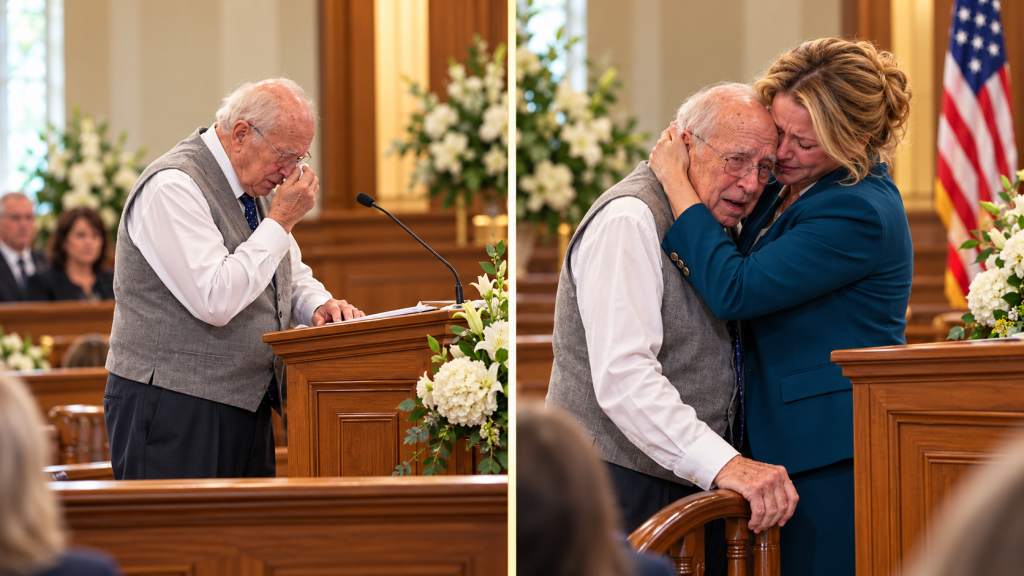
Walter began crying.
Emily continued.
“Your Honor, I understand that stealing is wrong. I understand that the store has a right to protect its business. But I want the court to know that I never asked Walter to do any of this.”
She looked toward the prosecutor.
“I never encouraged him. I never knew what he was doing. I didn’t even know he was the man who saved me from having to explain to my little boy why we couldn’t afford groceries that week.”
The prosecutor remained silent.
Emily returned to her seat.
The judge asked the store manager, Thomas Alvarez, to approach.
Thomas had been listening carefully.
He had initially attended the hearing expecting to request restitution and explain the store’s financial losses.
But now he understood something he hadn’t considered before.
Walter had been caught repeatedly taking merchandise.
The store had lost money.
Employees had spent time dealing with the incidents.
And yet the items had been going directly to a family that needed assistance.
Thomas looked at Walter.
“Mr. Miller, I remember you.”
Walter nodded.
“I remember you too.”
“You used to come in every Thursday morning.”
“Yes, sir.”
“Your wife came with you sometimes.”
Walter smiled faintly.
“She liked your bakery department.”
Thomas smiled sadly.
“I remember.”
Then his expression became serious.
“I wish you had spoken to us. We have a community assistance program. We provide groceries to families who are experiencing financial hardship.”
Walter looked surprised.
“I didn’t know.”
“We don’t advertise it very well. That’s something we need to improve.”
Thomas turned toward the judge.
“Your Honor, I don’t want to minimize what happened. Our employees deserve protection, and the store has suffered a financial loss. But I would be willing to discuss a reasonable repayment arrangement.”
The judge nodded.
“Thank you, Mr. Alvarez.”
Then he turned toward Walter.
“Mr. Miller, I want to ask you something.”
Walter stood as straight as he could.
“Yes, Your Honor.”
“If you were given another opportunity to handle this situation, what would you do?”
Walter thought carefully.
“I would ask for help.”
“Would you ask even if you felt embarrassed?”
“Yes, sir.”
“Would you accept help if someone offered it?”
Walter looked toward Emily.
“I believe I would.”
The judge nodded.
“Good. Because that may be the most important lesson you take from this experience.”
He reviewed the case documents again.
He considered Walter’s age, his health, his lack of previous convictions, his admission of responsibility, the nature of the stolen merchandise, and the circumstances explained by Margaret and Emily.
He also considered the store’s legitimate interests.
Finally, he addressed the courtroom.
“I am not going to pretend that good intentions make theft acceptable. Mr. Miller knew what he was doing. He admitted that himself. The store deserves restitution, and its employees deserve to work without worrying about repeated theft.”
He paused.
“However, this court also has a responsibility to consider the complete circumstances. I see an elderly man who made a series of serious mistakes while attempting to help someone who once saved his life.”
Walter lowered his head.
“I am ordering a formal assessment and a supervised restitution arrangement. I am also directing that the court consider an appropriate community-based alternative to imprisonment, taking into account Mr. Miller’s age, health, and circumstances.”
Walter looked up.
“Thank you, Your Honor.”
The judge raised one hand.
“Do not thank me yet. You still have responsibilities. You must follow every condition imposed by the court. You must repay the store according to the agreed arrangement. And you must understand that you cannot help someone by creating another problem.”
Walter nodded.
“I understand.”
The judge looked toward Emily.
“Miss Carter, you are not responsible for the defendant’s actions. You did something kind when you stopped to help him. You should never feel guilty about that.”
Emily wiped her eyes.
Then the judge turned back to Walter.
“Mr. Miller, you have lived 101 years. I suspect you have learned many things during that time. But I want you to remember this one: accepting help is not a failure.”
Walter’s eyes filled.
“Yes, Your Honor.”
The hearing ended shortly afterward.
But outside the courtroom, something unexpected happened.
Emily approached Walter while Margaret helped him put on his coat.
“Walter?”
He turned.
“Yes?”
“Would you like to come over for dinner?”
Walter looked confused.
“Dinner?”
“Yes. Oliver has been asking about you.”
“I don’t want you spending money on me.”
Emily smiled.
“I’m inviting you to dinner, not asking you to pay rent.”
Walter laughed quietly.
“I suppose I could come.”
Oliver, who had been sitting beside Margaret, suddenly ran toward him.
“Walter!”
The old man smiled.
“Hello, young man.”
“Are you coming to our house?”
“If your mother allows it.”
Oliver looked at Emily.
“Please?”
Emily laughed.
“Of course.”
Oliver grabbed Walter’s hand.
“Can you read my dinosaur book?”
Walter nodded.
“I think I can manage that.”
For the first time that day, Walter smiled without looking frightened.
And Margaret realized that the truth had finally brought something good out of a terrible situation.
The following week, Walter began making his restitution payments.
He calculated his monthly expenses carefully.
He wanted to make sure he could afford his medication, utilities, and groceries while still repaying the store.
His initial proposal was forty dollars a month.
Thomas accepted the arrangement after the court approved the appropriate terms.
Walter insisted on making every payment himself.
He wanted to take responsibility.
He didn’t want anyone paying his debt for him.
But he also began accepting help in other areas.
Margaret helped him arrange transportation to medical appointments.
Emily started checking on him every evening.
Thomas arranged for the store’s community assistance program to contact Emily and explain what support was available.
Emily was initially reluctant.
She didn’t want people thinking she was taking advantage of Walter’s situation.
But Thomas explained that the program existed precisely for families like hers.
Eventually, she accepted.
She received help with groceries and school supplies.
It wasn’t enough to solve every problem, but it made a meaningful difference.
She was able to reduce her evening cleaning shifts.
She spent more time with Oliver.
She started sleeping properly again.
And something else happened.
Walter and Oliver became inseparable.
Every Wednesday afternoon, Oliver visited him after school.
Sometimes they read books.
Sometimes they watched old nature documentaries.
Sometimes Walter showed him photographs from his younger days.
Walter had worked as a mechanic for almost fifty years.
He had repaired thousands of vehicles.
He had worked on engines before modern computers became standard equipment.
He had seen cars change from simple machines into complicated electronic systems.
Oliver loved hearing about it.
“Walter, did cars have computers when you were young?”
Walter laughed.
“Not the way they do today.”
“Then how did you fix them?”
“With my hands, a toolbox, and a little patience.”
Oliver considered that.
“Can you fix my bicycle?”
Walter smiled.
“I can certainly try.”
The following Saturday, Oliver arrived with his bicycle.
The chain had slipped off.
Walter sat on a small stool in the garage and examined it.
His fingers trembled, making the repair difficult.
Emily offered to help.
But Walter shook his head.
“Let me try first.”
After several minutes, he managed to put the chain back into place.
Oliver clapped.
“You fixed it!”
Walter smiled proudly.
“Not bad for an old mechanic.”
Emily stood nearby, watching them.
She had spent months believing that she needed to protect her son from the difficulties of life.
But Walter was teaching Oliver something she couldn’t teach him alone.
Patience.
Responsibility.
Gratitude.
And the importance of looking beyond appearances.
One evening, Oliver asked Walter a question that surprised him.
“Walter, why were you stealing?”
Emily immediately looked uncomfortable.
“Oliver, that’s not something we need to ask right now.”
But Walter gently raised his hand.
“It’s all right.”
He looked at the little boy.
“I made a mistake.”
“Why?”
“Because I wanted to help someone, but I chose the wrong way.”
Oliver frowned.
“Couldn’t you just ask?”
Walter smiled sadly.
“I should have.”
“Like when I can’t reach something?”
“Exactly.”
Oliver thought about it.
“Next time, ask Mommy.”
Walter laughed.
“I’ll remember that.”
The months passed.
Walter continued attending his appointments.
His health remained fragile, but he was stable.
He completed every requirement imposed by the court.
He made every scheduled restitution payment.
And he never returned to the store without paying.
In fact, he developed a new habit.
Whenever he entered, he greeted the employees.
He thanked them for their patience.
And he sometimes brought small homemade cookies for the staff, after checking that the store’s management was comfortable with it.
One day, Rosa, the cashier who had first caught him, approached him.
“Mr. Miller?”
Walter turned.
“Yes?”
“I wanted to say something.”
He looked concerned.
“Have I done something wrong?”
Rosa laughed.
“No. I just wanted to tell you that I’m glad things worked out.”
Walter looked down.
“I caused a lot of trouble.”
“You did.”
He nodded.
“I know.”
“But you also took responsibility. That matters.”
Walter smiled.
“Thank you.”
Rosa continued.
“And if you ever need help, please ask someone.”
Walter looked at her.
“I will.”
Then she added something he never forgot.
“You don’t have to wait until things become desperate before you deserve kindness.”
Walter stood silently for a moment.
He had heard similar words from Emily.
From Margaret.
From the judge.
But hearing them from the employee who had caught him stealing made them feel different.
He nodded.
“I’ll remember that.”
Several weeks later, Margaret celebrated her seventy-ninth birthday.
She invited Walter, Emily, Oliver, and a few other neighbors to her backyard.
Walter arrived carrying a small wrapped gift.
Margaret looked at him suspiciously.
“What have you brought?”
“Nothing expensive.”
“Walter.”
He smiled.
“Open it.”
Inside was a framed photograph of Margaret and Walter taken nearly thirty years earlier.
They were standing beside their houses, much younger, smiling at the camera.
Margaret stared at it.
“Oh, Walter.”
“I found it in an old box.”
She looked at the photograph again.
“I remember that day.”
“So do I.”
Margaret hugged him.
“Thank you.”
Oliver ran toward them.
“Can I have cake now?”
Margaret laughed.
“That’s what you’ve been waiting for, isn’t it?”
“Yes!”
Everyone laughed.
For a while, the afternoon was filled with ordinary happiness.
People talked.
Children played.
Someone burned a few sausages on the barbecue.
Walter sat beneath a tree with a cup of lemonade.
Emily brought him a plate of food.
He thanked her.
Then he looked around the garden.
For years, he had believed that growing old meant slowly becoming invisible.
People stopped asking his opinion.
They stopped expecting him to participate.
They assumed he was too frail to contribute anything meaningful.
He had gradually accepted the idea that his most important years were behind him.
But now he was surrounded by people who wanted him there.
He wasn’t simply being tolerated.
He was included.
And that meant more than he could explain.
Later that evening, Emily walked him home.
The sky was turning orange.
Walter moved slowly, leaning heavily on his cane.
“Emily?”
“Yes?”
“Can I tell you something?”
“Of course.”
“I used to think that when you reached my age, there wasn’t much left to look forward to.”
Emily smiled.
“And now?”
He looked toward her apartment.
“Now I look forward to Wednesdays.”
She laughed softly.
“Oliver looks forward to them too.”
Walter stopped beside his front gate.
“I want to thank you.”
“For what?”
“For allowing an old man to become part of your family.”
Emily’s eyes filled.
“You don’t have to thank us for that.”
“I do.”
She hugged him.
“Good night, Walter.”
“Good night.”
A few days later, something happened that brought the entire neighborhood together.
A severe winter storm was approaching.
The weather service warned residents to prepare for heavy snowfall and possible power outages.
Emily had been working when she received a call from the school.
Oliver’s classes would be dismissed early.
She immediately left work.
But the roads were already becoming dangerous.
By the time she reached her apartment building, the snow was falling heavily.
She brought Oliver inside, made him something warm to eat, and checked on Margaret.
Then she remembered Walter.
His house was older.
His heating system had been unreliable for years.
She called him.
“Walter, are you all right?”
“I’m fine.”
“Is the heat working?”
“More or less.”
Emily frowned.
“What does more or less mean?”
“It makes some noises.”
“Walter.”
He laughed.
“Don’t worry.”
Emily told him she would come over with extra blankets.
When she arrived, she discovered that his heating system had stopped working completely.
The house was becoming cold.
Walter was sitting in the living room wearing two sweaters.
“Why didn’t you tell me?”
“I didn’t want to bother you.”
Emily shook her head.
“You’re not bothering me.”
She called Margaret.
Within twenty minutes, Margaret arrived with additional blankets.
Thomas, the store manager, heard about the problem through a neighbor and contacted a local repair company.
A technician came out despite the difficult weather.
The repair took several hours.
Meanwhile, Emily prepared soup at Walter’s house.
Oliver sat beside him, telling him about the snow.
“Walter, tomorrow we’ll make a snowman.”
Walter smiled.
“If my legs cooperate.”
“I’ll help you.”
Margaret laughed.
“Perhaps we’ll build a small one.”
Walter looked around his living room.
People were moving through his house, bringing blankets, checking the windows, preparing food, and making sure he was comfortable.
For the first time, he didn’t feel embarrassed.
He simply felt grateful.
When the heating system finally began working, everyone applauded.
The technician laughed.
“It’s not pretty, but it’ll keep you warm.”
Walter shook his hand.
“That’s all I ask.”
The next morning, Oliver knocked on Walter’s door.
He was wearing a bright red winter coat.
“Walter! Snowman!”
Walter looked outside.
The entire neighborhood was covered in white.
He put on his coat, wrapped a scarf around his neck, and slowly followed Oliver into the yard.
Emily and Margaret helped them build a small snowman.
Walter couldn’t stay outside for long.
But before returning indoors, he placed a small stone where the snowman’s heart should have been.
Oliver looked confused.
“Why did you put that there?”
Walter smiled.
“Every snowman needs a heart.”
Oliver laughed.
“Snowmen don’t have hearts!”
Walter looked at him.
“Maybe not. But people do.”
That evening, Walter sat beside his fireplace.
He thought about the courtroom again.
He remembered the judge asking him whether he understood the consequences of his actions.
He remembered Margaret breaking her promise.
He remembered Emily crying.
And he remembered the feeling of shame that had followed him for months.
He had made mistakes.
Serious mistakes.
He had caused financial losses.
He had frightened employees.
He had allowed pride to make him believe that stealing was preferable to asking for assistance.
He would never defend those decisions.
But he also understood something now.
He had been wrong about what it meant to be independent.
Independence didn’t mean refusing every helping hand.
It didn’t mean pretending to be fine when you weren’t.
And it certainly didn’t mean sacrificing your own safety to protect someone else from embarrassment.
Real strength sometimes meant admitting that you needed help.
The following spring, Walter received a letter from the court confirming that he had successfully completed the required supervision period.
His restitution arrangement was nearly finished.
He had complied with every condition.
He had not committed another offense.
When he read the letter, he placed it on the kitchen table and sat quietly.
Then he called Margaret.
“It’s finished.”
“What is?”
“The court requirements.”
Margaret gasped.
“Walter! That’s wonderful.”
He smiled.
“I wanted to tell you first.”
She immediately came over.
They sat together in the kitchen.
Margaret brought coffee.
Walter brought out two small pieces of cake.
They celebrated quietly.
Then Walter looked at her.
“Margaret?”
“Yes?”
“I’m still glad you stood up in court.”
She smiled.
“Even though I broke my promise?”
He nodded.
“Especially because you broke your promise.”
Margaret laughed through her tears.
“I was so frightened you would never forgive me.”
Walter reached across the table.
“You were trying to save me from myself.”
She squeezed his hand.
“And you were trying to save everyone else.”
He smiled.
“Perhaps we both needed to learn something.”
A few months later, the neighborhood organized a small gathering at the community center.
The purpose was to raise awareness about food insecurity among elderly residents and struggling families.
Thomas spoke about the store’s assistance program.
Margaret spoke about the importance of checking on neighbors.
Emily spoke about the difficulties of raising a child alone after losing a spouse.
Then someone asked Walter whether he would like to say a few words.
He initially refused.
But Oliver tugged at his sleeve.
“Walter, you should talk.”
Walter smiled.
“All right.”
He slowly approached the microphone.
He looked at the audience.
There were familiar faces.
Neighbors.
Store employees.
Teachers.
Volunteers.
People who had once known him only as the elderly man accused of stealing merchandise.
He took a breath.
“My name is Walter Miller. I’m 101 years old.”
A few people smiled.
“I’ve lived through a lot. I’ve seen wars, economic difficulties, changes in technology, and more automobiles than I could ever count.”
The audience laughed softly.
“But I want to tell you about something I learned recently.”
He paused.
“When I was younger, I believed that a good person should be able to take care of himself. I thought asking for help meant admitting that I had failed.”
He looked toward Emily.
“Then I met someone who saved my life. I wanted to thank her, so I tried to help her family. But I made a terrible mistake. I allowed my pride to convince me that breaking the law was better than asking for help.”
The room became quiet.
“I was wrong.”
He paused again.
“I want everyone to understand something. Good intentions do not make bad decisions right. If you take something that belongs to someone else, you must take responsibility. But I also hope we can learn to look at people with compassion.”
He looked around the room.
“Sometimes, someone who seems perfectly fine is struggling. Sometimes, an elderly person who insists they don’t need anything is frightened of becoming a burden. Sometimes, a young mother smiling at her child has been crying all night because she doesn’t know how she will pay the rent.”
Emily wiped her eyes.
Walter continued.
“And sometimes, the person who needs help is the one who spends all their time trying to help everyone else.”
He looked toward Oliver.
“I am 101 years old. I thought I had already learned everything important. Apparently, I still had a few lessons left.”
The audience applauded.
Walter smiled.
“Thank you.”
Afterward, a young boy approached him.
“Mr. Miller?”
Walter turned.
“Yes?”
“What’s the most important thing you’ve learned?”
Walter thought about it.
Then he crouched slightly, as much as his back allowed.
“That people should never have to prove they deserve kindness.”
The boy nodded.
Walter continued.
“But remember something else. Being kind means doing the right thing, even when the wrong thing seems easier.”
The boy smiled.
“Okay.”
Then he ran back toward his mother.
Walter watched him go.
Emily approached.
“You did beautifully.”
He smiled.
“I was nervous.”
“You didn’t look nervous.”
“That’s because I was trying not to fall over.”
She laughed.
Later that evening, Emily invited Walter to dinner again.
This time, he didn’t hesitate.
He arrived carrying a small box.
Inside were two children’s books.
One was about dinosaurs.
The other was about the stars.
Oliver was delighted.
“Can we read both?”
Walter laughed.
“Perhaps one tonight and one tomorrow.”
Emily prepared dinner.
Margaret joined them.
The table was crowded with plates, glasses, and serving dishes.
Oliver talked almost continuously.
He told everyone about school.
He explained that he wanted to become a mechanic when he grew up.
Walter looked delighted.
“That’s an excellent profession.”
“Will you teach me?”
“I’ll teach you everything I can.”
After dinner, Oliver brought out a drawing.
He had made it at school.
It showed four people standing beneath a bright yellow sun.
One was a woman with long hair.
One was a little boy.
One was an elderly man holding a cane.
And one was a woman with short gray hair.
Above them, in uneven handwriting, were the words:
MY FAMILY AND FRIENDS.
Walter stared at it.
“Is that me?”
Oliver pointed.
“That’s you.”
“And that’s your mother?”
“Yes.”
“Who’s this?”
“Margaret.”
Walter smiled.
“And who’s that?”
Oliver pointed toward the little figure in the middle.
“Me.”
Walter looked at the drawing for a long time.
Then he carefully folded it.
“May I keep this?”
Oliver nodded.
“Of course.”
Walter placed it inside his coat.
He didn’t want it damaged.
The next morning, he bought a small frame.
He placed the drawing beside a photograph of Helen.
Then he sat in his chair and looked at both pictures.
He remembered his wife.
He remembered their younger years.
He remembered the children they had raised.
He remembered the difficult months after her death.
And he remembered the loneliness that had slowly become part of his daily life.
He thought about how close he had come to spending his final years in a place where he would have been separated from the people who had become important to him.
Then he looked at Oliver’s drawing.
A small smile appeared on his face.
Perhaps his life wasn’t finished after all.
Perhaps there were still things worth looking forward to.
A few weeks later, Emily knocked on his door carrying a homemade banana bread.
Walter opened it.
“Good morning.”
“Good morning. I made something for you.”
He smiled.
“You didn’t have to.”
“I know.”
She handed him the bread.
He accepted it.
Then she noticed a small envelope on his table.
“What’s that?”
Walter looked toward it.
“A letter.”
“From whom?”
“From my daughter.”
Emily was surprised.
Walter had rarely spoken about his daughter.
He explained that Margaret had helped him contact her after the court hearing.
His daughter, Susan, had learned about the case through a relative.
At first, she had been upset.
She couldn’t understand why her father hadn’t told her he was struggling.
But after hearing the full story, she had agreed to visit.
The letter was the first step toward rebuilding their relationship.
Emily smiled.
“Are you happy?”
Walter nodded.
“Very.”
“That’s wonderful.”
He looked at the letter again.
“I spent too many years thinking I had to handle everything myself.”
Emily sat beside him.
“It’s never too late to change that.”
He nodded.
Then he looked at her.
“Thank you for teaching me.”
Emily shook her head.
“You taught me too.”
They sat quietly for a while.
Outside, Oliver was playing with his bicycle.
Margaret was watering her flowers.
The neighborhood was beginning another ordinary day.
And Walter, who had once believed that he had nothing left to offer, was surrounded by people who cared about him.
A few months later, Susan visited.
She was in her late sixties and had not seen her father in several years.
Their reunion was emotional.
She hugged him tightly.
“Dad, why didn’t you tell me you were having trouble?”
Walter looked down.
“I didn’t want to worry you.”
Susan began crying.
“You’re my father. I’m supposed to worry about you.”
Walter took her hand.
“I know.”
She looked around the house.
She noticed the framed drawing on the mantelpiece.
“Who’s this?”
“Oliver.”
“Who’s Oliver?”
Walter smiled.
“That’s a long story.”
He told her everything.
The young mother.
The heart attack.
The groceries.
The courtroom.
Margaret’s letter.
The judge.
The store manager.
And the little boy who now considered him a friend.
Susan listened without interrupting.
When he finished, she looked at him.
“Dad, you’ve always had a problem accepting help.”
He smiled sadly.
“Your mother used to say the same thing.”
“She was right.”
He nodded.
“I know.”
Susan stayed for several days.
She helped him organize his financial documents.
She arranged for regular deliveries of medication.
She made sure his house was safe.
And most importantly, she began visiting regularly.
Walter’s world became a little bigger again.
He now had Wednesday afternoons with Oliver, occasional visits from Susan, conversations with Margaret, and dinners with Emily.
His life was no longer as quiet as it had been.
One evening, he sat on the porch with Margaret.
The sun was setting.
He watched Oliver riding his bicycle along the sidewalk.
“Margaret?”
“Yes?”
“Do you remember what I told you when you first found out about the stealing?”
She thought for a moment.
“You said you didn’t want Emily to feel responsible.”
He nodded.
“I thought protecting her meant keeping the truth hidden.”
“And now?”
Walter watched Oliver.
“Now I understand that keeping a secret isn’t always protecting someone. Sometimes it only prevents people from helping each other.”
Margaret smiled.
“That’s a good lesson.”
He looked at her.
“I’m glad you didn’t keep your promise.”
She laughed.
“Don’t get used to me breaking promises.”
He smiled.
Then Oliver rode toward them.
“Walter!”
“Yes, young man?”
“Look! I can ride without holding the handlebars!”
Walter’s eyes widened.
“Careful!”
Oliver laughed and continued down the sidewalk.
Emily hurried outside.
“Oliver, slow down!”
The boy finally stopped.
Everyone laughed.
Walter watched him carefully.
Then he turned toward Margaret.
“You know what?”
“What?”
“I think I have another reason to look forward to tomorrow.”
Margaret smiled.
“What is it?”
“Seeing what that little boy learns next.”
She placed her hand over his.
And for a moment, neither of them said anything.
Because they both understood that the story had never really been about the stolen groceries.
It had been about loneliness.
It had been about pride.
It had been about a man who believed that accepting help meant losing his dignity.
It had been about a young mother who had been trying desperately to hold her family together.
And it had been about a neighbor who finally decided that keeping a promise was less important than saving a friend from carrying a painful secret alone.
Walter had entered the courtroom believing that his only choice was to accept punishment.
He had refused to defend himself.
He had refused to reveal Emily’s name.
He had been prepared to lose his freedom rather than allow someone else to feel guilty.
But the truth had changed everything.
Not because it erased what he had done.
Not because the store’s losses suddenly stopped mattering.
And not because his age made him immune to consequences.
It changed everything because people finally understood the complete story.
Walter still had responsibilities.
He still had to remember that kindness must never become an excuse for wrongdoing.
But he had also learned that he didn’t have to carry every burden alone.
And Emily had learned that accepting help didn’t make her weak.
It simply made her human.
One year after the courtroom hearing, Walter celebrated his 102nd birthday.
Margaret organized a small gathering.
Emily prepared his favorite meal.
Susan came from out of state.
Thomas sent a birthday card signed by the store employees.
And Oliver brought him a present.
It was a small blue notebook.
On the first page, Oliver had written:
THINGS WALTER TAUGHT ME.
Walter opened it carefully.
The first sentence read:
BE KIND TO PEOPLE.
The second read:
ASK FOR HELP WHEN YOU NEED IT.
The third read:
ALWAYS PAY FOR YOUR GROCERIES.
Everyone burst into laughter.
Walter laughed harder than anyone.
He looked at Oliver.
“That’s a very important lesson.”
Oliver grinned.
“I know.”
Then Walter hugged him.
“Thank you, young man.”
The birthday cake arrived.
There were 102 candles represented by a few large number-shaped decorations because nobody wanted to set the house on fire.
Everyone sang.
Walter closed his eyes and made a wish.
When he opened them, Emily asked what he had wished for.
He smiled.
“That’s a secret.”
“Come on,” Margaret teased. “You can tell us.”
Walter shook his head.
“No. Some things are better kept to yourself.”
Everyone laughed.
After the guests left, Walter sat quietly in his living room.
He looked at the birthday cards.
He looked at the photograph of Helen.
He looked at Oliver’s drawing.
Then he opened the small notebook again.
He read the three sentences.
He smiled.
For 101 years, he had believed that his greatest achievement was being someone who never needed anything from anyone.
At 102, he finally understood that his greatest achievement might be something entirely different.
It might be the people who had allowed him to become part of their lives.
The people who had forgiven his mistakes without pretending they didn’t matter.
The people who had stood beside him when he was frightened.
The people who had taught him that dignity wasn’t something he lost by accepting help.
He picked up a pen.
Beneath Oliver’s three sentences, he wrote one more.
Then he placed the notebook beside the framed drawing.
The sentence read:
NEVER LET PRIDE STOP YOU FROM ACCEPTING THE KINDNESS YOU WOULD HAPPILY GIVE TO SOMEONE ELSE.
He sat back in his chair.
Outside, the neighborhood was quiet.
Somewhere down the street, a child was laughing.
Walter smiled.
He had once stood before a judge with nothing to say in his defense.
Now he understood that the truth was more complicated than a collection of security photographs.
He was not innocent.
He was not perfect.
He was simply an old man who had made a terrible mistake while trying to do something he believed was right.
And he was fortunate enough to discover that people could hold him accountable while still treating him with compassion.
That was something he would remember for whatever time remained.
The next morning, Oliver knocked on his door.
Walter opened it.
“Good morning, young man.”
Oliver held up another book.
“Can we read this one?”
Walter smiled.
“What is it about?”
“Space. There are planets and stars and maybe aliens.”
Walter laughed.
“Well, I suppose we should investigate.”
Oliver hurried inside.
Walter settled into his favorite chair.
He adjusted his glasses and opened the book.
And as he began reading, the little boy leaned against his arm.
Outside, Emily watched through the window.
She smiled.
The elderly man who had once quietly left groceries outside her door was now sitting inside her home, surrounded by people who loved him.
She thought about the day she had found him lying on the pavement.
She remembered how frightened she had been.
She remembered the ambulance.
She remembered the thank-you card.
And she remembered the mysterious packages that had appeared during the darkest months of her life.
She had once believed that she had saved Walter’s life.
Now she understood that, in a different way, he had helped save hers too.
Not by stealing.
Not by sacrificing his own safety.
But by reminding her that kindness still existed in a world that sometimes felt unbearably difficult.
And Walter had learned something equally important.
He didn’t need to prove his worth by giving away everything he had.
He didn’t need to hide his struggles.
He didn’t need to face every difficult moment alone.
Sometimes, the greatest gift a person can give is simply allowing someone else to stand beside them.
As the sun rose higher, Walter turned another page.
Oliver laughed at a picture of a strange-looking planet.
Walter laughed with him.
And in that ordinary little living room, surrounded by books, photographs, and memories, an old man discovered that even at 102 years old, there were still beautiful stories waiting to be written.
Because sometimes, the person who needs saving isn’t the one lying on the pavement. Sometimes, it’s the person who has spent a lifetime convincing everyone that they’re strong enough to stand alone.
💬 THE END! THANK YOU FOR READING!