
I am Diane. I’m sixty-three years old, and until last Thanksgiving, I had confused being useful to my family with being valued by them.
It took one humiliating sentence, spoken across a beautifully decorated dining table, to make me question nearly twenty years of decisions.
But what happened afterward changed much more than one holiday.
I didn’t scream. I didn’t throw anything. I didn’t confront my daughter-in-law in front of her guests or demand that my son defend me.
I simply went home, opened my laptop, and finally did something I had been promising myself I’d do for eleven months.
I booked a trip to Portugal.
And when my son eventually discovered that I wasn’t coming back to my usual routine, he realized that the woman who had spent years making everyone else’s lives easier had finally decided to live her own.
The story began on Thanksgiving morning.
I left my home in Raleigh shortly after eight, carrying a roasted turkey in a large insulated cooler. Two homemade pies were secured on the passenger-side floor, and the back seat was practically overflowing with dishes.
Green bean casserole.
Sweet potato casserole.
Homemade stuffing.
Cranberry sauce.
A large container of gravy.
And several smaller dishes that Cassandra, my daughter-in-law, had requested during the previous week.
I had spent most of Wednesday preparing everything.
The pies had cooled overnight. The casseroles were covered tightly with foil, and the turkey had been roasted early that morning so it would still be warm when I arrived.
I had even packed extra serving spoons because the last time I’d visited, Cassandra had complained that she couldn’t find enough matching utensils.
I was sixty-three years old, but I still treated family holidays as though they were important examinations I needed to pass.
The traffic was heavier than expected, and what should have been a little over two hours became almost three.
Throughout the drive, I worried about the food.
Would the turkey stay warm?
Would the sweet potatoes dry out?
Would the pies slide when I turned?
I stopped once to adjust the cooler and again to check the casserole containers.
When I finally reached Derek’s house in Charlotte, I was tired, hungry, and relieved to see the familiar white house at the end of the driveway.
Cassandra had decorated the porch beautifully.
Matching wreaths hung on the front doors, golden pumpkins lined the steps, and small arrangements of autumn flowers sat beside the windows.
Everything looked like something from a holiday magazine.
I parked, collected my handbag, and began carrying the food inside.
Cassandra opened the door before I could knock.
She was wearing a cream-colored sweater, black trousers, and gold earrings. Her hair was perfectly styled.
She looked at the dishes in my arms.
Then she called over her shoulder.
“Derek, your mother’s here. We can stop worrying about dinner now.”
She gave me a quick air kiss near my cheek.
“Hi, Diane.”
“Happy Thanksgiving, sweetheart.”
“Happy Thanksgiving.”
She stepped aside, but didn’t offer to help.
I balanced the turkey against my hip and maneuvered the remaining dishes through the doorway.
Derek appeared from the hallway.
“Mom!”
He hugged me briefly and took the roasting pan.
“You’re a lifesaver.”
Those three words used to make me feel wonderful.
I would have smiled for the rest of the day.
Instead, I simply followed him into the kitchen.
“Where would you like everything?”
“Anywhere there’s room,” Cassandra answered from behind us. “Just keep the counters clear because the guests will be coming through.”
I nodded.
I had learned that arguing over small things never made the day easier.
Derek carried the turkey into the kitchen and disappeared.
I began arranging the dishes.
As I worked, I glanced around the house.
There were framed photographs of Derek, Cassandra, and their two children on nearly every wall. A large Christmas tree had already been assembled in the corner of the living room, although Thanksgiving was still several hours away.
I remembered when Derek was fourteen and his father, Leonard, died suddenly.
At the time, our daughter Joanna was eleven.
I had been forty-three, widowed, and suddenly responsible for two children who were trying to understand why their father wasn’t coming home.
Leonard had been a wonderful husband.
He was the sort of man who noticed when I was tired before I said anything. He made coffee on Sunday mornings, repaired whatever needed fixing, and always insisted that we take at least one vacation each year.
When he died, I lost more than my husband.
I lost the person who shared the responsibilities of our home.
I continued working at a dental clinic, managing appointments and insurance records. I paid the mortgage, handled the bills, attended school meetings, and made sure the children never felt that their father’s absence meant they had to grow up without security.
There were nights when I sat in my car outside the supermarket, calculating whether I could afford Derek’s baseball equipment and Joanna’s winter coat in the same week.
Somehow, I always managed.
I worked extra hours whenever possible.
I learned how to repair things around the house.
I stopped buying clothes for myself unless something was absolutely necessary.
I even postponed several vacations because the children needed something more important.
I never regretted raising them.
Not once.
But I had always promised myself that when they were grown, I would finally have time to enjoy the world Leonard and I had dreamed of exploring.
I wanted to see Italy.
I wanted to walk through the little villages of Ireland.
I wanted to learn watercolor painting.
I wanted to spend entire afternoons reading books without checking the clock or worrying about what needed to be cleaned.
I retired with enough savings to live comfortably if I managed my money responsibly.
For the first few months, I enjoyed my freedom.
Then Derek and Cassandra began needing help.
Sometimes it was something small.
Could I watch the children for a weekend?
Could I collect a piece of furniture?
Could I pick up groceries because they were both working late?
Other times, it involved money.
An unexpected car repair.
A temporary shortage.
A bill that needed to be paid before the end of the month.
I helped because I loved my son.
I also enjoyed seeing my grandchildren.
Somewhere along the way, however, being available became an expectation.
And expectations slowly became responsibilities.
I didn’t recognize how far things had gone until Thanksgiving.
By eleven thirty, I had finished arranging the food in Derek’s kitchen.
Guests began arriving shortly afterward.
Cassandra welcomed everyone with hugs and compliments. Her mother, Renee, arrived carrying a bottle of wine. Her sister came with her husband and two children.
Several neighbors followed.
The house quickly filled with conversations, laughter, and the smell of expensive perfume.
I was still in the kitchen.
“Can you warm the green beans?” Cassandra asked.
“Of course.”
“And the sweet potatoes need another twenty minutes.”
“All right.”
“Oh, and could you find the gravy boat? I put it somewhere in the cabinet.”
I opened the cupboard.
“Is this the one?”
“Yes, perfect.”
She disappeared.
I warmed the casseroles, checked the turkey, and located the serving dishes.
Every few minutes, someone entered the kitchen looking for something.
A corkscrew.
An extra glass.
A clean spoon.
A paper towel.
I was happy to help, but I couldn’t help noticing that nobody seemed interested in asking whether I wanted to sit down.
At one point, Renee entered.
She smiled when she saw me washing a skillet.
“Oh, Diane, you’re always happiest when you’re busy.”
I laughed politely.
“Some habits are difficult to break.”
She poured herself a glass of water.
“You really do make everything look effortless.”
I smiled again.
But the truth was that I was exhausted.
I wanted to sit in the living room with everyone else.
I wanted someone to ask about my recent trip to New Zealand.
I wanted to talk about the book I’d just finished.
I wanted to be part of the family rather than the person quietly keeping the family gathering running.
Shortly after three, I finally had a few minutes to myself.
I washed my hands, adjusted my sweater, and walked toward the dining room.
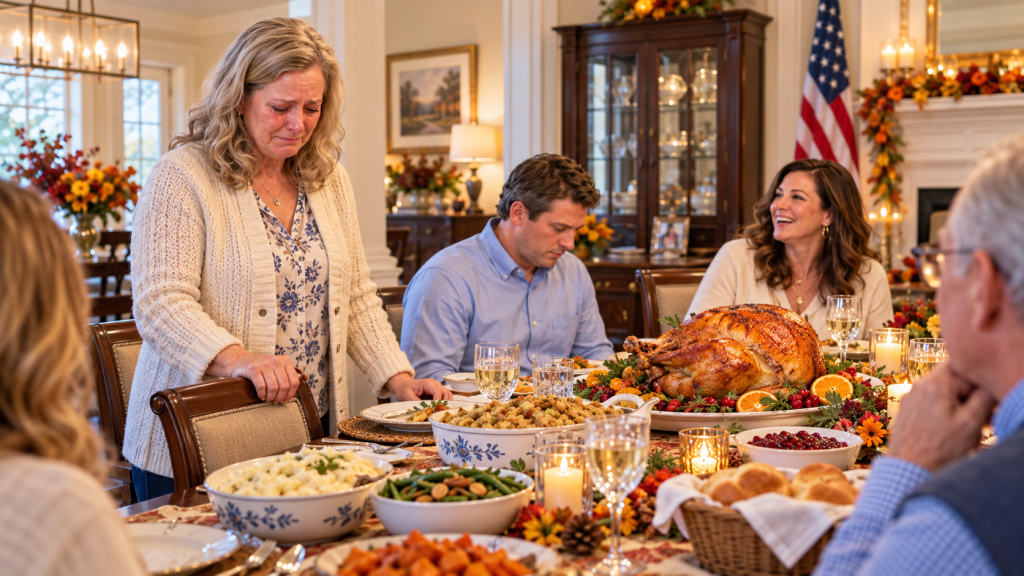
The table was beautiful.
Eucalyptus branches ran along the center, small golden candles stood between the plates, and folded linen napkins were arranged beside gold-rimmed glasses.
Cassandra had clearly spent time making everything look perfect.
I complimented her.
“This is lovely, sweetheart.”
She smiled.
“Thank you. I’ve been thinking about starting an event-planning business. Presentation is everything.”
“You’re very good at it.”
She seemed pleased.
Then she looked toward the kitchen.
“Could you check the turkey?”
I returned to the kitchen.
Dinner finally began shortly after four.
Derek carved the turkey while I brought out the casseroles.
Everyone praised the food.
“This turkey is wonderful,” one of the neighbors said.
“The stuffing is delicious,” Renee added.
Cassandra smiled.
“Thank you. I wanted everything to feel traditional this year.”
I didn’t correct her.
I wasn’t interested in taking credit.
I simply enjoyed watching everyone eat.
Then one of Cassandra’s friends noticed a framed photograph on the sideboard.
It showed me standing on a hillside outside Queenstown, New Zealand.
I was wearing a blue raincoat, my hair was blowing across my face, and I was laughing at something the photographer had said.
“Is that you, Diane?”
I brightened immediately.
“Yes. That’s from my trip to New Zealand two years ago.”
“How beautiful! Did you go with family?”
“No. I went alone.”
“Really?”
“Yes. It was my first major trip after retiring.”
She asked what I had enjoyed most.
I began describing the ferry ride through Milford Sound.
I told her about the enormous mountains rising from the water, the waterfalls cascading down the cliffs, and the incredible silence that settled over everyone as the boat moved through the landscape.
For the first time that afternoon, I felt genuinely included.
I was talking about something I loved.
Then Cassandra interrupted.
“Oh, don’t get her started.”
She laughed and waved her fork in my direction.
“Cooking and cleaning—that’s your whole personality, Diane. Traveling is just what she does between family dinners.”
Several guests exchanged uncomfortable glances.
I stared at her.
For a moment, I genuinely thought I had misunderstood.
Perhaps she had intended the remark as a harmless joke.
Perhaps she would notice my expression and apologize.
But she simply lifted her wineglass, looking pleased with herself.
I glanced across the table.
Derek was looking down at his plate.
He was cutting a piece of turkey into smaller pieces.
He didn’t say anything.
He didn’t smile.
He didn’t defend me.
He didn’t even look at me.
I waited another moment.
Nothing.
One of the guests finally changed the subject.
“So, what are everyone’s plans for Christmas?”
Cassandra leaned forward immediately.
“We’re hosting again this year. I’ve already been thinking about the menu.”
Then she turned toward me.
“Diane will handle the cooking, of course. Nobody does Christmas like she does.”
She said it as casually as someone assigning a task to an employee.
I lowered my fork.
Nobody had asked me.
Nobody had discussed dates or plans.
Nobody had considered that I might want to spend Christmas differently.
I looked at Derek.
He reached for the water pitcher and passed it toward me.
I accepted it without saying anything.
I suddenly remembered the last Christmas.
I had driven to Charlotte with two turkeys, several casseroles, and enough desserts for a small restaurant.
I’d spent the previous evening preparing food and arrived early to help Cassandra organize everything.
After dinner, while the guests watched television, I had washed dishes and packed leftovers.
When I finally left, Cassandra had thanked me for helping.
Derek had said, “We couldn’t do it without you, Mom.”
I had driven home feeling tired but useful.
Now I wondered why being useful had become the only way I knew how to remain involved.
After dinner, I helped serve pumpkin pie.
I packed leftovers into containers, washed several serving dishes, and wiped the kitchen counters.
Cassandra was already discussing her Christmas guest list.
I heard her mention that she might invite another couple from the neighborhood.
Then she called toward the kitchen.
“Diane, I’ll send you the guest count tomorrow.”
I didn’t answer.
I dried my hands, collected my handbag, and picked up my coat.
I hugged my grandchildren.
Ethan was seven and Lily was five.
“Are you leaving already, Grandma?” Ethan asked.
“Yes, sweetheart. I have a long drive.”
“Will you come back soon?”
“Of course.”
I kissed their foreheads.
Then I walked toward Derek.
“Drive safely tomorrow,” I told him. “I heard you’re taking the children skating.”
“Yeah, Mom. Thanks for coming.”
He gave me a brief hug.
I wanted to ask whether he had noticed what Cassandra said.
I wanted to ask why he hadn’t defended me.
I wanted to tell him that his silence had hurt more than her joke.
But I didn’t.
I simply said goodbye.
The drive back to Raleigh took nearly three hours.
The highway was dark, and houses along the road were beginning to display Christmas lights.
I passed a family standing outside their home, laughing as they decorated a tree.
I thought about the photograph from New Zealand.
I remembered the cold wind against my face.
I remembered standing on that hillside, surrounded by mountains, with absolutely nobody expecting anything from me.
I had been happy.
Not because I was cooking for someone.
Not because I was solving a problem.
Not because I was making another person’s life easier.
I was happy simply because I was alive and experiencing something beautiful.
When I finally reached home, I carried my overnight bag inside and placed my handbag on the kitchen counter.
I made tea.
Then I opened my laptop.
I began reviewing my bank statements.
At first, I wasn’t entirely sure what I was looking for.
But the more I examined the accounts, the more I realized how many expenses had quietly become part of my monthly routine.
There were streaming subscriptions I barely used.
A storage unit Derek had asked me to cover temporarily.
Small recurring transfers.
Occasional purchases for the children.
Bills I had agreed to help with months earlier.
None of these expenses had seemed particularly significant at the time.
Together, however, they represented a substantial amount of money.
I opened my retirement savings account.
The balance was healthy, but I knew I needed to protect it.
Leonard and I had worked hard for that money.
We had saved carefully, avoided unnecessary debt, and planned for the future.
I had spent years telling myself that I was saving for emergencies.
But what about the years I had left to enjoy?
What about the places I wanted to see?
What about the experiences I had postponed?
I closed the bank statement and opened a folder on my computer titled “Places to Go.”
It contained photographs and travel listings I had saved over eleven months.
Italy.
Ireland.
Greece.
Portugal.
One particular property had always caught my attention.
It was a small furnished home in Óbidos, Portugal.
Whitewashed walls.
Blue shutters.
A little courtyard hidden behind an ancient stone street.
The photographs showed a simple kitchen, a comfortable bedroom, and a small table near a window.
It wasn’t luxurious.
It wasn’t enormous.
But it looked peaceful.
I had bookmarked it almost a year earlier.
I opened the listing again.
The property was available for eight weeks beginning in December.
I checked the price.
Then I checked my travel budget.
I read the cancellation policy carefully and reviewed the details of the property.
For several minutes, I simply stared at the photographs.
Then I entered my payment information.
A confirmation appeared on the screen.
My reservation was complete.
I had just booked eight weeks in Portugal.
I leaned back in my chair.
For a moment, I didn’t move.
Then I began laughing.
Not because anything particularly funny had happened.
But because I had finally done something for myself without asking whether it would inconvenience anyone.
I booked a flight to Lisbon.
I chose a one-way ticket because I wanted the freedom to decide when to return, although I fully intended to spend the entire eight weeks in the little house.
I printed the confirmation and placed it beside my coffee cup.
It was almost midnight when my phone illuminated.
Derek had sent a message.
“Cassie says we should start planning Christmas before everything gets booked.”
I looked at the message.
Then I looked at my flight confirmation.
For years, I would have immediately started discussing menus, guest counts, and shopping lists.
Instead, I typed:
“You should make whatever arrangements work for your family. I won’t be cooking Christmas dinner this year.”
I pressed send.
Then I put my phone down.
Within minutes, it began ringing.
It was Derek.
I answered.
“Mom, what do you mean you won’t be cooking?”
“I mean exactly what I said.”
“But we already told everyone Christmas would be at our house.”
“That’s lovely.”
“Mom.”
“Derek, I’m going to Portugal.”
There was a pause.
“What?”
“I’ve reserved a little house in Óbidos. I’m leaving December tenth.”
“You’re going to Portugal?”
“Yes.”
“By yourself?”
“Yes.”
He sounded genuinely confused.
Then I heard Cassandra in the background.
“What is she saying?”
Derek repeated something to her.
A few seconds later, she took the phone.
“Diane, this is ridiculous.”
I remained quiet.
“We have twenty people coming for Christmas. My parents, my sister’s family, the neighbors, and several friends. What are we supposed to do about dinner?”
I almost laughed.
“You’re going to have to make other arrangements.”
“Other arrangements? Diane, we’ve already invited everyone.”
“Then perhaps you should have discussed the plans with me before assuming I would cook.”
She sighed dramatically.
“I thought you enjoyed being involved.”
“I enjoy being involved with my family. I don’t enjoy being treated like the person responsible for feeding everyone.”
“That’s not what we’re doing.”
“Then why did you tell everyone I would handle Christmas without asking me?”
She didn’t answer.
Finally, she said, “You’re being very sensitive about Thanksgiving.”
I looked at the photograph of Leonard on the bookshelf.
“No, Cassandra. I’m being very clear about what I will and won’t do.”
She lowered her voice.
“Are you seriously choosing a vacation over your grandchildren?”
That sentence nearly made me lose my composure.
I loved Ethan and Lily more than I could explain.
But loving grandchildren did not mean sacrificing every personal desire.
“Please don’t use the children to make me feel guilty,” I said.
Before she could answer, Derek returned to the phone.
“Mom, can we please talk about this?”
“We can talk when you want to have a conversation about something other than dinner.”
I ended the call.
The following morning, I received another call from Derek.
He wanted to discuss Thanksgiving.
Apparently, Cassandra had told him that I had misunderstood her joke.
“Mom, she didn’t mean to hurt you.”
“What did she mean, Derek?”
“She was joking.”
“Then explain the joke to me.”
He sighed.
“She didn’t mean that cooking and cleaning are all you do.”
“But that’s exactly what she said.”
“She was just trying to make everyone laugh.”
I looked out the kitchen window.
“Derek, I drove three hours to spend Thanksgiving with you. I brought enough food for twelve people. I spent most of the afternoon preparing dinner while everyone else socialized. Then, when I finally tried to share something about my life, your wife reduced my entire personality to cooking and cleaning.”
He was quiet.
“And you sat there looking at your plate.”
“Mom, I didn’t know what to say.”
“You could have said that I was more than the person who prepares your meals.”
He didn’t respond.
I continued.
“Your father used to encourage me to travel. He wanted me to experience the world. I spent years raising you and Joanna after he died. I don’t regret a moment of it. But I refuse to spend the rest of my life waiting for everyone else to decide whether I deserve to enjoy myself.”
“Are you really that unhappy with us?”
The question hurt.
“No, Derek. I’m unhappy with the way I’ve allowed myself to be treated.”
He went quiet again.
Eventually, he said, “I’ll talk to Cassandra.”
I almost smiled.
“That’s between you and Cassandra. I’m not asking you to fight with your wife. I’m asking you to understand your mother.”
We ended the call.
Later that afternoon, I called Joanna.
She answered with her usual cheerful greeting.
“Mom! What’s happening?”
“I have some news.”
“Good news?”
“I booked a trip to Portugal.”
She screamed.
“Mom! That’s amazing!”
I laughed.
“It’s eight weeks.”
“Eight weeks? Even better!”
Then I told her about Thanksgiving.
I described the journey, the food, the decorations, and Cassandra’s remark.
Most importantly, I told her about Derek’s silence.
Joanna listened without interrupting.
When I finished, she said something that made my eyes fill with tears.
“Mom, you know you don’t have to earn your place in this family by cooking for everybody, right?”
I swallowed.
“I think I’ve forgotten that sometimes.”
“You haven’t forgotten. You’ve just spent so many years taking care of everyone else that you stopped taking care of yourself.”
We talked for nearly an hour.
She encouraged me to check my travel insurance, arrange someone to inspect my house while I was away, and make sure I had enough medication for the trip.
Before hanging up, she said, “Promise me something.”
“What?”
“Don’t cancel Portugal because Derek gets uncomfortable.”
I smiled.
“I promise.”
During the next few days, I prepared for my trip.
I contacted the property manager in Portugal, confirmed the reservation, and arranged transportation from Lisbon.
I also reviewed my household expenses.
I canceled subscriptions I no longer needed and began separating my finances from the expenses I had been covering for Derek.
It wasn’t an act of revenge.
It was simply responsible planning.
I had no intention of allowing my retirement savings to disappear because I had become accustomed to helping everyone.
One afternoon, Cassandra’s mother, Renee, called.
“Diane, sweetheart, I heard you’re going away.”
“Yes. Portugal.”
“How exciting. But why Christmas?”
“Because that’s when the house is available.”
She laughed softly.
“Well, Cassandra is quite stressed about the arrangements.”
“I’m sorry to hear that.”
“She was counting on you.”
I looked at the papers on my table.
“That’s exactly the problem, Renee. Everyone seems to have been counting on me without asking whether I was available.”
She was quiet.
Then she surprised me.
“For what it’s worth, I thought her comment at Thanksgiving was unkind.”
I sat up.
“You did?”
“Yes. I wanted to change the subject, but I didn’t know what to say.”
“Thank you for telling me.”
She continued.
“And Derek should have said something.”
I looked toward the living room.
There was an old photograph of Leonard standing beside Derek at his high school graduation.
“Yes,” I replied. “He should have.”
The week before my departure, Derek came to visit.
He arrived carrying a paper bag from my favorite bakery.
“I thought I’d stop by.”
I invited him inside.
He placed the bag on the kitchen counter and looked toward my suitcase.
“So you’re really going.”
“Yes.”
“Eight weeks?”
“That’s the reservation.”
He shook his head.
“I still can’t believe it.”
I poured coffee.
“Would you like some?”
“Sure.”
We sat at the kitchen table.
For a while, we talked about ordinary things.
His work.
The children’s school activities.
Cassandra’s plans for her event business.
Eventually, he brought up Christmas.
“She told her mother and sister that you’d be cooking.”
“I know.”
“She already invited twenty people.”
“Then she’ll need to organize dinner.”
He rubbed his forehead.
“Mom, I think we both got used to you doing everything.”
I looked at him.
“Yes. You did.”
He seemed surprised by my direct answer.
I continued.
“And I got used to agreeing because I thought being needed was the same as being loved.”
He looked down.
“I never wanted you to feel that way.”
“I believe you. But intentions don’t erase the way someone feels.”
For several seconds, neither of us spoke.
Then he said, “I’m sorry.”
I nodded.
“Thank you.”
He hugged me before leaving.
It wasn’t a complete solution, but it was a beginning.
On December tenth, I woke before sunrise.
My suitcase was packed.
My passport was beside my handbag, and the printed flight confirmation was sitting on the kitchen counter.
I walked through the house one final time.
I checked the windows, adjusted the thermostat, and watered the plants.
Then I stopped in front of Leonard’s photograph.
He was smiling in the picture, wearing the blue shirt I’d bought him for our twentieth anniversary.
I touched the frame.
“Well, Leonard, we’re finally doing it.”
I picked up my suitcase.
At the airport, I checked in and found a quiet seat near the window.
As I watched the planes move across the runway, I remembered our anniversary trip to New York.
Leonard had carried both suitcases and insisted on buying me a magazine.
“You’ll need something to read,” he’d said.
“We’re only going for three days.”
“Exactly. You need entertainment.”
I smiled.
For years, I had believed that traveling without him would somehow mean leaving part of our marriage behind.
Now I understood that enjoying the life we had built together was not a betrayal of his memory.
It was a way of honoring it.
The flight to Lisbon was long.
I watched a movie, read several chapters of my book, and slept for a few hours.
When we finally landed, I felt an excitement I hadn’t experienced in years.
The airport was busy, and Portuguese announcements echoed through the terminal.
I collected my suitcase and found my driver.
During the journey toward Óbidos, I watched the countryside pass outside the window.
Rolling fields.
Small villages.
Stone walls.
Terracotta rooftops.
The winter sunlight made everything look beautiful.
When we arrived, a woman named Sofia was waiting outside the property.
She was in her early fifties, with short dark hair and a warm smile.
“Welcome to Óbidos, Diane!”
She showed me the kitchen, bedroom, bathroom, and small courtyard.
The house was even more charming than the photographs.
The walls were white.
The shutters were blue.
There was a little table near the window and a lemon tree growing beside the courtyard wall.
Sofia explained how everything worked and handed me the keys.
“If you need anything, just call.”
I thanked her.
After she left, I stood alone in the courtyard.
I listened to footsteps on the cobblestones outside.
Somewhere nearby, someone was playing music.
A church bell rang.
I looked around the little house and smiled.
For the first time in years, nobody was waiting for me to prepare dinner.
Nobody was asking me to clean anything.
Nobody needed me to solve a problem.
I was simply Diane.
And I was exactly where I wanted to be.
The first few days passed quickly.
I discovered a bakery that sold warm pastries every morning.
I found a small grocery store where the owner patiently helped me understand the different cheeses.
I visited the historic streets, explored the old castle, and took photographs of the beautiful buildings.
I also learned that the town was famous for its cherry liqueur.
One morning, I joined a walking tour.
There were six people in the group.
Among them was a retired teacher from Ireland named Margaret.
She was seventy, had silver hair, and wore a bright red scarf.
We began talking while walking along the old town walls.
“Are you here with family?” she asked.
“No. Just me.”
She smiled.
“Good for you.”
I laughed.
“You make it sound unusual.”
“It is, sometimes. People assume older women should always travel with someone.”
“I used to think that.”
“And now?”
I looked at the rooftops below us.
“Now I think I should have started sooner.”
She laughed.
We spent the afternoon together and discovered that we were staying in the same neighborhood.
Over the following days, we became friends.
Margaret introduced me to a little restaurant where the owner served traditional Portuguese dishes.
I showed her a shop where I found beautiful handmade pottery.
We spent afternoons talking about our families, our travels, and the things we had postponed.
One evening, she asked about my husband.
I told her about Leonard.
She listened quietly.
Then she said, “I lost my husband twelve years ago. For a long time, I thought doing things without him meant I was moving on too quickly.”
I looked at her.
“That’s exactly how I felt.”
She smiled.
“Then one day I realized that missing someone and enjoying life can exist together.”
I thought about that sentence for the rest of the evening.
Meanwhile, back in North Carolina, Christmas was approaching.
Cassandra began sending messages.
“Do you happen to have your stuffing recipe?”
I sent it.
“How long do you cook the sweet potatoes?”
I answered.
“What temperature did you use for the turkey?”
I sent the information.
Then, one afternoon, she wrote:
“The stuffing didn’t turn out like yours.”
I was sitting in a little restaurant with Margaret, enjoying lunch.
I smiled and replied:
“I’m sorry. I’m sure everyone will enjoy dinner.”
She didn’t respond.
A few days later, Derek called.
“Mom, how are you?”
“Wonderful. I went walking this morning.”
“How’s Portugal?”
I told him about Margaret, the bakery, and the old streets.
He listened.
Then he asked whether I had sent Cassandra the sweet potato recipe.
I laughed.
“Yes, Derek. I sent it.”
“Okay. She couldn’t find it.”
“Then I’ll send it again.”
He chuckled.
“Christmas is going to be different this year.”
“Different how?”
He explained that Cassandra had struggled to organize the dinner.
The catering company they had contacted canceled at the last minute.
Derek had been responsible for collecting groceries, arranging chairs, preparing several dishes, and cleaning afterward.
“Mom, I honestly never realized how much work you did.”
I sat down.
“Why do you say that?”
“Because I had to do it myself.”
I smiled sadly.
“I wasn’t trying to make you understand by leaving, Derek.”
“I know.”
“I just needed to stop doing everything.”
He was quiet.
Then he said something I had wanted to hear for years.
“I’m sorry I didn’t defend you at Thanksgiving.”
I closed my eyes.
“Thank you.”
“I should have said something.”
“Yes.”
“I love you, Mom.”
“I love you too.”
For the first time, I felt that my son was beginning to understand that I was more than the person who prepared his favorite meals.
In January, Margaret and I took a train to Lisbon.
We visited museums, explored historic neighborhoods, and spent an afternoon looking at paintings.
I was fascinated by the traditional Portuguese tilework.
The blue and white patterns were beautiful.
One afternoon, while sitting in a café, I told Margaret that I’d always wanted to learn watercolor painting.
“Have you ever taken a class?” she asked.
“No.”
“Why not?”
I laughed.
“I was busy.”
She looked at me over her coffee.
“Being busy can become a habit, Diane. Sometimes we continue doing things long after anyone needs us to.”
Her words stayed with me.
A few days later, I found a small art studio offering beginner watercolor classes.
I enrolled.
The instructor, Teresa, was patient and encouraging.
She showed us how to mix colors, create shadows, and paint simple landscapes.
My first painting was terrible.
The houses looked crooked.
The trees resembled green clouds.
The sky was an unfortunate shade of gray.
But I loved making it.
Nobody expected perfection.
Nobody needed me to finish anything for them.
I was learning something simply because I wanted to.
I sent a photograph of the painting to Joanna.
She replied immediately.
“Mom! I love it!”
Derek also responded.
“Looks great, Mom. Keep going.”
Then, unexpectedly, Cassandra sent a message.
“I didn’t know you painted.”
“I’m learning,” I replied.
“That’s wonderful.”
It wasn’t an apology, but it was the first time she had shown genuine interest in something I enjoyed.
I decided to leave it there.
Toward the end of January, Derek called again.
This time, he wanted to discuss money.
He explained that their household expenses had increased.
Property taxes had gone up.
Cassandra’s business plans had cost more than expected.
The children’s extracurricular activities were becoming expensive.
Then he asked whether I could help them with six hundred dollars each month.
I looked at the little painting resting on my table.
I thought about my retirement savings.
I thought about the money Leonard and I had carefully put aside.
“Derek, I’m no longer comfortable making regular financial transfers.”
He responded quickly.
“I understand. We just need a little help until things settle down.”
“Six hundred dollars every month isn’t a small amount.”
“You have savings, Mom.”
I closed my eyes.
“Yes. Savings I’ve worked for. Savings intended to support me for the rest of my life.”
He was quiet.
“I’m not saying I will never help you again. If there’s a genuine emergency, we’ll discuss it. But I won’t become responsible for your household budget.”
He sounded disappointed.
“Okay.”
I continued.
“I love you, Derek. But you and Cassandra need to make financial decisions based on your own income.”
He didn’t argue.
Before hanging up, he said, “I hope you understand.”
“I do. I hope you understand too.”
After the call, I reviewed every recurring expense connected to his household.
I discovered that I was still paying for a streaming package they used, a storage unit containing furniture they hadn’t collected, and an insurance expense I had agreed to cover temporarily.
I canceled the payments I was entitled to cancel, provided proper notice where necessary, and informed Derek of the changes.
I didn’t do it angrily.
I simply stopped paying for things that were no longer my responsibility.
A few days later, Joanna called.
“Mom, how are you?”
“Very well.”
“Are you still enjoying Portugal?”
“Every minute.”
Then I told her about Derek’s request.
She sighed.
“Mom, I’m glad you said no.”
“I felt terrible afterward.”
“Why?”
“Because he’s my son.”
Joanna paused.
“Being someone’s mother doesn’t mean you have to finance every decision they make.”
I laughed softly.
“You sound just like your father.”
“Good. He was usually right.”
We both laughed.
By February, I had become comfortable in Óbidos.
I knew the bakery owner.
I knew the woman who sold flowers near the main square.
I had learned enough Portuguese to order coffee, ask for directions, and exchange simple greetings.
I also had a routine.
Coffee in the courtyard.
A morning walk.
Painting lessons.
Lunch with Margaret whenever our schedules allowed.
Sometimes I sat near the window and read for hours.
Sometimes I did absolutely nothing.
And I discovered that doing nothing could be one of the most enjoyable things in the world.
One morning, Sofia knocked on my door.
She was holding a small envelope.
“Diane, I thought you might like this.”
Inside was an invitation to a local art exhibition.
The students from Teresa’s class would be displaying their paintings.
My little landscape was included.
I couldn’t believe it.
“Mine?”
Sofia laughed.
“Of course. You should be proud.”
That evening, Margaret accompanied me to the exhibition.
My painting was displayed beside several others.
It wasn’t particularly impressive.
But I recognized the little street I’d tried to capture.
Margaret insisted on taking photographs.
“Look at you,” she said. “An artist.”
I laughed.
“A beginner.”
“Everyone begins somewhere.”
After the exhibition, we went to dinner.
I returned home feeling happier than I had in years.
The next morning, I called Joanna.
“I’ve decided something.”
“What?”
“I’m going to keep painting when I get home.”
She cheered.
Then I called Derek.
I told him about the exhibition.
He listened with genuine interest.
“Mom, that’s amazing.”
“Thank you.”
“Maybe you could show us when you get home.”
“I’d like that.”
He paused.
“And Mom, Cassandra wants to apologize.”
I sat quietly.
“She does?”
“Yes. We’ve talked about Thanksgiving. She realizes what she said was hurtful.”
I took a breath.
“I appreciate that.”
“She also said she’d like to hear about Portugal.”
“She can ask me anything she wants.”
We talked for another twenty minutes.
Before hanging up, Derek asked when I planned to return.
“In a few weeks.”
“Good. The kids miss you.”
“I miss them too.”
When I finally returned to Raleigh, Joanna met me at the airport carrying flowers.
She hugged me tightly.
“Welcome home, traveler!”
I laughed.
“It’s good to see you.”
She helped me with my suitcase and drove me home.
During the journey, she asked about Margaret, the art classes, and the little bakery.
I told her everything.
At home, I found a small package waiting beside my front door.
It was from Derek and the children.
Inside was a card covered with colorful drawings.
Ethan had written:
“We missed you, Grandma.”
Lily had drawn an airplane with a smiling woman inside.
I laughed through my tears.
That evening, Derek called.
“Did you get the package?”
“I did. It was wonderful.”
“The children wanted to make something for you.”
“Please thank them for me.”
He asked whether I would come for dinner the following Sunday.
I agreed.
On Sunday afternoon, I drove to Charlotte.
This time, I didn’t bring a turkey, casseroles, pies, or enough food to feed twelve people.
I brought a small box of Portuguese pastries and two framed photographs.
Derek opened the door himself.
“Mom!”
He hugged me.
“Come in.”
The house looked different.
The dining table was simply arranged, with a small vase of flowers in the center.
Cassandra was in the kitchen.
When she saw me, she walked over.
“Diane, welcome home.”
“Thank you.”
She seemed nervous.
“Can we talk for a minute?”
I nodded.
We sat in the living room while Derek took the children outside.
Cassandra folded her hands in her lap.
“I’ve been thinking about Thanksgiving.”
I waited.
“What I said was cruel. I tried to make a joke, but I embarrassed you in front of everyone.”
“Yes, you did.”
She nodded.
“I know.”
Her eyes filled with tears.
“I think I got used to you doing so much for us that I stopped thinking about what it meant for you.”
I remained quiet.
She continued.
“I also realize I treated your help as though I was entitled to it. It wasn’t.”
That was the first apology I’d heard from her that didn’t contain an excuse.
“Thank you for saying that.”
She wiped her eyes.
“I hope you know we love you.”
I looked at her.
“I hope you understand that love needs to show up in ordinary moments, too. It isn’t only about saying nice things when someone is upset.”
She nodded slowly.
“I understand.”
I wasn’t ready to pretend that everything had been perfect.
But I was willing to begin again.
During dinner, Cassandra asked about Portugal.
She listened while I described Óbidos, the Christmas market, and the little art exhibition.
She asked about Margaret and wanted to know which restaurants I’d enjoyed most.
I showed her photographs of the little streets and the house with blue shutters.
Derek laughed when I showed him my first painting.
“That’s actually pretty good.”
“It’s better than the first version.”
The children wanted to see every photograph.
Ethan was fascinated by the train station.
Lily wanted to know whether the little houses were real.
“Yes, sweetheart. People live in them.”
“Can we go someday, Grandma?”
“Perhaps. If your parents arrange it.”
Cassandra smiled.
“Maybe we should plan a family trip.”
I smiled back.
“I’d love that. But I also intend to keep taking trips on my own.”
“Of course,” she replied.
For once, nobody argued.
As dinner ended, I offered to help clear the table.
Cassandra smiled and shook her head.
“No, Diane. Sit down. You’ve been traveling. We’ll take care of it.”
I hesitated.
It was such a small gesture.
But it meant something.
Derek began collecting plates.
Cassandra carried glasses into the kitchen.
The children helped put napkins away.
I sat in the living room and watched them move around together.
Nobody seemed particularly burdened.
Nobody needed me to rescue the evening.
When I finally left, Derek walked me to my car.
“Mom?”
“Yes?”
“Thank you for coming.”
“I enjoyed it.”
He put his hands in his pockets.
“I know I’ve apologized, but I want you to know I really am sorry. I should have stood up for you.”
I looked at my son.
I remembered the fourteen-year-old boy who had cried when his father died.
I remembered helping him with homework, attending his baseball games, and sitting beside his bed whenever he was sick.
I had loved him through every stage of his life.
I didn’t want to lose that relationship.
But I also didn’t want to lose myself trying to preserve it.
“Derek, I love you. I always will. But I’m not going back to the way things were.”
He nodded.
“I understand.”
“I’ll visit. I’ll celebrate holidays with you when it works for everyone. I’ll help when I genuinely can. But I won’t automatically take responsibility for everything.”
“That’s fair.”
“And if you need my help, ask me. Don’t make plans assuming I’ll provide it.”
He smiled faintly.
“Deal.”
We hugged.
I drove home feeling peaceful.
Over the following months, things changed gradually.
Cassandra began organizing holidays differently.
Sometimes they ordered food.
Sometimes Derek cooked.
Once, they hosted a family dinner and asked everyone to bring something.
I brought a salad because I wanted to.
Not because anyone expected me to prepare the entire meal.
Derek also began calling simply to ask how I was doing.
Not every conversation involved a problem or a request.
Sometimes he wanted to tell me about the children’s school activities.
Sometimes he asked about my paintings.
Occasionally, he invited me to join them for a weekend outing.
I also began spending more time with Joanna and her family.
She encouraged me to join a local watercolor group.
I attended classes twice a week.
My paintings improved slowly.
I learned how to capture light on buildings, the shape of trees, and the colors of an afternoon sky.
Eventually, I sold one small painting at a community exhibition.
It wasn’t much money.
But I celebrated by buying myself a beautiful set of brushes.
I continued traveling, too.
The following summer, I spent ten days in Maine, visiting coastal villages and photographing lighthouses.
In autumn, I took a short trip to Charleston.
I began keeping a journal again, filling it with observations and memories.
Then Thanksgiving approached.
One evening, almost a year after the dinner that had changed everything, I received a message from Cassandra.
“Diane, would you like to come for Thanksgiving this year? We’re planning something smaller. Everyone is bringing a dish, and we’d really like you to be there.”
I read it twice.
Then I looked at my calendar.
I had already planned to spend Thanksgiving weekend with Joanna, but I was free on the actual holiday.
I replied:
“I’d love to come. I’ll bring a dessert.”
Her answer arrived quickly.
“That would be wonderful. And please bring one of your Portugal photographs. I’d love to see more.”
I smiled.
Thanksgiving arrived on a bright November afternoon.
This time, I drove to Charlotte without a cooler full of food.
I carried a small pecan pie and a framed photograph of the courtyard where I’d spent those eight weeks.
When I entered the house, Cassandra greeted me with a genuine smile.
“Diane, I’m so glad you’re here.”
Derek came from the kitchen and hugged me.
The dining table was beautiful, but simpler than the previous year.
There were fewer decorations, fewer guests, and no elaborate expectations.
Everyone had contributed something.
Derek had roasted the turkey.
Cassandra had prepared vegetables.
Renee had brought a salad, and her sister had made a casserole.
The grandchildren were excited to see me.
Ethan immediately asked whether I had brought another souvenir from Portugal.
Lily wanted to know whether I had painted anything new.
I laughed and promised to show them after dinner.
During the meal, Renee asked about my travels.
I began describing my recent visit to Maine.
Cassandra listened, then turned toward the other guests.
“You should see Diane’s paintings. She’s become quite good.”
I was pleasantly surprised.
“I’m still learning,” I said. “But I’m enjoying it.”
One of the guests asked whether I planned to return to Portugal.
“Actually, yes. I’ve been thinking about spending another month there next spring.”
Cassandra smiled.
“That sounds wonderful.”
Across the table, Derek raised his glass.
“To Mom, for reminding all of us that life doesn’t stop when the children grow up.”
Everyone laughed.
Then he added something that meant more to me than the toast itself.
“And for reminding us that being family means taking care of one another, not assuming one person will take care of everybody.”
I looked at him.
His expression was sincere.
I lifted my glass.
“To family,” I said. “And to making room for everyone at the table.”
Later, while the children played in the living room, Cassandra approached me.
“Diane, can I ask you something?”
“Of course.”
“Would you ever consider teaching me how to make your pecan pie?”
I laughed.
“I’d be happy to show you.”
She smiled.
“I don’t want you to feel like it’s your responsibility anymore. I just realized I never learned how to make it myself.”
“That’s a very good reason to learn.”
We agreed to spend an afternoon together before Christmas.
Not because she needed me to prepare food for a gathering.
But because we both wanted to learn something.
It was a small difference.
But an important one.
When I drove home that evening, I thought about the previous Thanksgiving.
I remembered the three-hour journey, the heavy cooler, the hot dishes, and the remark that had changed the way I saw my family.
At the time, I had believed the worst part was Cassandra humiliating me.
But looking back, I realized the most important moment had happened afterward.
It was the moment I opened my laptop and chose something for myself.
I hadn’t booked Portugal to punish my son.
I hadn’t wanted revenge against Cassandra.
I hadn’t planned to make anyone feel guilty.
I had simply wanted to remember what it felt like to make a decision because it brought me happiness.
And that decision had changed much more than one Christmas.
It had changed the way I understood love.
I still loved cooking.
I still enjoyed preparing a beautiful meal for people I cared about.
I still loved my grandchildren, welcomed family visits, and wanted to remain part of their lives.
But I no longer believed my value depended on how much I could provide.
I could sit at the table without preparing the food.
I could visit without cleaning the kitchen.
I could say no without writing a long explanation.
And I could travel halfway around the world without feeling guilty for leaving everyone behind.
A few weeks after Thanksgiving, I received a Christmas card from Derek and Cassandra.
Inside was a photograph of the family gathered around their dining table.
Everyone was smiling.
On the back, Derek had written:
“Mom, thank you for teaching us that family is about love, respect, and making time for one another. We hope your next adventure is wonderful.”
I placed the card beside Leonard’s photograph.
Then I opened my laptop and searched for another little house in Portugal.
The same town was calling me back.
I found a property with a sunny balcony, a small garden, and a view of the old rooftops.
It was available for six weeks in the spring.
I checked the dates.
I checked the price.
I reviewed the reservation conditions.
Then I booked it.
This time, I didn’t wait for anyone to approve my plans.
I called Joanna and told her the news.
She cheered.
I called Derek, and he laughed.
“You’re becoming quite the traveler, Mom.”
“I suppose I am.”
“Good. You deserve it.”
And for the first time, I believed he understood.
On the day I left for my second trip, I stood in my kitchen and looked around the home Leonard and I had built together.
There were photographs of our children.
Books on the shelves.
Paintings on the walls.
A little vase of flowers on the table.
Nothing had changed about the house.
But something had changed about the woman living in it.
I was still a mother.
Still a grandmother.
Still a widow who missed her husband.
Still a woman who loved her family deeply.
But I was also Diane.
Sixty-three years old, with places to see, paintings to make, friendships to build, and years of life still waiting to be lived.
Before leaving, I glanced once more at Leonard’s photograph.
“I’ll send you pictures,” I whispered.
Then I picked up my suitcase, locked the door, and headed toward the airport.
I didn’t know exactly what the next chapter would bring.
But I finally understood something I wished I had learned years earlier.
Being a good mother doesn’t mean being available every minute.
Being a loving grandmother doesn’t mean giving up your own dreams.
Being generous doesn’t mean allowing people to take your kindness for granted.
And being part of a family doesn’t mean disappearing into everyone else’s needs.
For years, I had believed that if I stopped doing everything, my family might stop needing me.
What I eventually discovered was that the people who truly loved me didn’t need me to exhaust myself to prove it.
They needed me to be present, happy, and genuinely part of their lives.
I still wanted to share holidays with them.
I still wanted to hear about their successes, celebrate birthdays, and watch my grandchildren grow.
But I wanted to do those things as Diane.
Not simply as the woman who brought the turkey.
And if there was one thing my little house in Portugal taught me, it was that sixty-three was not too old to begin again.
I had spent decades making sure everyone else had a place at the table.
It was finally time to make sure I had a place in my own life.
So, if you’re reading this and you recognize yourself in my story, remember something.
You can love your family without making every sacrifice.
You can help without becoming responsible for everything.
You can forgive someone without returning to the same situation.
And you can start living for yourself without apologizing for it.
Sometimes the most important journey isn’t the one that takes you across an ocean.
It’s the one that brings you back to yourself.
And that Thanksgiving, after three hours on the highway, carrying enough food to feed twelve people, I finally began that journey.
💬THE END! THANK YOU FOR READING!