
My daughter-in-law told me to find something in the refrigerator while her wealthy parents sat down to enjoy the luxurious dinner I’d spent two days preparing.
I didn’t raise my voice. I didn’t demand an apology.
Instead, I quietly lifted my twelve-pound honey-glazed ham from the kitchen counter, carried it to my car, secured it with the passenger seat belt, and drove home.
Christa probably assumed I was just a sensitive older woman who would calm down and forget everything.
What she didn’t know was that, before the evening ended, I would make three financial decisions that would change our relationship forever.
And when she showed up at my doorstep days later, furious about the money she’d lost, she discovered something else.
Her spare key no longer opened my front door.
But the real shock came three weeks later, when my son arrived carrying an envelope filled with bank statements, copied signatures, and a photograph of a man I hadn’t seen in thirty-one years.
By the time I discovered what my family had been hiding, I realized that a missing dinner plate was the smallest betrayal of all.
My name is Dorothy Hale. I’m sixty-three years old, retired, and for most of my life, I believed that loving your family meant making sacrifices without expecting anything in return.
I had been raised by a mother who could stretch one chicken into three meals and still find enough food for an unexpected visitor.
She used to say, “Dorothy, a good home is a place where nobody has to ask whether they’re welcome.”
I carried those words into adulthood.
Unfortunately, I spent many years confusing being welcoming with allowing people to take whatever they pleased.
My only son, Owen, was nine when his father, Richard, walked out on us.
It happened on a Thursday morning.
I remember because I’d made pancakes before school, and Richard had complained that the coffee was too weak.
An hour later, he carried two suitcases through the front door and announced that he needed a different life.
He didn’t say what was wrong with the life we had built together.
He didn’t explain how I was supposed to pay the mortgage on one salary.
He simply kissed Owen on the forehead, promised to call, and drove away.
For the first few months, Owen waited beside the telephone every Sunday.
Eventually, he stopped waiting.
But I never forgot the expression on his face when he realized that some promises weren’t going to be kept.
I worked two jobs for nearly eleven years.
During the week, I handled payroll for a manufacturing company. On weekends, I worked at a bakery, decorating birthday cakes and wedding cupcakes.
There were mornings when I was so tired that I poured orange juice into my coffee.
There were evenings when I cried quietly in the laundry room because I didn’t want Owen to see how frightened I was about money.
Still, we managed.
I paid the mortgage.
I kept food on the table.
I helped Owen through college, bought him his first reliable used car, and cheered when he landed a decent job.
When I finally paid off my little three-bedroom house, I sat on the front steps and cried.
For the first time in my adult life, no bank had a claim on the roof above my head.
I thought that feeling of security would last forever.
Then Owen married Christa.
At first, I genuinely liked her.
She was confident, beautifully dressed, and always seemed to know exactly what she wanted.
Her parents, Gerald and Elaine Whitcomb, were wealthy people who lived in an enormous house with a curved driveway, a swimming pool, and furniture nobody appeared allowed to sit on.
When I first met them, Gerald wore a watch that probably cost more than my first car.
Elaine asked where I lived and responded to my answer with a sympathetic smile.
“Oh, one of those older neighborhoods. How charming.”
I pretended not to notice the condescension.
They were important to Christa, and Christa was important to Owen.
That was enough for me.
The wedding was beautiful.
I contributed toward the flowers, paid for the rehearsal dinner, and gave the newlyweds a generous cash gift.
Christa hugged me afterward.
“You’re the sweetest mother-in-law anyone could ask for.”
Those words warmed my heart.
I didn’t realize how often she would repeat them whenever she wanted something.
The requests began innocently.
Could I help cover an unexpected car repair?
Could I watch Maya for a weekend?
Could I purchase some groceries while their kitchen was being remodeled?
When their daughter, Maya, was born, I was overjoyed.
She had Owen’s brown eyes and a little dimple in her left cheek.
I loved her immediately.
I started an education savings account earmarked for her future, adding money whenever I could.
I also began sending Owen and Christa four hundred dollars every month to help with Maya’s expenses.
It wasn’t something they demanded at first.
I offered.
But what began as a gift gradually became part of their monthly budget.
Soon I was paying for Owen’s car insurance and both their phone lines.
I covered a family cottage rental one summer because Christa said Maya deserved a proper vacation.
When their dishwasher broke, I purchased a replacement.
When they wanted new patio furniture, I contributed.
And whenever I hesitated, Owen always said the same thing.
“Mom, we really appreciate you. You know that, right?”
I wanted to believe him.
There were warning signs, of course.
Birthdays when I received a hurried text instead of an invitation.
Mother’s Days when Christa’s parents were treated to elaborate restaurant lunches while I was told everyone was too busy.
Thanksgiving dinners where I cooked most of the food but was somehow expected to clean the kitchen afterward.
Yet I kept making excuses.
Young families were busy.
Money was tight.
Christa’s parents were accustomed to a different lifestyle.
And Owen loved his wife.
I told myself that maintaining peace was more important than counting invitations.
Then came that Sunday dinner.
Owen called on Wednesday afternoon.
“Mom, could you make your famous honey-garlic ham this weekend? Christa’s parents are coming over, and she’s been telling them how incredible it is.”
I smiled so hard my cheeks hurt.
“Of course, sweetheart. How many people?”
“Just the family.”
Those four words meant more to me than he probably realized.
Just the family.
I imagined sitting around the table, listening to Maya describe kindergarten and laughing with everyone over dessert.
I bought a beautiful twelve-pound ham from the butcher.
I prepared the glaze with honey, garlic, mustard, brown sugar, and a little orange zest.
I made scalloped potatoes because Maya loved them.
I baked green beans with almonds and prepared homemade dinner rolls.
On Saturday evening, I mixed the glaze and organized everything in my refrigerator.
On Sunday morning, I started cooking before breakfast.
By the time I drove the forty minutes to Owen’s house, my car smelled like a holiday.
I carried the roasting pan through the front door with both hands.
Christa appeared wearing an elegant cream-colored dress.
“Oh, Dorothy! That smells wonderful.”
She kissed the air beside my cheek.
“Just put everything in the kitchen. We’re almost ready.”
I smiled and followed her.
The dining room looked like something from a magazine.
Fresh flowers stood in a crystal vase.
Candles flickered beside polished silverware.
Gerald and Elaine were seated in the living room, drinking wine.
Elaine barely glanced toward me.
“Hello, Dorothy. I hope traffic wasn’t dreadful.”
“Not at all.”
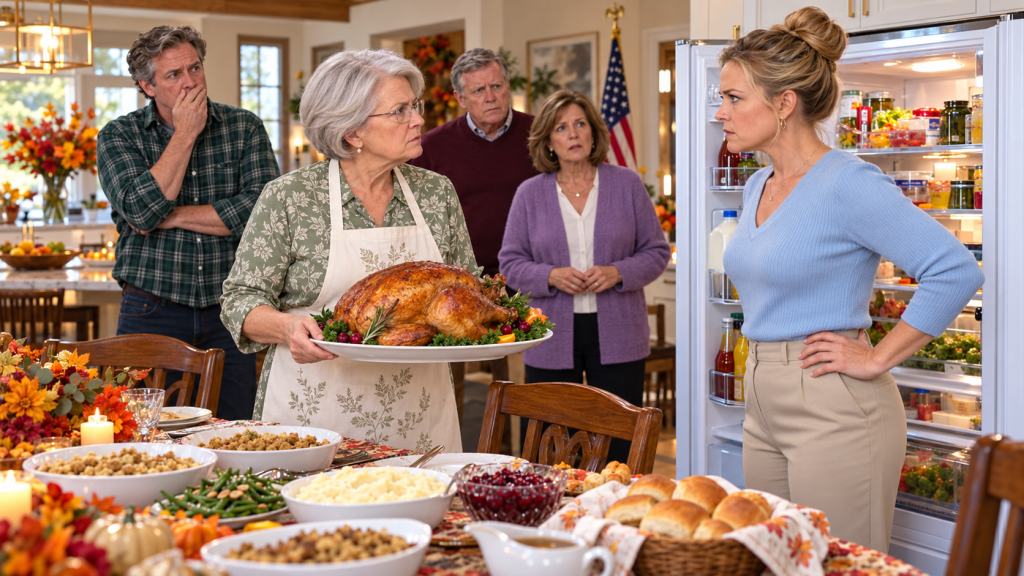
I carried the ham into the kitchen, placed it on the counter, and began unpacking the side dishes.
Then I noticed the table.
Five place settings.
One for Gerald.
One for Elaine.
One for Christa.
One for Owen.
And one for Maya.
There were six of us.
I assumed Christa had simply forgotten.
“Sweetheart, should I bring another plate?”
She looked at me with mild surprise.
“Oh, Dorothy, you won’t need one.”
I waited for her to explain.
She pointed toward the refrigerator.
“There are leftovers in there. You can have those. Tonight’s dinner is really for my parents.”
For several seconds, I couldn’t speak.
I looked at the ham.
The potatoes.
The rolls I’d kneaded by hand.
Then I looked back at her.
“You’re asking me to eat separately?”
Christa sighed.
“Please don’t make this uncomfortable. My parents traveled a long way. We’re trying to have a sophisticated evening.”
A sophisticated evening.
Apparently, I was sophisticated enough to cook the meal but not sophisticated enough to sit at the table.
I turned toward Owen.
He stood near the doorway holding a bottle of sparkling water.
He had heard everything.
Our eyes met.
For one brief moment, I expected him to say something.
Anything.
“Christa, Mom should eat with us.”
Or even, “We’ll make room.”
But he lowered his eyes.
That silence was worse than Christa’s insult.
I opened the refrigerator.
Inside were half-empty takeout containers, cold pasta, a plastic container of rice, and a small package of cheese.
Something inside me became very quiet.
Not angry.
Not dramatic.
Simply finished.
I closed the refrigerator.
“Alright,” I said softly. “Now I understand.”
Christa smiled, apparently relieved.
“Thank you for being reasonable.”
She walked back toward the dining room.
I stood alone in the kitchen for another moment.
Then I picked up the ham.
The roasting pan was heavy, but I had carried heavier things in my life.
I wrapped the handles in a towel, lifted it carefully, and walked out the front door.
I placed the pan securely inside my car.
Because I didn’t want it sliding around, I fastened the passenger seat belt around the covered roasting pan.
When I stepped back and looked through the windshield, the sight was so ridiculous that I almost laughed.
There I was, a sixty-three-year-old woman driving home with a twelve-pound ham buckled into the passenger seat.
But for the first time in years, I felt as though I had finally chosen myself.
My phone rang before I reached the highway.
Owen.
I let it ring.
Then came a text.
“Mom, where did you go? Christa’s parents are waiting for the ham.”
I stared at the screen.
Not “Are you okay?”
Not “I’m sorry.”
Not even “Why did you leave?”
His concern was for the ham.
I switched my phone to silent and drove home.
During that forty-minute journey, memories surfaced like objects rising through muddy water.
The birthday parties I had paid for.
The groceries I had delivered.
The vacations.
The insurance bills.
The monthly transfers.
The countless times I had rearranged my life because Christa needed something.
I remembered one Christmas when I’d spent four hours baking cookies for Maya’s preschool party.
Christa had accepted the containers without inviting me inside.
I remembered sitting alone on Easter Sunday because Owen had forgotten to mention they were traveling with Christa’s parents.
I remembered offering to take Maya to the zoo, only for Christa to ask whether I could pay for a family membership instead.
None of those incidents had seemed enormous individually.
Together, they formed a pattern I could no longer ignore.
When I reached home, I placed the ham in my oven on low heat.
Then I changed into comfortable clothes, poured a small glass of wine, and sat at my desk.
I opened my laptop.
For the first time in years, I reviewed my finances with my retirement in mind instead of Owen’s household.
The numbers startled me.
Between the monthly support, phone bills, insurance, occasional emergencies, and extra purchases, I had been spending thousands of dollars every year on two employed adults.
I wasn’t wealthy.
I had a pension, Social Security, a modest retirement account, and the little house I’d worked so hard to pay off.
I had enough to live comfortably if I was careful.
But I wasn’t getting younger.
What would happen if I needed medical care?
What if the roof needed replacing?
What if I simply wanted to take a vacation without feeling guilty?
I made three decisions that evening.
First, I contacted the mobile provider about transferring Owen and Christa’s phone lines to their own account, with advance notice.
Second, I arranged for the insurance payments I had been making for Owen’s vehicle to end at the next renewal date, giving him plenty of time to obtain his own coverage.
Third, I canceled the automatic four-hundred-dollar monthly transfer.
That last decision hurt.
Maya was innocent.
I loved her more than I could express.
But I realized that supporting my granddaughter didn’t require sending unrestricted money to her parents.
I could buy her school supplies directly.
I could contribute to her education fund.
I could take her shopping for winter coats.
My love didn’t need to pass through Christa’s bank account.
Afterward, I sat quietly, listening to the ticking clock.
For once, I wasn’t afraid of disappointing someone.
I was more afraid of disappointing myself.
The next morning, I sliced the ham into portions.
I kept some for myself, froze several packages, and brought a generous container to my neighbor, June Patterson.
June was seventy and had been my friend for almost twenty years.
She took one look at the ham and raised an eyebrow.
“Did you host a wedding without telling me?”
I laughed.
“Something like that.”
We sat at her kitchen table while I told her everything.
She listened without interrupting.
When I finished, she pushed her coffee cup aside.
“Dorothy, do you know what your biggest problem has been?”
“Apparently, my cooking.”
“No. You’ve spent so long trying to prove you’re a good mother that you’ve forgotten you already are one.”
I looked down at my hands.
June continued.
“You raised that boy. You educated him. You gave him a home. You don’t need to keep paying installments on your motherhood.”
I laughed through unexpected tears.
Those words stayed with me.
Three days later, Owen called.
“Mom, did you change something with our phone account?”
“Yes, dear.”
“Christa says we’re going to owe about two hundred and forty dollars a month now.”
“That’s correct.”
“And my insurance?”
“You’ll need to arrange your own policy when the current coverage ends.”
He sounded genuinely confused.
“But Mom, you’ve always handled those things.”
“I know. And now it’s time for you to handle them.”
There was a long silence.
“Is this about Sunday?”
“Sunday made me think about quite a few things.”
He sighed.
“Christa says she’s sorry things got awkward.”
I closed my eyes.
“Awkward?”
“Mom, you know what I mean.”
“No, Owen. I don’t.”
He said nothing.
“I spent two days preparing dinner. Your wife told me to eat leftovers while everyone else enjoyed my food. And you stood there watching.”
“She just wanted her parents to feel special.”
“And what did you want me to feel?”
Another silence.
Then he whispered, “I didn’t know what to say.”
I felt my heart sink.
“Owen, you’re forty years old. There comes a point when not knowing what to say becomes a decision.”
He ended the conversation shortly afterward.
I cried that evening.
But I didn’t restore a single payment.
Several days later, Christa arrived in her white SUV.
I was pruning roses when I heard her tires crunch across the driveway.
She walked straight toward my front door without acknowledging me.
Then she pulled out her spare key.
She inserted it into the lock.
Nothing happened.
She tried again.
Then a third time.
Finally, she turned around.
“You changed your locks!”
I straightened.
“Yes, I did.”
“Without telling us?”
“It’s my house.”
She marched toward the garden.
“Owen told me what you’ve done. The phone bill, the insurance, the monthly money. Are you seriously punishing us because dinner didn’t go the way you wanted?”
I removed my gardening gloves.
“Christa, dinner wasn’t the problem. Dinner showed me the problem.”
She folded her arms.
“My parents were important guests.”
“Yes,” I said. “And I was family.”
She looked away.
“I didn’t ask for a special chair. I didn’t ask anyone to praise my cooking. I expected one ordinary plate at a table where my food was being served.”
“You’re making this into something enormous.”
“No. I’m finally recognizing how enormous it’s become.”
Her expression hardened.
“Well, cutting off financial help isn’t going to make Owen and me visit more often.”
I stared at her.
There it was.
The thing I’d quietly feared for years.
She believed my money purchased my place in their lives.
Once, that would have frightened me enough to apologize.
Instead, I felt strangely calm.
“Then perhaps it’s time we all learned to live differently.”
She blinked.
“What does that mean?”
“It means I love my family. But I don’t have to finance your household to prove it.”
Christa laughed sharply.
“You’re going to regret this.”
“Perhaps,” I replied. “But I don’t believe so.”
She climbed into her SUV and slammed the door.
I went back to my roses.
For three weeks, I heard almost nothing from Owen.
Maya called once using his phone.
“Grandma, are you mad at me?”
My heart nearly broke.
“Never, sweetheart. Why would you think that?”
“Mommy said you don’t want to help us anymore.”
I pressed my hand against my chest.
“Oh, honey. Grown-ups sometimes have disagreements about money. That has nothing to do with you. I love you every single day.”
“Even Tuesdays?”
“Especially Tuesdays.”
She giggled.
After we hung up, I sat motionless for a long time.
I had expected Christa to be angry.
I hadn’t expected her to involve a five-year-old child.
That evening, I wrote Maya a letter to give her when she was older.
I told her she was loved.
I told her nothing adults argued about could ever change that.
Then I tucked the letter into my desk drawer.
Three weeks after the dinner, Owen appeared at my door alone.
It was raining.
He stood on the porch looking exhausted, his hair damp and his shirt wrinkled.
In his hand was a thick white envelope.
“Mom,” he whispered, “there’s something I should have told you years ago.”
I stepped aside.
He entered without looking at me.
We sat at the kitchen table where he’d done his homework as a child.
I made tea.
He didn’t touch it.
Finally, he pushed the envelope toward me.
“Please don’t hate me.”
I stared at him.
“What have you done, Owen?”
He swallowed.
“I don’t know how much of this you already know.”
I opened the envelope.
Inside were bank statements, printed emails, copies of financial forms, and several photographs.
The first statement carried the name of an account I recognized immediately.
It was the savings account I’d opened when Maya was born.
I had placed twenty-five thousand dollars into it initially, adding smaller amounts on birthdays and holidays.
The money was meant to help with her future education.
I had always considered it one of the most important gifts I could leave her.
But the balance shown on the latest statement was far lower than it should have been.
I turned to the transaction pages.
Transfer.
Transfer.
Transfer.
Again and again.
My hands began trembling.
“Owen, what is this?”
He lowered his head.
“Christa said you agreed to help her parents.”
I stared at him.
“Help them with what?”
“Some financial trouble. She said you authorized a temporary loan and wanted it kept private.”
I looked back at the statements.
Thirty-eight thousand six hundred dollars had been withdrawn over eighteen months.
Money I had saved for Maya.
Money I had never authorized anyone to touch.
“Your wife told you I gave her parents money from Maya’s account?”
He nodded.
“And you believed her?”
“I wanted to.”
I turned another page.
There was a copy of a transfer authorization bearing my signature.
Except it wasn’t my signature.
It looked similar.
The loops were close.
The slant was familiar.
But the final stroke of my last name was wrong.
I had been signing my name for more than forty years.
I knew the difference.
“Someone forged this.”
Owen’s face drained of color.
“I thought you might say that.”
“How did Christa get these documents?”
He covered his face.
“Because I helped her.”
The room seemed to tilt.
I set the papers down.
“Explain.”
He took a shaking breath.
“Last year, Christa told me she was helping you update financial paperwork. She said you wanted copies of your identification and old account forms. I knew where you kept some of them.”
I remembered giving Owen access to my filing cabinet years earlier in case of an emergency.
He had always been able to enter my house.
I had never imagined my trust could be used against me.
“You gave her my documents?”
“Yes.”
“Without asking me?”
He nodded.
I closed my eyes.
Then I opened them again.
“What else?”
Owen reached into the envelope.
He withdrew a photograph.
It showed Gerald and Elaine standing at an elegant outdoor gathering beside a tall, silver-haired man in a navy suit.
The man had a familiar crooked smile.
A small scar near his right eyebrow.
And a way of standing with his shoulders tilted slightly backward.
My breath caught.
I knew that face.
Even after thirty-one years, I knew it.
“Richard.”
Owen looked at me.
“You recognize him?”
“Of course I recognize him.”
The photograph trembled in my fingers.
“That’s your father.”
Owen began crying.
Not loudly.
Just the quiet, helpless crying of someone who’d been carrying a secret too long.
“He came back last year, Mom.”
I couldn’t speak.
“He contacted me through social media. He said he’d spent decades regretting what happened. He wanted to see me.”
“And you met him?”
“Yes.”
“Why didn’t you tell me?”
“Because I knew how much he hurt you.”
I stared at the photograph.
Richard had aged.
His hair was gray.
His face carried deeper lines.
But he wore the same confident expression I’d once mistaken for strength.
“How does he know Christa’s parents?”
Owen rubbed his eyes.
“He’s been working with Gerald.”
The words landed heavily.
“Working with him doing what?”
“Investment consulting. Gerald introduced him as Rick Harlan. I didn’t know they were connected until after Dad contacted me.”
I put down the photograph.
“Richard is using another surname?”
“He said it was his mother’s maiden name.”
I remembered Richard’s mother.
Her maiden name had indeed been Harlan.
Then Owen whispered something that changed everything.
“Mom, Gerald and Elaine aren’t wealthy anymore.”
I stared at him.
“What?”
“They’ve been in serious financial trouble for years. Their house is heavily mortgaged. Gerald made some terrible investments. He’s been borrowing money to keep everything going.”
I thought of Elaine’s expensive jewelry.
Gerald’s luxury car.
The elaborate Sunday dinner.
Their polished image.
“How long have you known?”
“Not all of it. Christa told me bits and pieces. She said they were waiting for some property deals to close.”
“And Richard?”
Owen hesitated.
“He’s been helping Gerald find investors.”
I looked again at the copied signature.
Suddenly, the past and present seemed to overlap.
Richard had always been persuasive.
He could convince a stranger to lend him money within fifteen minutes.
He had left our marriage with unpaid credit cards and debts I hadn’t known existed.
And now, decades later, he had found his way back into my life through my son’s marriage.
I pressed my palms against the table.
“Owen, tell me everything. Don’t protect anyone.”
He nodded.
And for the next two hours, my son finally told me the truth.
Richard had contacted him nearly two years earlier.
At first, their conversations were ordinary.
Childhood memories.
Questions about Owen’s work.
Photographs of Maya.
Richard apologized repeatedly for abandoning him.
He claimed he’d spent years building a successful business and wanted to make up for lost time.
Then he invited Owen and Christa to dinner.
Gerald and Elaine were there.
Apparently, Richard and Gerald had become business associates through a real estate investment group.
Christa had been delighted.
She saw the reunion as an opportunity.
Two successful families connected through business and marriage.
But there was a problem.
Richard wasn’t as successful as he claimed.
Neither was Gerald.
Their investments had gone badly.
Several partners wanted their money returned.
Gerald was struggling to keep up with payments on his house and other debts.
And Christa, who had spent her entire life believing her parents were wealthy, couldn’t bear the possibility that everyone would find out.
At first, she used money from her own savings.
Then she borrowed against her car.
Then she began asking Owen for more.
Eventually, she discovered Maya’s education account.
“She said it was a family loan,” Owen whispered. “She said you already knew.”
I felt sick.
“And you never asked me?”
“I thought she’d handled everything.”
“Owen.”
He looked up.
“Your wife was taking money from an account in my name. You knew I had spent years saving it for your daughter. How could you not ask?”
He covered his face.
“I was ashamed. Every time something seemed wrong, I told myself there must be an explanation.”
I recognized that reasoning.
I’d spent six years doing the same thing.
But recognition didn’t excuse the damage.
“Did you sign anything?”
He hesitated.
Then he nodded.
“One form. Christa said I was only witnessing your authorization.”
“Did you see me sign it?”
“No.”
“Then you knew you weren’t witnessing anything.”
His shoulders collapsed.
“Yes.”
There was nothing else to say.
I had spent decades protecting Owen from pain.
Now I was sitting across from a grown man who had helped create it.
That night, after he left, I locked my front door and sat in the dark.
I wasn’t thinking about Christa’s insult anymore.
I was thinking about my signature.
My savings.
My son.
And the husband who had abandoned us thirty-one years earlier.
I had finally begun protecting myself, only to discover how deeply my trust had already been violated.
The next morning, I called my bank.
I didn’t accuse anyone over the telephone.
I simply requested an urgent appointment with the branch manager and the fraud department.
I brought every statement Owen had given me.
I also brought identification, copies of my genuine signature, and a notebook.
The manager, a patient woman named Ms. Rios, listened carefully.
When I finished, she examined the transfer documents.
“Mrs. Hale, we’ll need to investigate how these instructions were submitted and verified.”
“I understand.”
“We can place additional security restrictions on your accounts while we review the activity.”
“Please do.”
She explained that the bank would need to examine the transaction history, authorization records, and changes to my contact information.
That last phrase caught my attention.
“Changes to my contact information?”
She turned her computer monitor slightly.
“At some point, your account preferences were changed to electronic statements.”
I stared at her.
“I never requested that.”
She checked the records.
The email address associated with my education savings account was unfamiliar.
Not completely unfamiliar.
It contained part of Christa’s name.
My stomach turned.
For eighteen months, someone had redirected my account notices away from me.
I had assumed the bank had stopped mailing paper statements as part of its normal changes.
I hadn’t realized they were being delivered elsewhere.
Ms. Rios handed me a fraud declaration to review.
“This is serious, Mrs. Hale. We recommend filing a police report and consulting an attorney.”
I nodded.
“That’s exactly what I intend to do.”
By lunchtime, I had filed a formal report and frozen unnecessary access to my accounts.
I changed passwords.
I updated security questions.
I checked my credit reports for unfamiliar accounts.
And I called an attorney named Evelyn Price, who had helped June settle her late husband’s estate.
Evelyn was in her fifties, practical, and refreshingly direct.
She reviewed the documents without interrupting.
When I finished, she removed her glasses.
“Dorothy, this isn’t merely a family misunderstanding.”
“I know.”
“This involves possible forgery, unauthorized transfers, and misuse of financial information. We need evidence preserved before anyone starts changing their story.”
She helped me organize everything.
Bank statements.
Emails.
Copies of forms.
Messages from Owen.
Records of my financial contributions.
I also wrote a detailed timeline while my memory was fresh.
Evelyn explained that recovering the missing funds could be complicated.
The bank’s investigation, the method used to authorize transfers, and the people involved would all matter.
She refused to promise an easy outcome.
I appreciated that.
I’d heard enough reassuring promises in my lifetime.
For the first time, I wanted facts.
Two days later, Richard called me.
I recognized his voice immediately.
“Dorothy.”
I sat very still.
“Richard.”
He gave a small, nervous laugh.
“It’s been a long time.”
“Thirty-one years.”
“I suppose it has.”
He began talking about regret.
About second chances.
About how he’d always wondered whether I was happy.
I let him finish.
Then I asked, “Why are you involved with Gerald Whitcomb?”
Silence.
“That’s complicated.”
“Not really.”
He cleared his throat.
“Gerald and I have business interests together.”
“Did those interests include taking money from my granddaughter’s education savings?”
His tone changed.
“Dorothy, you shouldn’t jump to conclusions.”
I almost laughed.
There it was.
The same voice that had once told me unpaid bills were nothing to worry about.
The same smooth confidence.
The same attempt to make me question what I knew.
“Richard, I have bank statements and documents bearing a forged version of my signature.”
“You don’t understand the entire situation.”
“Then explain it.”
He sighed.
“Gerald was under pressure. Christa wanted to help her family. Nobody intended to hurt you.”
I felt my anger sharpen.
“Thirty-eight thousand six hundred dollars disappeared from an account I opened for Maya. Someone imitated my signature. And you’re telling me nobody intended to hurt me?”
“It was supposed to be temporary.”
“So you knew.”
He stopped speaking.
I looked at the recorder on my desk but did not turn it on. I had no intention of making a secret recording without knowing the applicable law.
Instead, I wrote down his words as he spoke.
“Richard, my attorney will handle any further communication about this.”
His voice grew urgent.
“Dorothy, please. Think about Owen.”
“I have spent my entire life thinking about Owen.”
“He’s finally rebuilding a relationship with me. Do you really want to destroy that?”
Something inside me settled.
For thirty-one years, part of me had wondered whether Richard understood the damage he’d caused.
Now I knew.
He still believed relationships were bargaining chips.
“Whatever relationship Owen chooses to have with you is his decision,” I said. “But you’re not using my son to frighten me.”
I ended the call.
Then I contacted Evelyn and told her exactly what had happened.
That afternoon, Owen came over.
I asked him to sit down.
He looked nervous.
“Mom, Christa says you’re involving lawyers.”
“Yes.”
“She’s terrified.”
“Good. Perhaps she’ll finally understand the seriousness of what happened.”
He winced.
“Gerald says the money will be repaid when one of his investments closes.”
I studied my son.
“Do you believe him?”
Owen looked down.
“No.”
That answer mattered.
For the first time, he wasn’t repeating someone else’s explanation.
He was acknowledging the truth.
“Have you spoken to Christa about the forged signature?”
He nodded.
“She says Richard helped prepare the paperwork.”
I felt cold.
“Did she admit she knew I hadn’t signed it?”
Owen’s eyes filled.
“Yes.”
I looked away toward the window.
Outside, the first autumn leaves were falling across my garden.
I had spent years imagining that Richard might someday return to apologize.
Instead, he’d returned to help steal from the child whose grandfather he was.
Owen whispered, “Mom, I don’t know what to do.”
I turned back to him.
“Start by telling the truth.”
“I am.”
“All of it, Owen. To the bank. To the investigators. To your wife. To yourself.”
He nodded slowly.
Then he said something I hadn’t expected.
“I think I need to move out for a while.”
I didn’t celebrate.
I didn’t tell him to divorce Christa.
Marriage was complicated, and Maya deserved parents who made careful decisions rather than impulsive ones.
But I said, “You need to decide what kind of man you want your daughter to grow up knowing.”
He began crying again.
This time, I didn’t rush to make him feel better.
Sometimes love means allowing someone to sit with the consequences of their choices.
The following week, Christa called.
I almost didn’t answer.
But I wanted to hear what she had to say.
“Your attorney contacted me,” she began.
“Yes.”
“Do you understand how humiliating this is?”
I looked at the kitchen clock.
“Christa, you took money that wasn’t yours.”
“We were going to replace it.”
“Without telling me?”
She sighed.
“You don’t understand what my parents have been going through.”
“Then help me understand.”
Her voice cracked.
For the first time, she sounded less angry than frightened.
Gerald had lost a significant amount of money in failed real estate ventures.
He had borrowed against properties to cover previous losses.
Elaine knew the situation was serious but continued maintaining their expensive lifestyle.
They attended charity dinners.
Hosted parties.
Bought clothing on credit.
Kept their luxury vehicles.
From the outside, nothing had changed.
Inside, their finances were collapsing.
Christa knew because her father had confided in her.
She had begun helping him secretly.
At first, she thought the problems were temporary.
Then Gerald told her he needed additional money urgently.
She used her savings.
Then she borrowed.
Then, when those funds were exhausted, she turned to the account I’d opened for Maya.
“I knew you’d never let Maya suffer,” Christa whispered.
I closed my eyes.
“That’s why you chose her money?”
“It wasn’t supposed to happen like this.”
“How was it supposed to happen?”
She began crying.
I waited.
Finally, she said, “Richard told Dad that family resources could be used temporarily as long as everything was put back.”
I gripped the telephone.
“Family resources?”
“That’s what he called them.”
“Christa, my savings were not your father’s emergency fund.”
“I know.”
“Do you?”
She didn’t answer.
I spoke carefully.
“You watched me work to support your household. You accepted my money every month. And while I was helping you, you were secretly taking even more.”
Her voice became defensive.
“You make it sound like I never cared about you.”
“Then tell me why you excluded me from dinner.”
Silence.
“That had nothing to do with the money.”
“Perhaps not directly. But it told me exactly how you viewed me.”
She whispered, “I was embarrassed.”
“By what?”
Another pause.
“My mother can be judgmental.”
I felt a bitter smile form.
“And you were embarrassed to have your mother-in-law sit at your table?”
Christa began crying harder.
“I wanted everything to look perfect.”
“There were five plates, Christa. You made certain there wasn’t one for me.”
She had no answer.
I realized then that her behavior wasn’t simply about money.
She had spent years chasing the approval of parents who measured people by appearances.
She had mistaken wealth for worth.
And she’d decided that my ordinary house, modest clothes, and quiet manner made me less important.
I couldn’t repair that belief for her.
Only she could.
“I won’t discuss the financial investigation further without my attorney,” I said. “But I want you to understand one thing.”
“What?”
“I would have helped someone facing a genuine crisis if they’d asked honestly and respected my right to decide. You took that choice away.”
I ended the conversation.
That evening, June came over with a homemade apple pie.
I told her what Christa had admitted.
June listened, then shook her head.
“People can become so desperate to look rich that they forget how much it costs to be dishonest.”
We sat at my kitchen table, eating pie and drinking tea.
For the first time since the dinner, I felt something other than anger.
I felt grief.
Not just for the missing money.
For the family I thought I’d had.
For the relationship I imagined building with Christa.
For the trust I’d placed in Owen.
And for the years I’d spent trying to earn a seat that should never have been conditional.
“Do you think I’m doing the right thing?” I asked June.
She put down her fork.
“Dorothy, you’ve spent thirty-one years being the person everyone runs to when something breaks.”
I nodded.
“Maybe now it’s time they learn how to fix something themselves.”
Over the following months, the investigation moved slowly.
There were interviews.
Documents.
Requests for additional information.
The bank reviewed how the transfers had been initiated and why the change in statement delivery hadn’t raised concerns.
Evelyn worked with me to pursue recovery of the missing funds while protecting my remaining savings.
Some people seemed surprised that I refused to simply forgive everything.
A distant relative called and suggested I should keep the matter private.
“Family problems belong inside the family,” she said.
I responded, “So does family money. Unfortunately, mine didn’t stay there.”
She didn’t call again.
Elaine sent me a long message accusing me of destroying Christa’s marriage.
I didn’t respond.
Gerald attempted to contact me through Owen, offering vague assurances about future payments.
Evelyn directed him to communicate through her office.
Richard sent flowers.
I donated them to a local community center.
Then he sent a handwritten letter.
It began with memories of our marriage and ended with a request that I withdraw my allegations for Owen’s sake.
I kept the letter as evidence.
I didn’t answer.
For decades, Richard had been a shadow in my life.
Now he was finally revealing who he had always been.
Owen, meanwhile, began doing something I hadn’t seen him do in years.
He took responsibility.
He arranged his own phone account.
He obtained his own insurance.
He rented a small apartment close enough to remain involved in Maya’s daily life.
He met with investigators and provided the documents he had signed.
He also began attending counseling.
The first time he told me, I was surprised.
“I thought you might think it was silly,” he admitted.
“Why would I think that?”
“Because I’m forty years old.”
I smiled sadly.
“Owen, there’s no expiration date on learning to make better decisions.”
He looked relieved.
But I didn’t immediately invite him back into every corner of my life.
Trust doesn’t return because someone says they’re sorry.
It returns when their behavior changes consistently.
Some weeks, we spoke for only ten minutes.
Other weeks, we shared lunch.
I listened when he wanted to talk, but I stopped solving every problem he brought me.
One afternoon, he asked whether I could help pay a deposit for a larger apartment.
My old instincts immediately surfaced.
I wanted to say yes.
I wanted to write a check.
I wanted to make his life easier.
Instead, I asked, “Have you looked at places within your budget?”
He hesitated.
“Not really.”
“Then start there.”
He looked disappointed.
But two weeks later, he found a smaller apartment he could afford.
When he told me, there was pride in his voice.
“Mom, I did it without borrowing anything.”
I smiled.
“Good for you, sweetheart.”
And I meant it.
Meanwhile, Maya remained the bright spot in my life.
Owen brought her over on alternate Saturdays when their parenting arrangements allowed it.
We baked cookies.
Worked in the garden.
Painted flowerpots.
And read stories on the porch.
One afternoon, while we were planting tulip bulbs, she asked a question that stopped me.
“Grandma, why doesn’t Mommy come here anymore?”
I set down my trowel.
“Your mommy and I are having a disagreement.”
“Because of the ham?”
I looked at her.
“Who told you that?”
“Daddy said everyone got upset at dinner.”
I considered my answer carefully.
“Sometimes adults hurt each other’s feelings. Then they have to decide how to make things better.”
Maya frowned.
“Did Mommy hurt your feelings?”
“Yes, sweetheart.”
“Did you hurt hers?”
“She might feel hurt by some of my decisions.”
Maya thought about this.
Then she asked, “Can we make another ham?”
I laughed unexpectedly.
“We certainly can.”
“Then everybody can have a plate.”
My eyes filled with tears.
I pulled her close.
“That’s exactly right.”
Children sometimes understand fairness more clearly than adults.
As autumn turned into winter, I began changing other parts of my life.
I joined a local book club.
I signed up for a watercolor class.
I replaced the old living room curtains I’d been meaning to change for years.
I finally scheduled a weekend trip with June to a small coastal town we’d talked about visiting for almost a decade.
When I booked the hotel, I felt guilty.
The familiar voice in my head whispered that the money could help Owen.
Then I remembered how much of my life I’d already devoted to helping others.
I booked the room anyway.
We walked along the beach in warm jackets, collected shells, and ate seafood at a restaurant overlooking the water.
On the second evening, June raised her glass.
“To Dorothy Hale.”
I laughed.
“What did I do?”
“You remembered you’re allowed to have a life.”
We clinked glasses.
For the first time in years, I wasn’t thinking about what my family needed from me.
I was simply enjoying the moment.
But the financial case was far from finished.
In January, Evelyn called with an update.
The records indicated that the missing money had moved through an account controlled by Christa before being distributed toward Gerald’s obligations.
Some transfers had been used to cover payments associated with his property debts.
Others had gone toward business expenses.
The bank was still reviewing its responsibility for the unauthorized transfers.
Christa had admitted to investigators that she had submitted forms I hadn’t signed.
Richard’s role was also being examined.
Evelyn explained that restitution and any criminal decisions would follow their own processes.
Nothing was guaranteed.
I listened carefully.
Then I asked, “What happens if they can’t repay everything?”
“We’ll evaluate every available option,” she said. “But I don’t want you making decisions based on promises of money that may not exist.”
I thanked her.
After the call, I walked into my backyard.
For a moment, I felt the old fear return.
Thirty-eight thousand six hundred dollars was an enormous amount to me.
I had spent years saving it.
Part of me wanted to scream at how easily someone else had treated it as disposable.
Then I looked at the house.
The garden.
The little stone path Owen and I had laid together when he was thirteen.
I reminded myself that I’d rebuilt my life before.
I could face this, too.
A month later, Christa requested a meeting.
Not at my house.
At Evelyn’s office.
I agreed.
When I arrived, Christa was sitting beside her own attorney.
She looked different.
Her hair was pulled into a simple ponytail.
She wore a plain sweater.
There was no expensive handbag, no elaborate jewelry, no carefully practiced smile.
For a moment, she looked like an exhausted woman rather than the daughter-in-law who had ordered me toward the refrigerator.
She began with an apology.
“I’m sorry, Dorothy.”
I waited.
She took a breath.
“I’m sorry I excluded you from dinner. I’m sorry I took advantage of everything you’ve done for us. And I’m sorry I used money that didn’t belong to me.”
I studied her.
She continued.
“I kept telling myself I’d replace it before you noticed.”
I asked, “And if I’d never noticed?”
Her eyes filled.
“I don’t know.”
That answer was more truthful than anything she’d said before.
She explained that Gerald’s financial situation had finally become public within their circle.
The large house was being marketed for sale.
One of the cars had been returned to the lender.
Elaine had moved into a smaller rental property.
The image Christa had spent her life protecting was falling apart.
“My parents taught me that people respect you when you have money,” she whispered.
I listened.
“They taught me that appearances matter. That you never admit you’re struggling. That you keep everything looking perfect.”
She wiped her cheeks.
“And I believed them.”
I leaned forward.
“Christa, I understand being raised with unhealthy ideas. But you were an adult when you decided to take my money.”
“I know.”
“You were an adult when you decided I wasn’t good enough to sit at your table.”
Her face crumpled.
“I know.”
“I don’t want explanations that make the choices disappear. I want you to acknowledge that they were your choices.”
She nodded.
“They were.”
For the first time, I believed she understood at least part of what she’d done.
But understanding didn’t erase responsibility.
The meeting continued with the attorneys discussing the financial issues.
Christa agreed to return money she could access immediately and to work toward a documented repayment arrangement for the remaining amount.
Her lawyer explained that selling her SUV and liquidating certain personal assets could provide an initial payment.
I didn’t feel triumphant.
Watching someone lose the possessions they’d valued so highly wasn’t satisfying.
I would have preferred an honest relationship from the beginning.
When the meeting ended, Christa approached me.
“Do you think you’ll ever forgive me?”
I considered the question.
“I don’t know.”
She looked down.
“But I hope someday I can.”
I touched her arm gently.
“Forgiveness and trust aren’t the same thing, Christa. Even if I forgive you, that doesn’t mean everything goes back to how it was.”
She nodded.
“I understand.”
I hoped she did.
In the months that followed, several important things happened.
A portion of the missing money was returned through an initial payment from Christa.
The bank completed additional review of the disputed transactions, and the remaining financial claims continued through the appropriate channels.
Evelyn helped me understand each step before I agreed to anything.
I kept a careful record of payments received and amounts still outstanding.
I didn’t announce victory.
I didn’t boast to neighbors.
I simply followed the process.
Meanwhile, Gerald’s investment troubles continued.
The sale of his house did not produce the enormous fortune people had imagined.
Much of the proceeds were needed to address secured debts and other obligations.
Elaine eventually stopped sending angry messages.
Richard’s business relationship with Gerald collapsed amid the investigation and their financial disputes.
His attorney contacted Evelyn about the allegations involving my signature.
I let the professionals handle it.
I wasn’t interested in another dramatic confrontation.
Richard had already taken enough of my time.
Then, one afternoon in early spring, I received a handwritten note from Owen.
It was only one page.
He had written it himself.
“Mom, I used to think you could fix anything. When I needed money, you found it. When I made mistakes, you helped me. When Dad left, you held everything together. Somewhere along the way, I stopped seeing how much effort that cost you. I treated your strength like a resource that would never run out. I’m sorry. I don’t expect you to forget what I did. I only hope I can become someone you can trust again.”
I read it three times.
Then I folded it carefully and placed it in my desk drawer beside Maya’s letter.
A few days later, I invited Owen to dinner.
Not because everything was fixed.
It wasn’t.
But because I could see that he was making genuine changes.
I prepared roast chicken, green beans, and mashed potatoes.
Nothing elaborate.
When he arrived, he brought flowers and a small carton of ice cream.
We sat at the kitchen table.
For a while, we talked about ordinary things.
His work.
Maya’s school.
The weather.
Then he put down his fork.
“Mom, can I ask you something?”
“Of course.”
“Why didn’t you ever tell me how bad things were after Dad left?”
I looked at him.
“What do you mean?”
“All those years when you worked two jobs. When you were exhausted. When you couldn’t afford things.”
I smiled sadly.
“Because you were a little boy. You deserved to feel safe.”
He stared at his plate.
“I thought we were fine.”
“We were fine in the ways that mattered. We had each other.”
He looked up.
“I think I spent my whole life assuming you’d always be able to save me.”
I reached across the table.
“Owen, I will always love you. I will always care about what happens to you. But I can’t live your life for you.”
He nodded.
“I know that now.”
We finished dinner quietly.
Then he stood and washed the dishes without being asked.
It was such a small thing.
Yet somehow, it moved me more than the expensive gifts he’d given me in previous years.
Because this time, he wasn’t performing gratitude.
He was participating.
Later that evening, he told me he and Christa were attending counseling separately while deciding what their future would look like.
They were working out parenting arrangements for Maya.
I didn’t ask for details.
I didn’t offer advice.
I simply said, “Whatever you decide, remember that Maya needs honesty, stability, and love more than she needs a perfect-looking family.”
He nodded.
“That’s what we’re trying to give her.”
I hoped they would.
By early summer, my garden was blooming.
The roses had returned.
The tulips had faded.
And the lavender beside my front steps was attracting butterflies.
One Saturday, Maya came over carrying a small paper bag.
“Grandma, I have a present!”
She pulled out a handmade card decorated with purple flowers.
Inside, in uneven kindergarten handwriting, were the words:
“GRANDMA, YOU ALWAYS SAVE ME A SEAT.”
I stared at the card.
Maya smiled proudly.
“Daddy helped me spell it.”
I couldn’t speak.
I hugged her so tightly she squealed.
Then I placed the card on my refrigerator.
Not because I needed a reminder of what had happened.
But because I wanted to remember what mattered.
A few weeks later, I hosted my first family dinner in a long time.
I invited Owen, Maya, June, and two neighbors who had become dear friends.
I made my honey-garlic ham again.
Twelve pounds.
The same glaze.
The same scalloped potatoes.
The same rolls.
But this time, something was different.
I wasn’t cooking to earn anyone’s approval.
I was cooking because I loved feeding people who loved being there.
Maya helped arrange the napkins.
June brought a salad.
Owen carried the roasting pan from the oven.
Before we ate, I counted the place settings.
One.
Two.
Three.
Four.
Five.
Six.
Six people.
Six plates.
No one was missing.
Maya climbed into her chair and grinned.
“Grandma, everybody gets ham!”
I laughed.
“Everybody who wants some, sweetheart.”
We passed dishes around the table.
People told stories.
June teased Owen about how many potatoes he’d eaten.
Maya announced that she planned to become a veterinarian, a ballerina, and possibly the president.
The room filled with laughter.
At one point, I looked around and felt a wave of gratitude so strong that my eyes watered.
Not because my life had become perfect.
It hadn’t.
There was still money to recover.
Relationships to repair.
Difficult conversations ahead.
But I was no longer sitting outside my own happiness, waiting for someone to invite me in.
I had built a table where I belonged.
And I finally understood that I was allowed to decide who sat beside me.
After dinner, Owen helped me carry dishes into the kitchen.
He stood beside the sink for a moment.
“Mom?”
“Yes?”
“I’m really glad you took that ham home.”
I turned toward him.
He gave a sad little smile.
“I know it sounds strange. But if you hadn’t, I don’t think I would have realized how badly things had gotten.”
I considered his words.
“Taking the ham home didn’t change everything, Owen.”
He looked puzzled.
“What did?”
“I stopped pretending that being mistreated was the price of keeping my family.”
He nodded slowly.
Then he hugged me.
For the first time in a long while, I hugged him without feeling the need to rescue him from something.
We simply stood there, mother and son.
Two imperfect people learning how to have an honest relationship.
That evening, after everyone left, I sat on the porch with a cup of tea.
The sky was turning pink above the neighboring rooftops.
A warm breeze moved through the roses.
My little house was quiet.
And I thought about the woman I’d been only months earlier.
The woman who paid bills without question.
Who accepted last-minute cancellations.
Who convinced herself that being useful was the same as being loved.
Who stood in her son’s kitchen, staring into a refrigerator filled with leftovers, wondering why she wasn’t worthy of a dinner plate.
I wished I could reach back through time and take that woman’s hand.
I would tell her that she didn’t need to scream.
She didn’t need to beg.
She didn’t need to convince anyone of her value.
She only needed to recognize it herself.
My telephone buzzed.
A message from Christa.
For a moment, I hesitated.
Then I opened it.
“Dorothy, Maya told me about dinner. She said everyone had a place at the table. I’m glad she got to experience that. I’m still working on making things right. I know I have a long way to go.”
I read it twice.
Then I responded.
“Thank you, Christa. Maya deserves to grow up knowing that love and respect matter more than appearances. I hope we can all keep learning that.”
I didn’t invite her over.
I didn’t promise everything was forgiven.
I didn’t offer to pay a bill.
I simply wished her well.
Sometimes a peaceful response is enough.
Several months later, Evelyn informed me that additional money had been recovered and that the remaining restitution arrangements were progressing.
I thanked her.
Then I updated my records and returned to my ordinary life.
I continued contributing directly to Maya’s education in ways I could monitor and afford.
I maintained my financial boundaries.
I kept my locks changed.
And I stopped allowing anyone to make me feel selfish for protecting what I’d spent a lifetime building.
The greatest surprise wasn’t that my family had changed.
It was that I had.
I no longer apologized for having limits.
I no longer mistook silence for peace.
And I no longer believed generosity required sacrificing my dignity.
On my sixty-fourth birthday, Owen and Maya arrived at my house carrying a homemade cake.
The frosting leaned to one side.
The letters were crooked.
And Maya had used so many sprinkles that the kitchen floor sparkled for two days afterward.
But it was the most beautiful cake I’d ever seen.
Owen lit the candles.
Maya began singing loudly and slightly off-key.
When they finished, she leaned forward.
“Grandma, make a wish!”
I looked at the two of them.
Then at my little kitchen.
My flowers.
My clean table.
My peaceful home.
I smiled.
“I think my wish already came true.”
Maya giggled.
“Then wish for a puppy!”
We all laughed.
And as I blew out the candles, I realized something I wished I’d understood much earlier.
A loving family isn’t measured by how much money you give them.
It isn’t measured by the size of the house, the price of the furniture, or the importance of the guests.
It’s measured by whether people notice when you’re missing.
Whether they make room when you arrive.
Whether they respect you when you say no.
And whether they still love you when you have nothing left to give except yourself.
I spent too many years believing that I needed to keep everyone happy to deserve a place in their lives.
Now I know better.
I didn’t lose my family when I stopped paying their bills.
I stopped losing myself.
And that was worth far more than the money.
As for that twelve-pound ham?
I still make it every holiday.
But I have one new rule in my kitchen.
Before I begin cooking, I count the chairs.
Because nobody who prepares a meal in my home will ever be told to eat forgotten leftovers while everyone else enjoys the feast.
Not my friends.
Not my family.
And certainly not me.
I may be sixty-four now, with gray hair, a modest pension, and a house that isn’t worth millions.
But I have something Gerald and Elaine spent years pretending to possess.
I have financial security built on honest work.
I have relationships that no longer depend on keeping up appearances.
And I have the freedom to close my front door without feeling guilty.
Sometimes I think back to the moment I fastened that seat belt around my ham.
At the time, I thought I was simply taking my dinner home.
I didn’t realize I was taking back the most important thing I’d surrendered.
My self-respect.
And if there’s one lesson I hope Maya remembers when she’s grown, it’s this:
Never confuse someone needing you with someone valuing you.
Never believe you must buy your place at a family table.
And never be afraid to carry your own ham home when the people you cooked for refuse to offer you a chair.
Because the people who truly love you will never make you choose between your dignity and belonging.
They’ll move over.
They’ll bring another plate.
And they’ll be glad you came.
💬THE END! THANK YOU FOR READING!